Brad Garlinghouse (@bgarlinghouse) is the chief executive of @Ripple, the company behind $XRP and the XRP Ledger. He leads one of the most recognized companies in crypto payments, and he spen
Brad Garlinghouse (@bgarlinghouse) is the chief executive of @Ripple, the company behind $XRP and the XRP Ledger. He leads one of the most recognized companies in crypto payments, and he spent nearly five years fighting the U.S. Securities and Exchange Commission in a case that reshaped how American courts treat digital assets.
If crypto has a poster child for the clash between regulators and the industry, it is Garlinghouse. He is a Silicon Valley veteran who turned a quiet payments startup into a global firm, took a federal agency to court, and walked away with a ruling the rest of the sector now cites as precedent.
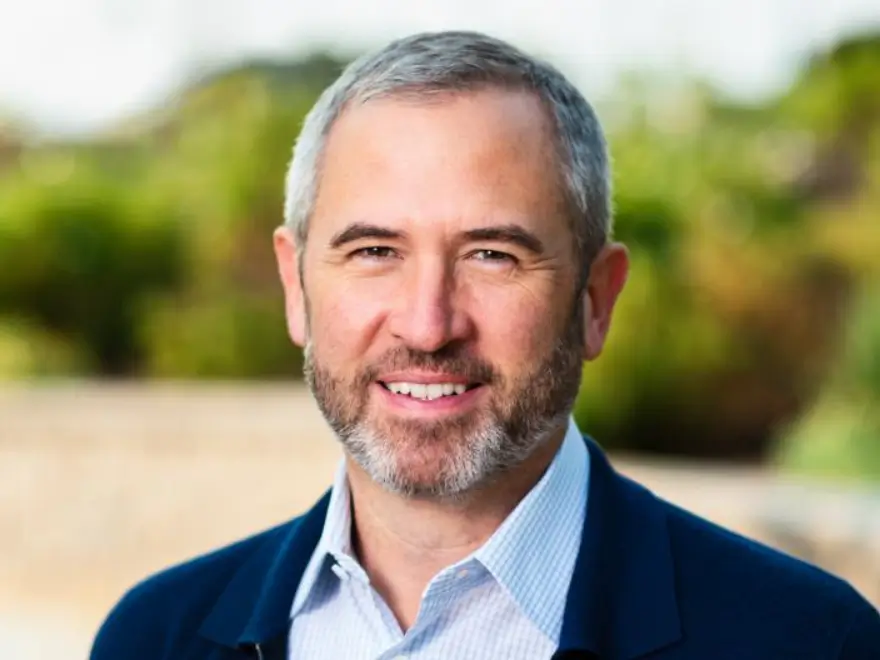
Brad Garlinghouse (ripple.com)
From Kansas to Silicon Valley
Garlinghouse, born in Topeka, Kansas, in 1971, had a knack for tech from the start, sparked when his father brought home a TRS-80 computer. He went on to study economics at the University of Kansas before earning an MBA from Harvard Business School in 1997.
From there, he rode the dot-com boom through a string of Silicon Valley jobs, including the broadband company At Home and its venture arm, before a run as CEO of Dialpad Communications. His highest-profile stop came at Yahoo, where he spent five years as a senior vice president overseeing some of the company's biggest consumer products, including Yahoo Mail, Messenger, Flickr, and the homepage.
What was the Peanut Butter Manifesto?
Yahoo is also where his name first reached a wide audience. In 2006, an internal memo he wrote leaked to the press, and in it he accused the company of spreading its money and attention too thin, "like peanut butter," across too many products with no clear strategy. His prescription was blunt: kill the overlap, give managers real ownership and cut headcount.
The memo did not save Yahoo, but it became a case study in corporate candor that business schools still teach. It also previewed the trait that would define his later career, a willingness to say in public what most executives keep to themselves.
Why did he join Ripple?
Several jobs followed Yahoo, including an advisory role at Silver Lake Partners, a stint running consumer applications at AOL, and a turn as CEO of the file-sharing company Hightail. None of them stuck the way that Ripple would. He joined as chief operating officer in April 2015, working under co-founder Chris Larsen (@chrislarsensf), and took over as CEO in December 2016.
What drew him was a narrow, practical pitch: use blockchain to move money across borders faster and cheaper than the existing banking system. Rather than chasing retail speculation, Garlinghouse has pointed Ripple toward banks and payment firms, and his framing has barely changed in a decade. "Financial engineering doesn't drive long-term value. Utility does," is the line he keeps coming back to.
The SEC fight
The defining test of his tenure landed in December 2020, when the SEC sued Ripple, Garlinghouse, and Larsen, claiming the company's XRP sales were an unregistered securities offering that had raised more than $1.3 billion. Garlinghouse did not retreat. He publicly went after the agency, accusing it of regulating through enforcement rather than by issuing clear rules.
The case turned in July 2023, when Judge Analisa Torres ruled that XRP sold on public exchanges was not a security, even though sales to institutional buyers were. A few months later, in November 2023, the SEC dropped its claims against Garlinghouse and Larsen personally.
What remained was the size of the penalty, and that dragged on through appeals. Twice in 2025, the two sides asked the court to reduce Ripple's fine to $50 million and lift the injunction barring institutional XRP sales, and twice Torres refused, leaving her original judgment in place. The fight finally closed in August 2025, when the SEC and Ripple jointly dropped their appeals. Ripple paid a $125 million civil penalty, a fraction of the roughly $2 billion the agency first sought, and Garlinghouse claimed the result as a win for the whole industry.
Where Ripple stands now
With the case behind him, Garlinghouse moved fast. Over roughly two years, Ripple spent billions buying companies that round out a full financial stack:
- GTreasury, a corporate treasury software firm, for $1 billion
- Hidden Road, a prime broker, for $1.25 billion, has since been rebranded Ripple Prime
- Custody and stablecoin businesses, including Metaco and Rail
Ripple's $RLUSD stablecoin, launched in late 2024, has since passed $1 billion in market value, and the first U.S. XRP exchange-traded funds went live in 2025. By November that year, the company was raising $500 million from outside investors at a valuation reported near $40 billion.
Garlinghouse has paired that expansion with a steady push for clearer U.S. crypto law, backing the CLARITY Act and lobbying senators in Washington. The recognition has followed. In April 2026, the Harvard Business School Association of Northern California named him its Business Leader of the Year, an honor previously awarded to Andy Jassy, John Chambers, and Gordon Moore.
What is Brad Garlinghouse's net worth?
Any figure attached to him is an estimate, and the estimates vary widely. At XRP's highs his net worth has been pegged at around $10 billion, while Forbes put it closer to $3.5 billion in late 2025. Most of it sits in his roughly 6% stake in Ripple, a private company valued near $40 billion on the back of its acquisitions, stablecoin business and payment volume, not in the token alone. His personal XRP holdings move with the market, pulling the number up or down, but Ripple's underlying value does most of the work. Either way, he ranks among the wealthiest people in crypto.
A more private personal life
Away from the company, Garlinghouse stays mostly out of view. He was previously married to Kristen Mautner, with whom he has three children. In September 2025, he married Tara Milsti, a certified dietitian-nutritionist, in a ceremony at the Hotel du Cap-Eden-Roc on the French Riviera that drew a celebrity crowd, with Nina Dobrev, Zac Efron, and Miles Teller among the guests, and Coldplay's Chris Martin performing.
For all the noise around XRP, Garlinghouse has spent a decade making the same bet: that crypto wins by being useful, not by being traded. So far, that bet seems to be paying off.
Sources
- Brad Garlinghouse on Wikipedia Biographical timeline from Topeka through Yahoo, AOL, Hightail and Ripple, with sourcing on the Peanut Butter Manifesto and the SEC case.
- Brad Garlinghouse on X Garlinghouse's verified account, source of his public comments on the SEC outcome, the CLARITY Act and his remarks on Michael Saylor and market volatility.
- CoinDesk Reporting on Judge Torres rejecting the second proposed $50 million settlement and keeping the injunction in place.
- Bloomberg Law Coverage of the August 2025 joint dismissal of appeals and the $125 million penalty that remained in force.
- Forbes Reporting on Ripple's $500 million raise, founder net worth estimates and the company's acquisition spree.
- Harvard Business School Association of Northern California Official announcement naming Garlinghouse 2026 Business Leader of the Year.
- Bitcoinist Details on the September 2025 wedding to Tara Milsti, including venue and guest list.