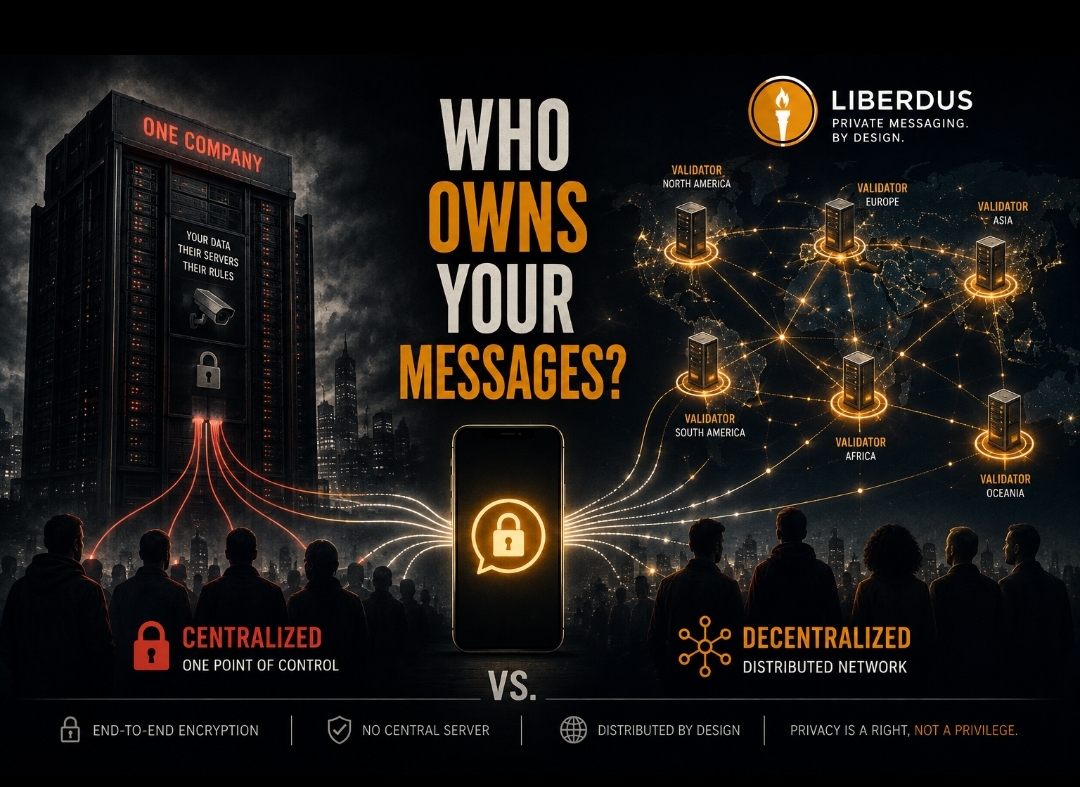
We often talk about private messaging as if encryption is the entire story. It isn't. When you use a centralized messenger, you trust more than its encryption. You trust the company operating
A
AnonymousCryptoCompass newsroom
August 10, 2026
1 min read
NEWS
CryptoCompass editorial visual for bitcoin coverage.
We often talk about private messaging as if encryption is the entire story.
It isn't.
When you use a centralized messenger, you trust more than its encryption.
You trust the company operating the infrastructure.You trust its policies.You trust its jurisdiction.You trust that the platform will still exist tomorrow.
Bitcoin changed the model for money by showing that a global network doesn't necessarily need a central authority to operate.
That raises an interesting question:What if we applied the same philosophy to communication?
That's the direction @Liberdus is exploring.Instead of relying on one centralized messaging server, Liberdus uses a distributed network of validators to maintain its infrastructure.
The goal isn't to pretend decentralization eliminates every privacy risk.
The goal is simpler:Don't concentrate so much control in one place.
That's what makes this interesting from a Web3 perspective.
Bitcoin asked:“Why should money depend on a central authority?”Liberdus asks:“Why should private communication depend on a central platform?”
Maybe the next step for Web3 isn't putting blockchain everywhere.
Maybe it's identifying the systems that should never have needed a central gatekeeper in the first place.
Veteran commodities trader Peter Brandt has projected that Bitcoin could reach approximately $500,000 during its next major bull market cycle, estimating a potential peak somewhere in the $30
Shiba Inu's recent price recovery has lost upward momentum as on-chain exchange reserve data points to rising sell-side supply, a pattern that historically precedes increased distribution pre
On 1 April 2026, the Akash network reported that its customers had passed 5 million dollars in cumulative spending on compute, real money paying for real processing power on a blockchain mark