Key Takeaways Charina Chou, Google’s Quantum AI COO, stated the federal funding included stipulations that would have restricted the company’s development velocity Specific requirements tied
Key Takeaways
- Charina Chou, Google’s Quantum AI COO, stated the federal funding included stipulations that would have restricted the company’s development velocity
- Specific requirements tied to the $2B initiative remain undisclosed
- Nine companies participated in the program, including IBM, GlobalFoundries, Rigetti, PsiQuantum, and Quantinuum
- Notable absences included Microsoft and IonQ alongside Alphabet
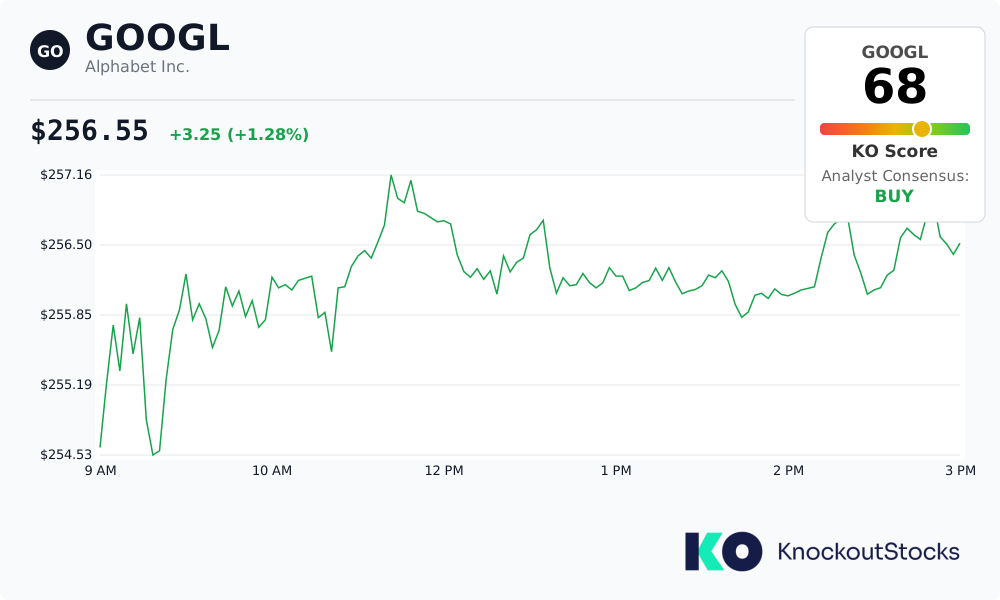
- GOOGL shares declined approximately 2.51% to trade near $347.46 on Thursday
Alphabet (GOOGL) has finally addressed why the tech giant didn’t participate in President Trump’s $2 billion quantum computing funding program — and the explanation centers on operational flexibility.
 Alphabet Inc., GOOGL
During remarks at the Semafor Tech Summit in San Francisco on June 10, Charina Chou, Chief Operating Officer of Google Quantum AI, revealed that the company opted out because participating would have compromised its ability to advance quantum computer development at its preferred rate.
GOOGL stock declined roughly 2.51% to approximately $347.46 during Thursday’s trading session.
The specific stipulations linked to the federal program haven’t been publicly revealed. However, Chou emphasized that Google maintains collaborative relationships with Washington through alternative channels and endorses government funding for foundational quantum research.
The $2B program was organized through non-binding letters of intent rather than finalized agreements. Its primary objective was to bolster America’s quantum computing infrastructure and counter China’s expanding influence in quantum technology.
In May 2026, nine organizations were designated as recipients. The roster featured IBM (IBM), GlobalFoundries (GFS), Quantinuum, PsiQuantum, Rigetti Computing (RGTI), and Infleqtion (INFQ).
Major Players Excluded from Funding
Alphabet, Microsoft (MSFT), and IonQ (IONQ) were notably missing from the recipient roster. Until Chou’s recent statements, no official rationale had been provided.
Neither IonQ nor Microsoft has issued comparable public explanations regarding their exclusion from the program.
The omission of these three prominent quantum technology leaders has sparked industry discussion, particularly given their substantial financial commitments and technological capabilities in the sector.
Perspectives on Federal Support
Pete Shadbolt, co-founder of PsiQuantum, championed government involvement in quantum development. He characterized public funding as entirely appropriate due to the technology’s national security ramifications.
This perspective isn’t universally shared. Questions about whether federal participation accelerates or impedes commercial quantum innovation appear to be intensifying across the industry.
IBM’s quantum computing leader Scott Crowder provided a development roadmap during the same conference. He projected IBM would deliver its first production-ready scalable quantum system by 2029.
This timeline positions IBM approximately three years from achieving a critical benchmark — while still operating under preliminary agreements with the Trump administration’s quantum program.
Alphabet hasn’t indicated whether it might reconsider participation in subsequent government initiatives under modified terms.
RGTI stock climbed approximately 2.38% on Thursday, while IBM shares decreased about 1.35%.
The post Why Alphabet (GOOGL) Rejected Trump’s $2 Billion Quantum Computing Initiative appeared first on Blockonomi.