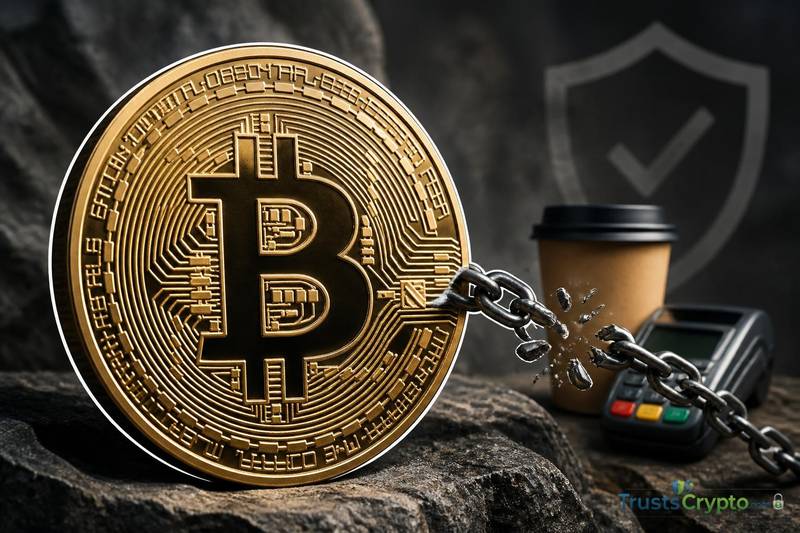
Bitcoin can settle a multimillion-dollar transfer across borders without a bank, but buying a $5 latte with it remains surprisingly impractical. The gap between Bitcoin's strength as a settle
Bitcoin can settle a multimillion-dollar transfer across borders without a bank, but buying a $5 latte with it remains surprisingly impractical. The gap between Bitcoin's strength as a settlement network and its weakness as a retail payment rail comes down to architecture, tax friction, and user experience problems that persist even as the Lightning Network matures.
Bitcoin Was Built to Move Value, Not Handle Tiny Retail Payments
Why Block Times Matter at the Register
Bitcoin produces a new block roughly every 10 minutes. A coffee shop expecting near-instant payment confirmation faces an awkward wait. Most point-of-sale systems using card networks finalize in under two seconds.
Merchants can accept zero-confirmation transactions, but that introduces chargeback-like risk. Waiting even one confirmation means the customer stands at the counter far longer than any traditional payment method requires.
Why Fee Spikes Break the Coffee Use Case
Every Bitcoin transaction competes for limited block space. When demand surges, fees can jump from under a dollar to $20 or more. A transaction fee that exceeds the price of the item being purchased makes the payment economically irrational.
This variable fee structure is a feature for high-value settlement, where a $5 fee on a $100,000 transfer is negligible. For a $5 coffee, that same fee represents a 100% surcharge.
Throughput in Plain Terms
Bitcoin's base layer processes roughly 7 transactions per second. Visa handles thousands. This throughput ceiling means Bitcoin was never designed to replace card networks at the checkout counter; it prioritizes security and decentralization over retail speed.
What Actually Goes Wrong When You Try to Buy Coffee With BTC
The Speed Problem
Even in the best-case scenario, a Bitcoin base-layer payment involves scanning a QR code, confirming the amount in a wallet app, broadcasting the transaction, and waiting. The cumulative friction adds 30 seconds to several minutes compared to tapping a card.
The Volatility Problem
Bitcoin's price can move 2-3% in the time between scanning a QR code and the transaction confirming. Merchants need price certainty. A coffee sold for 0.00005 BTC might be worth $5.00 at the moment of sale and $4.85 by the time it settles, creating accounting headaches.
The Tax Problem on Both Sides of the Counter
In the United States, the IRS treats Bitcoin as property. Every time a holder spends Bitcoin, it triggers a taxable capital gains event. Buying a coffee means calculating the cost basis, determining the gain or loss, and reporting it.
This tax treatment creates a powerful disincentive to spend Bitcoin on everyday purchases. As the Cato Institute has argued, taxing small Bitcoin transactions as capital gains makes no practical sense for either consumers or the tax system. The compliance burden alone outweighs the value of most retail transactions.
Block, the payments company led by Jack Dorsey, has gone further, launching a campaign explicitly calling for de minimis tax reform that would exempt small Bitcoin payments from capital gains reporting. Until such reform passes, every coffee purchase with Bitcoin is a potential line item on a tax return.
Lightning Makes Bitcoin Faster, but Not Frictionless
What Lightning Fixes
The Lightning Network moves Bitcoin transactions off the base layer into payment channels that settle nearly instantly and for fractions of a cent. For the coffee use case, Lightning eliminates the two biggest technical objections: slow confirmation and high fees.
Lightning-enabled point-of-sale systems can process a payment in under a second with fees well below one cent. On pure speed and cost, Lightning brings Bitcoin close to card-network performance.
Why Lightning Still Feels Too Technical for Average Users
Using Lightning requires a compatible wallet, sufficient inbound liquidity in a payment channel, and a merchant running Lightning-capable infrastructure. For a first-time user, the onboarding process involves concepts like channels, routing, and liquidity that have no equivalent in the tap-to-pay experience they already know.
Merchants face their own friction. Accepting Lightning payments typically requires a service provider or additional tooling beyond a standard payment terminal. The infrastructure exists, but it adds complexity that most small retailers are not motivated to adopt when card acceptance already works.
None of this means Lightning is a failure. It represents a genuine technical improvement. But closing the gap between "possible" and "mainstream" requires solving onboarding and merchant adoption problems that remain largely unsolved.
Why Cards and Stablecoins Still Beat Bitcoin for Everyday Spending
Consumers already carry a payment method that settles in under two seconds, requires no tax calculation per transaction, and works at virtually every retailer: a debit or credit card. The tap-to-pay experience sets the baseline that any Bitcoin payment solution must match or exceed.
Stablecoins pegged to the dollar eliminate the volatility problem entirely. A merchant accepting USDC or USDT knows the value will not shift between sale and settlement. The broader stablecoin payments trend, including moves like World Liberty Financial funding UFC bonuses in USD1 stablecoin, signals growing institutional comfort with dollar-denominated digital payments.
Bitcoin's strongest use cases likely lie elsewhere: cross-border remittances, censorship-resistant savings, and large-value settlement. For buying coffee, the honest assessment is that both traditional rails and newer stablecoin options offer a better experience today.
The broader volatility in crypto markets during 2026 has only reinforced the gap between store-of-value narratives and everyday payment usability.
FAQ: Bitcoin Payments and the Coffee Test
Why can't Bitcoin payments settle fast enough for coffee?
Bitcoin's base layer confirms transactions in blocks spaced roughly 10 minutes apart. Point-of-sale payments need finality in seconds. Accepting unconfirmed transactions is possible but introduces risk most merchants will not take for small purchases.
Doesn't Lightning solve the problem?
Lightning solves the speed and fee problems but introduces its own friction: wallet compatibility, channel liquidity, and merchant infrastructure requirements. It is a meaningful improvement, not a complete solution for mainstream retail adoption.
Could Bitcoin ever work for everyday purchases?
Two changes would significantly narrow the gap. First, tax reform creating a de minimis exemption for small Bitcoin transactions would remove the reporting burden. Second, continued improvements in Lightning wallet UX and merchant tooling could make the payment experience competitive with cards. Neither is guaranteed, but both are actively being pursued.
Disclaimer: This article is for informational purposes only and does not constitute financial or investment advice. Cryptocurrency and digital asset markets carry significant risk. Always do your own research before making any investment decisions.
Read original article on trustscrypto.com