War has always depended on more than weapons; behind every battlefield capability lies a chain of funding, suppliers, and transactions. Drones that once required substantial military resource
War has always depended on more than weapons; behind every battlefield capability lies a chain of funding, suppliers, and transactions. Drones that once required substantial military resources can today be built or acquired using commercially available technology. But getting that equipment into the hands of those who want it still requires money, suppliers, and a way to move funds across borders.
This is where cryptocurrency enters the picture. While digital assets were not created to finance military operations, their ability to move value across borders outside conventional banking channels has made them relevant to some drone procurement networks.
So, when money moves through digital networks and equipment passes through global commercial supply chains, how easily can authorities establish who is paying for what, and for whom?
The answer matters well beyond the crypto industry. Many drone components have legitimate civilian uses, and the same global trade networks that serve ordinary businesses can also be exploited to acquire equipment for military purposes. This explainer looks at how cryptocurrency fits into these supply chains, why tracking and restricting such transactions can be difficult, and what this means for sanctions enforcement and international security.
How Crypto Is Already Being Used for Drone Procurement
Cryptocurrencies are increasingly showing up as a supporting payment layer in drone procurement, especially in situations where access to banks is limited.

Crowdfunding links online support to real-world purchases
Some pro-Russia-linked volunteer and paramilitary groups haveraised more than $8.3 million in cryptocurrency donations since 2022 through open crowdfunding campaigns on social media. These campaigns explicitly listed drones among the purchases. One solicitation sought enough money to buy a reconnaissance drone, while another delivery manifest listed UAV components worth about 200,000 rubles (roughly $3,400), along with radios, medical supplies, and weapon-cleaning kits.

Radios, medical supplies, and weapon-maintenance equipment bought with crypto. Source:
Chainalysis
It was also discovered that a large batch of the purchased equipment was later delivered to the Rubicon Unmanned Systems Center.
Connecting buyers to global supply chains
Drones and their components are dual-use goods, meaning they are widely available for both civilian and military purposes. Parts such as motors, cameras, and batteries are openly sold on global e-commerce platforms.
Crypto has helped fund these markets. In most cases, buyers convert it to fiat or use intermediaries, then purchase drone parts or complete units from commercial suppliers operating through normal global trade networks.
Indirect vs direct crypto payments
Crypto enters drone procurement in two main ways:
- Direct use: Some drone manufacturers and suppliers have accepted cryptocurrency payments directly. Chainalysis identifies Russian UAV manufacturer KB Vostok as a clear example.
- Indirect use: More commonly, crypto funds accounts, brokers, or intermediaries that then complete purchases through traditional channels.
The indirect route is more widely used because it fits more easily into existing supply chains.
Sanctions Evasion Risk: Digital Assets and Restricted Procurement
While crypto helps enable funding and payments, it also creates a different challenge: it can make sanctions harder to enforce, especially when transactions cross borders outside traditional financial systems.
An alternative path around financial restrictions
Sanctions are designed to limit access to global banking systems. Cryptocurrency offers another way to transfer value outside the banking system and away from controls imposed by payment systems.
These methods don’t eliminate barriers; they just create more avenues that are harder to manage.
Reported use by sanctioned actors and networks
A Chainalysis report found that sanctioned actors linked to Iran and Russia are increasingly integrating cryptocurrency into military procurement. Investigators traced a wallet that purchased drone components from a Hong Kong supplier to liquidity flows connected to the Iranian exchange Nobitex, IRGC-associated wallets, and an OFAC-sanctioned facilitator.

The Reactor graph shows direct and indirect links between a drone-parts buyer and liquidity from Nobitex, IRGC wallets, and OFAC-sanctioned Alireza Derakhshan. Source:
Chainalysis
This shows how Chinese commercial supply chains can intersect with sanctioned procurement networks even when the manufacturers themselves are not publicly shown to accept crypto directly.
Separately, Iran’s Ministry of Defense Export Center (Mindex) advertised Shahed drones and other military hardware that could be purchased using cryptocurrency.
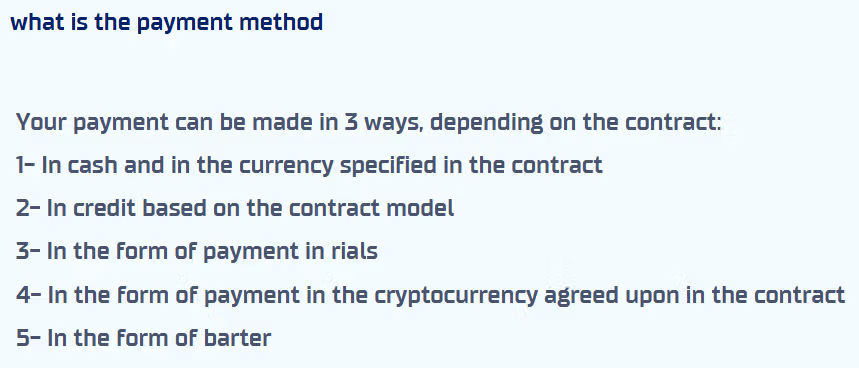
Iran’s Ministry of Defense Export Center (Mindex) Payment methods. Source:
iranintl.com
The US later removed the crypto payment option after enforcing sanctions. Mindex’s website is hosted on Arvan Cloud, an Iranian cloud provider Washington has blacklisted since 2023.
“Sanctions-proofing” through decentralized channels
Some chains try to bypass sanctions enforcement by implementing decentralized approaches like blockchain transactions, peer-to-peer transfers, and non-KYC networks. Such a strategy aims to ensure the independence of financial flows from centralized regulation, thus enhancing their immunity to interference.
How enforcement becomes more difficult
Unlike the conventional financial system, crypto chains have no central authority. While particular wallets and exchanges might be blacklisted, it is possible for the participants to:
- generate new wallets
- transfer assets between blockchains
- carry out transactions via multiple providers
Tracking exists, but attribution is limited
The blockchain ledger records every transaction, allowing investigators to trace how funds move across wallets, exchanges, and blockchains. However, it does not reveal who controls those wallets.
For example, in the $1.5 billion Bybit hack in 2025, investigators tracked the stolen funds across hundreds of addresses and services, but only linked the activity to the North Korean hacking group Lazarus after combining on-chain analysis with intelligence from exchanges, infrastructure providers, and government agencies.
As a result, attribution depends on transaction patterns and external evidence rather than blockchain data alone.
Compliance Challenges
As crypto becomes part of drone procurement, it creates real challenges for regulators, exchanges, and companies trying to separate normal trade from restricted or risky activity.

Dual-use problem
Drones and their components are difficult to regulate because many have legitimate civilian applications. The same aircraft, camera, motor, battery, or communications component can be used for farming, photography, surveying, logistics, or military operations.
The problem is not the product itself, but how it is used after purchase. This makes it difficult for regulators to restrict access without also affecting legitimate users.
Difficulty in classification
On paper, many transactions look completely normal. A buyer ordering drone parts or electronics does not automatically raise suspicion because these items are widely used in commercial industries.
Even payment records and shipping routes often appear standard. This makes it hard to clearly classify whether a transaction is harmless commercial activity or part of a higher-risk supply chain.
Enforcement gaps
Blockchain data shows money movement, but it does not always show the full story behind a transaction. Many of these interactions occur off-chain, in private communications, emails, or broker networks. These interactions reduce visibility for authorities, meaning they may have information about part of the process but not the full story.
Crypto exchanges and payment processors usually work as intermediaries between various participants in a transaction. Even if an exchange or processor is not associated with any criminal activity, funds passing through it may later be found to be connected to the restricted procurement process. The risk is particularly high for international platforms that process a large number of transactions daily.
Lack of coordination on a global level
While crypto exists globally, regulations do not. Each country has its own regulations and enforcement methods, so some transactions may be legal or outside controls in other parts of the world. Criminals may try to take advantage of this disparity by routing money through other regions.
Regulatory Implications
No single global framework governs crypto-funded drone procurement. Rules depend on the jurisdictions involved and can come from several regulatory systems, including sanctions, export controls, customs rules, and financial regulations.
The United States, European Union, and United Kingdom provide useful examples of how these issues are being handled differently.

United States: Export controls and sanctions
In the United States, authorities can examine whether the product is subject to export controls, who the end user is, where the goods are going, and whether a sanctioned person or jurisdiction is involved.
The Bureau of Industry and Security administers US export controls covering dual-use items. Separate sanctions administered by the Office of Foreign Assets Control can restrict dealings with designated individuals, entities, and jurisdictions.
For crypto companies, this adds another layer of compliance. A transaction involving an ordinary commercial product can become higher risk if blockchain analysis, customer information, or other evidence connects the funds or participants to a sanctioned network.
European Union: Trade restrictions also reach financial services
The EU has taken a particularly direct approach in its Russia sanctions framework.
EU rules prohibit the direct or indirect sale, supply, transfer, or export of certain dual-use goods and technology to Russia or for use in Russia. The rules can also prohibit related financing and financial assistance.
The framework also covers financial institutions and crypto-asset service providers outside the EU that facilitate transactions exporting restricted goods and technologies to Russia.
This matters for the crypto industry because regulatory concern can extend beyond the person buying the hardware. Financial and crypto service providers can also become part of the enforcement framework when their services facilitate restricted trade.
United Kingdom: Greater focus on end use and diversion
The UK operates its own strategic export-control system covering military and dual-use goods, software, and technology. Its rules can require an export licence based on the item being exported, the destination, or concerns about the end use or end user.
In April 2026, the UK also published guidance on new Sanctions End-Use Controls. These controls can require a licence for exports to a non-sanctioned third country when the government has identified a risk that the goods or related technology could ultimately be diverted to a sanctioned destination or person.
That matters for drone procurement because a shipment does not necessarily become safe simply because it is sent to a country that is not sanctioned. If there is evidence that the goods could be diverted later, the transaction may attract additional scrutiny.
What This Means for Crypto Companies
These differences mean crypto companies operating across borders cannot rely on a single global approach to drone-related transactions.
An exchange or payment provider may need to consider the customer’s identity, the origin and destination of funds, sanctions exposure, and the jurisdictions involved. When a transaction involves physical goods, additional questions can arise about the product, end user, destination, and potential diversion.
Blockchain analytics can help by tracing funds and identifying connections between wallets and known entities. But it cannot replace export-control or sanctions checks because the blockchain does not contain all the information needed to establish the underlying trade.
Cryptocurrency, Conflict Financing, and the Future of Regulations
Cryptocurrency plays a unique role within the current conflict systems. It was not built to finance or prevent conflict; instead, it serves a dual role, enabling both transparency and secrecy.
On the one hand, blockchain networks create permanent transaction records that allow investigators to trace financial flows in ways traditional cash systems often cannot. Analysts can follow wallet activity, identify suspicious transaction patterns, and map networks across borders with a level of visibility that would have sounded almost futuristic a decade ago. In some cases, crypto has actually made financial tracking easier, not harder.
At the same time, those same systems can also move funds quickly across jurisdictions through fragmented wallet structures, intermediaries, stablecoins, decentralized platforms, and cross-border payment networks that operate far outside traditional banking hours or controls. Once multiple chains, privacy tools, and offshore entities enter the picture, monitoring becomes significantly more complicated. The money doesn’t exactly disappear, but it can scatter across networks faster than regulators can realistically respond in real time.
This dual nature is what makes the issue difficult to resolve. Crypto does not create new types of conflict finance on its own, but it makes existing systems faster, more global, and more complex to monitor.
As drone procurement networks and other dual-use supply chains continue evolving, the bigger question is no longer whether cryptocurrency is involved at all. At this point, some level of involvement is almost expected. The real challenge is whether regulators, blockchain analytics firms, financial institutions, and international governments can adapt quickly enough to monitor increasingly complex financial networks without stifling legitimate innovation in the process.
FAQs
How is cryptocurrency used to finance drone procurement?
Cryptocurrency can fund drone procurement through direct payments to suppliers or indirectly through brokers, intermediaries, and accounts that facilitate purchases using traditional payment methods. Documented cases have linked crypto transactions to drone components and military equipment.
Can cryptocurrency be used to evade sanctions when buying drones?
Yes. Cryptocurrency can provide alternative payment channels for sanctioned actors seeking to acquire drones or related components. However, using crypto does not automatically bypass sanctions, and transactions can still be traced and investigated.
Can blockchain analysis trace cryptocurrency payments linked to drone purchases?
Yes. Blockchain analysis can help investigators follow funds between wallets, exchanges, and other services, potentially identifying links to known entities. However, blockchain records do not automatically reveal who controls a wallet or what physical goods a payment ultimately funded. Investigators often need additional evidence to establish those connections.
Why are drone components difficult to regulate?
Many drone components, including motors, cameras, batteries, and communications equipment, have legitimate civilian applications. Because the same products can be used for commercial or military purposes, regulators must consider factors such as the destination, end user, intended use, and potential diversion when assessing procurement risks.
What regulations apply to cryptocurrency-funded drone purchases?
There is no single global framework governing cryptocurrency-funded drone procurement. Applicable requirements may include financial sanctions, export controls, customs rules, and financial regulations. The United States, European Union, and United Kingdom each have frameworks that can restrict certain transactions involving controlled goods, sanctioned parties, or prohibited destinations.
Disclaimer: This article is intended solely for informational purposes and should not be considered trading or investment advice. Nothing herein should be construed as financial, legal, or tax advice. Trading or investing in cryptocurrencies carries a considerable risk of financial loss. Always conduct due diligence.
Enjoyed this? BookmarkDeFi Planet, explore related topics, and follow us onTwitter,LinkedIn,Facebook,Instagram,Threads, and CoinMarketCap Community for seamless access to high-quality industry insights.
Take control of your crypto portfolio with DEFI PLANET PRO, DeFi Planet’s suite of analytics tools.
The post Why Crypto Is Becoming Part of the Global Drone Business appeared first on DeFi Planet.