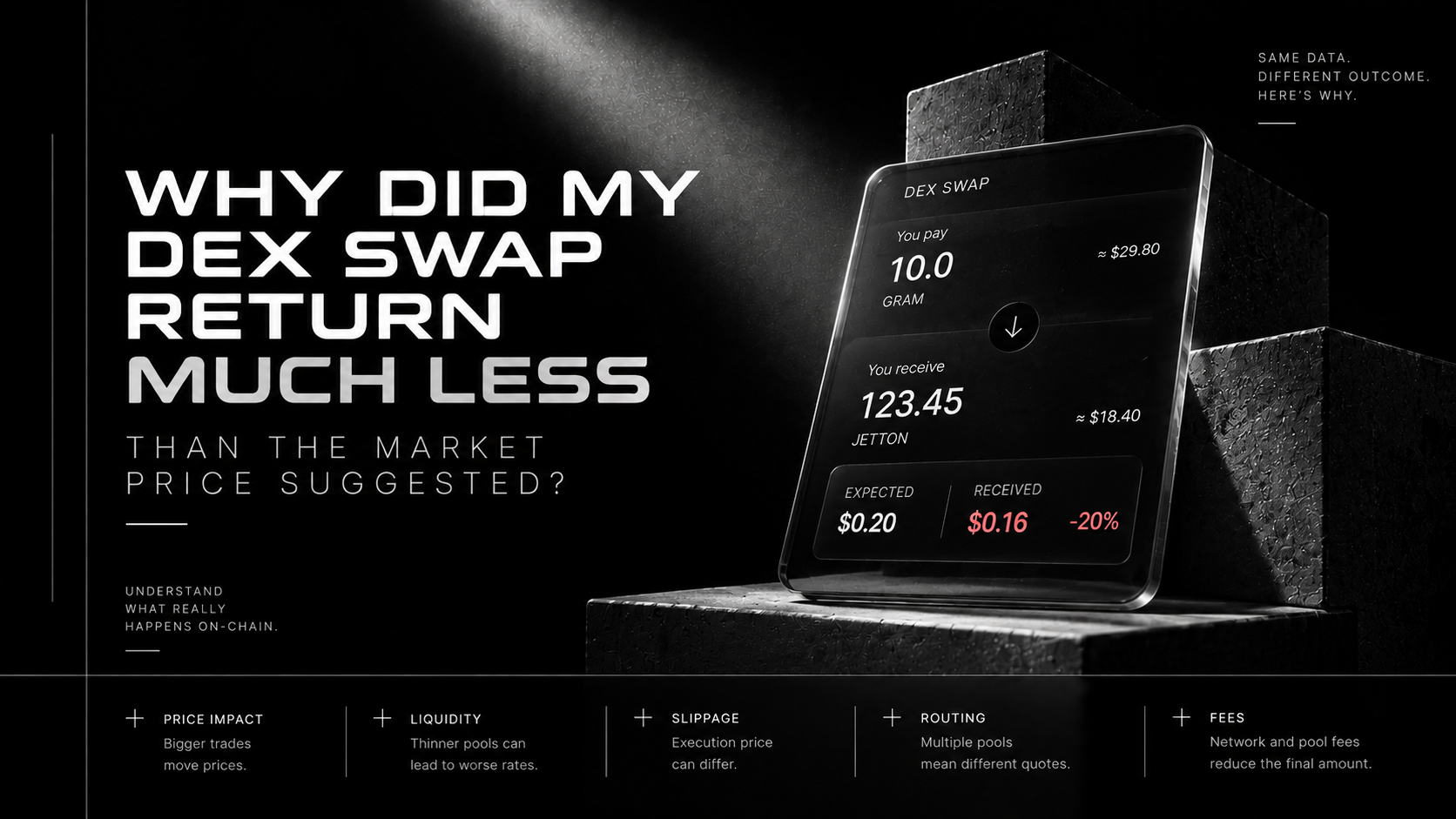
Why Did My DEX Swap Return Much Less Than the Market Price Suggested? This is one of those moments that feels like something broke, even when nothing actually did. You check a price somewhere
Why Did My DEX Swap Return Much Less Than the Market Price Suggested?
This is one of those moments that feels like something broke, even when nothing actually did. You check a price somewhere, open a DEX, go to swap that exact amount, and the number that comes back is noticeably worse than what you were expecting. No error message, no failed transaction — just a result that doesn't match the number you walked in with. It's a genuinely confusing experience the first time it happens, and it's worth understanding exactly why, because the answer isn't a bug. It's how on-chain trading actually works, once you know what you're looking at. 📉
The market price you saw was never a promise
The price you checked before opening your wallet — on a chart, an aggregator, a price-tracking site — is a reference point, not a quote. It's usually an average or a recent trade price pulled from wherever that source is looking, and it tells you roughly what an asset has been trading around. It was never a guarantee that your specific trade, at your specific size, would execute at that exact number.

A real execution price only exists once a specific pool, with specific reserves, processes a specific trade size, right now. Two people looking at the same reference price can get meaningfully different actual results depending on how much they're trading and which pool their trade actually routes through. The reference price is a snapshot of the market in general. Your quote is a calculation specific to you, your size, and the liquidity actually available at that moment — and those two numbers are only ever coincidentally the same.
What actually pulls execution below that reference number
A handful of concrete factors, working together or separately, explain most of the gap between a reference price and what you actually receive. Low liquidity is usually the biggest one — a pool with a small reserve base has less capacity to absorb a trade without its internal price ratio shifting, so the same trade that barely moves a deep pool can shift a shallow one noticeably. Trade size compounds this directly: a larger trade against any given pool represents a bigger share of what's actually sitting there, so size and liquidity depth are really two sides of the same underlying constraint, not separate issues.

Pool imbalance adds another layer. If a pool's reserves have drifted so one side is scarcer than the other, relative to its usual balance, trading further in that same direction gets more expensive than it would in a freshly balanced pool, even at an identical nominal size. And price impact is really just the name for what all three of these factors add up to — the actual, measurable difference between the price before your trade and the price your trade settles at, driven by exactly the liquidity, size, and imbalance conditions described above, on whichever specific DEX you happen to be using. None of this is unique to any one platform; it's simply how automated market makers price trades everywhere, on any chain, on any interface.
Why the quote is the thing to actually read, not the headline price
Once you accept that a reference price was never a promise, the practical takeaway is straightforward: the quote your interface shows you, for your specific trade, is the number that actually matters — not whatever price you saw somewhere else beforehand. That quote is calculated against real, current pool conditions, which the headline number you checked earlier almost never was.
This is a habit worth building regardless of which DEX you're using: treat the pre-confirmation quote as the actual information, and treat any price you saw elsewhere as context, not as an expectation the DEX owes you. A DEX quoting you something different from a reference price isn't malfunctioning — it's doing the one thing it's actually supposed to do, which is tell you what your specific trade will really produce, right now, given actual conditions rather than an average pulled from somewhere else entirely.
The four numbers that actually explain your result
Every serious swap interface shows a cluster of figures before you confirm, and together they explain exactly why your result looks the way it does, rather than leaving you to guess:
- Estimated amount — the optimistic figure for what you'll receive, calculated against the pool as it exists right now, before anything shifts further.
- Price impact — how much your specific trade size is moving the price, expressed as a percentage so you can judge at a glance whether it's negligible or significant.
- Minimum received — the actual guaranteed floor for the trade, accounting for your slippage tolerance, which is the number you can actually rely on rather than hope for.
- Slippage protection — the mechanism that enforces that floor, causing the trade to fail cleanly rather than execute at an arbitrarily worse price if conditions move too far between quote and confirmation.

Reading these four together, rather than fixating on just the estimated amount, is what actually explains a disappointing result instead of leaving it feeling mysterious. A low estimated amount paired with high price impact tells a clear story: thin liquidity relative to your trade size. A reasonable estimated amount that still came in lower than a reference price you saw elsewhere tells a different story entirely — that reference price simply wasn't describing your specific trade to begin with.
🧭 Where STONfi actually shows you all of this
This is worth grounding in something concrete rather than staying abstract, and STONfi is a reasonable place to see exactly how this should look in practice. Every swap on STONfi surfaces estimated amount, price impact, minimum received, and the slippage tolerance protecting that floor, all before you ever sign anything — not buried behind a secondary click, sitting right on the same screen where you're deciding whether to proceed.
What I actually find valuable here isn't a claim that STONfi somehow avoids price impact or thin liquidity — no DEX can escape those, because they're a property of markets and pool depth, not of any particular platform's design. What matters is that the conditions producing your result are visible before you commit, not discovered afterward as a surprise. Seeing an unusually high price impact number before confirming gives you the chance to reconsider size, split the trade, or simply decide the conditions aren't right for that specific swap at that moment — a decision you can only make if the information was actually in front of you.

The value I've come to appreciate here isn't that the number always looks great. It's that I'm never confirming a trade blind, wondering afterward why the result looked different from what I expected. Whatever the outcome is, I already knew it was coming.
Other DEXs, whichever you happen to use, are working with the exact same underlying market mechanics — the same liquidity, size, and impact relationships apply universally to AMM-based trading, regardless of interface. The real difference worth caring about isn't a competition between platforms; it's whether the execution conditions are actually shown to you clearly before you confirm, or left for you to reconstruct afterward from a result that looked worse than expected.
Why a same-chain swap doesn't just execute at "worse," and why cross-chain works differently
Here's a detail worth understanding precisely, because it explains behavior that can otherwise look inconsistent. For a standard, same-chain swap on STONfi, if market conditions move enough between your quote and execution that the trade would settle below your set minimum received, the transaction doesn't just quietly go through anyway at that arbitrarily worse number. Slippage protection is specifically designed to stop that from happening — the trade fails cleanly instead, and your original assets stay exactly where they were, untouched, ready to retry with a fresh quote once you're ready.

Cross-chain swaps through Omniston work under a meaningfully different model, worth knowing if you're moving between chains rather than trading within one. Rather than the same-chain approach of "execute unless it breaches this floor," a cross-chain swap is quoted and settled as an all-or-nothing outcome tied to that specific quote — the trade either completes at the quoted terms or it doesn't happen at all, rather than there being a live, shifting execution price the way there can be within a single chain's pool during the moments around confirmation. That distinction exists because coordinating a trade across two separate networks doesn't have the same continuous, live-pricing dynamic a single on-chain pool does — the quote itself is the commitment, not a floor beneath a moving number.
Both models are protecting you from the same underlying problem — ending up with a materially worse result than what you agreed to — they just do it through mechanisms suited to genuinely different execution environments, one within a single chain's continuous pricing, one coordinating a specific, quoted outcome across two chains at once.
❓ FAQ
Is it normal for my swap to return less than the price I saw on a chart or tracker?Yes, to some degree, almost always. That reference price is a general market snapshot, not a guaranteed execution price for your specific trade size against a specific pool.
Does high price impact mean something is wrong with the DEX?No. Price impact reflects your trade size relative to available liquidity in that specific pool, a property of the market itself rather than a platform malfunction.
What actually protects me if the price moves against me right before my swap executes?Slippage protection, enforced through your minimum received setting — it causes the trade to fail rather than execute at a worse price than you were willing to accept.
Why do cross-chain swaps behave differently from same-chain ones regarding minimum received?Cross-chain swaps are quoted and settled as an all-or-nothing outcome tied to the original quote, since coordinating across two networks doesn't have the same continuous, live-pricing behavior a single chain's pool does.
Not financial advice, DYOR. Disclosure: Official STONfi Ambassador.