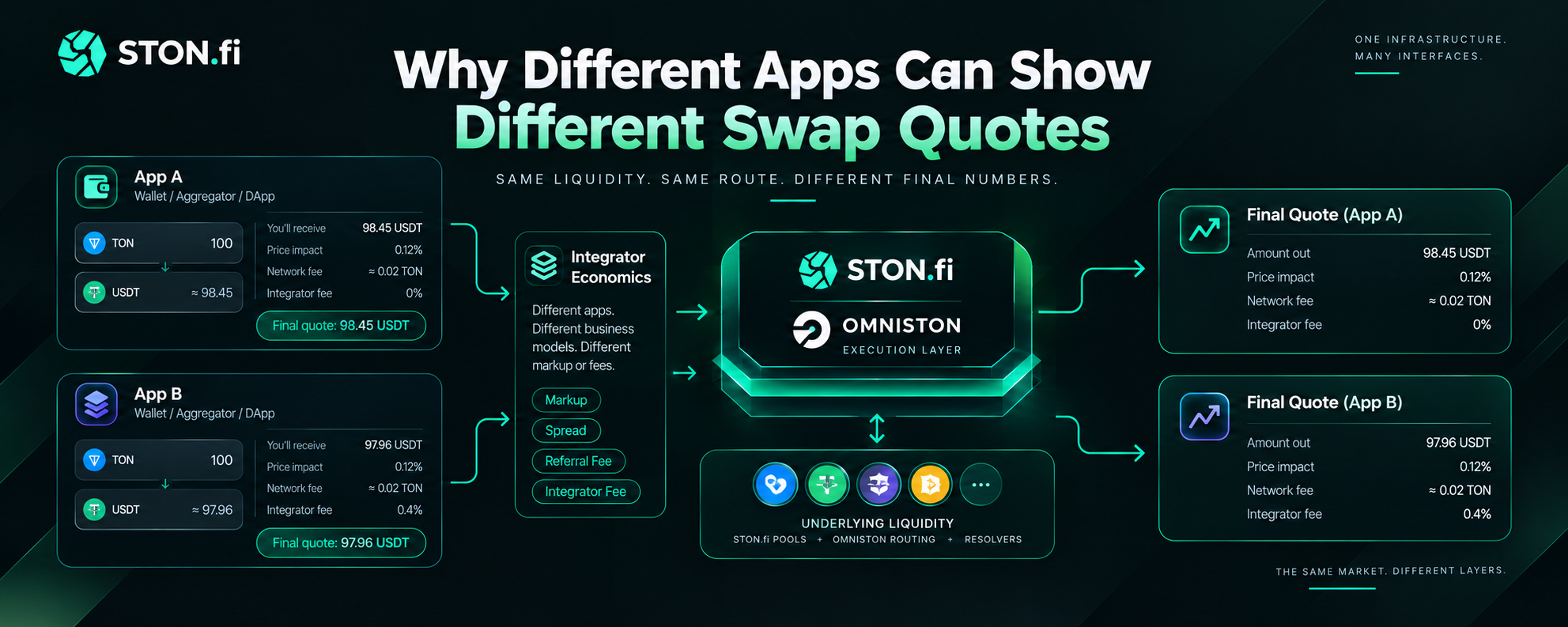
When two apps use the same underlying swap infrastructure, it is easy to assume they should always show the exact same quote. Same assets. Same market. Same liquidity. Same moment. But the in
When two apps use the same underlying swap infrastructure, it is easy to assume they should always show the exact same quote.
Same assets. Same market. Same liquidity. Same moment.
But the interface you use can still affect the final number you see.
The reason is the integrator: the wallet, aggregator, trading application, or DeFi interface that connects its users to infrastructure such as STONfi and Omniston.
Understanding where the integrator fits into the execution flow makes quote differences much easier to understand.
An integrator is an application that builds on top of existing swap infrastructure instead of creating the entire liquidity and execution system itself.
That could be a wallet adding cross-chain swaps, an aggregator providing routing, a trading application offering swaps as one of its features, or a DeFi app giving users access to external liquidity.
This composability is one of the useful properties of DeFi infrastructure.
A developer does not necessarily need to create liquidity pools, resolver infrastructure, routing logic, and settlement contracts from scratch. Instead, they can connect to an existing system and build their own user experience around it.
Omniston is designed for exactly this type of integration. Its current documentation describes it as an execution layer that wallets, aggregators, exchanges, and DeFi applications can integrate with.
But integration also introduces another economic layer.
Omniston's current integration model includes a configurable integrator fee.
According to STON.fi's documentation, integrators can set a fee per transaction through the RFQ flow, currently from 0.01 to 100 basis points. The fee is embedded into the quoted execution price, collected in the destination asset, and distributed automatically through smart contracts.
That means the economics do not necessarily appear as a completely separate line saying "integrator fee."
Instead, the fee can be incorporated into the final quoted output.
This creates an important distinction:
The infrastructure can determine the available execution, while the application integrating that infrastructure can have its own economics within the transaction.
That is why looking only at the interface without understanding the underlying quote structure can sometimes be misleading.

Imagine two applications requesting a quote for the same swap through Omniston.
Both can access the same resolver network and underlying execution infrastructure, but the applications may have different integration settings.
One may charge no integrator fee.
Another may configure a small fee.
The result can be different final output amounts even though the underlying swap infrastructure is similar.
This does not necessarily mean that one application has better or worse liquidity.
The difference can come from the additional economic layer introduced by the application itself.
Omniston's RFQ system also means that resolvers compete by returning executable quotes, including pricing, expected output, execution routes, and conditions. The available quote is therefore already the result of an execution process before the integrator's own economics are considered.
That is an important distinction when comparing interfaces.
For users, the practical question is not simply:
"What is the market price?"
It is:
"How much am I actually sending, and how much will I receive?"
That final output is what should be compared.
STON.fi's own interface exposes swap information such as the swap rate, price impact, minimum received, and blockchain fee before confirmation.
For cross-chain execution, the quote also reflects the resolver-based execution path and destination-side delivery.
So when comparing two interfaces, looking at the final amount received is more useful than assuming two displayed exchange rates must be identical.

An application taking a fee does not automatically make the quote unfair.
Wallets, aggregators, and DeFi applications have development, infrastructure, maintenance, and support costs. A configurable fee gives an integrator a way to monetize the service it provides.
The more useful question is transparency.
Can the user understand the final output before confirming?
Can they identify the relevant costs?
Can they compare the quote with another interface if they want to?
A fee that is clearly incorporated into the execution economics is fundamentally different from a situation where the user has no meaningful way to understand why the final amount differs.
Percentage-based differences become more noticeable as transaction size increases.
A small difference on a small swap may barely matter.
The same percentage applied to a much larger swap can become significant.
That is why comparing the final output between interfaces can be useful when the trade is large enough for small differences to matter.
It also helps separate two different questions:
Is the underlying market execution different?
or
Is the application applying different economics to the same infrastructure?
Those are not the same thing.
There is another distinction worth keeping clear.
Price impact describes how the size of a trade can affect the execution price relative to the available liquidity.
Integrator fees are an economic charge associated with the application integrating the infrastructure.
They can both affect the amount a user ultimately receives, but they come from different parts of the system.
STON.fi's documentation separately defines price impact, swap rate, minimum received, and blockchain fees, which makes this distinction especially important when reading the confirmation screen.
If you want to understand why two interfaces are showing different numbers, compare the same trade under the same conditions.
Look at:
Amount being sent
Destination asset
Expected amount received
Applicable network costs
Price impact
Slippage or minimum received
Route or execution information
Any integrator or partner economics disclosed by the application
The goal is not to assume that every difference means something is wrong.
It is to understand where the difference comes from.
This is one of the interesting consequences of composable DeFi infrastructure.
The same execution layer can power many different applications, while each application can build its own interface and business model on top.
That flexibility is useful for the ecosystem.
But it also means that the number displayed on your screen is not necessarily just a raw representation of one underlying market price.
There can be infrastructure, routing, resolver competition, protocol economics, and integrator economics all contributing to the final execution.
Once you understand those layers, quote differences become much easier to investigate.
Instead of asking only "Why is this app showing a different price?", you can ask the more useful question:
"Which part of the execution flow is responsible for the difference?"
That is the level at which cross-chain quotes start making sense.