Everything You Need to Know About the NodeLink Network Supply Token supply decisions shape how a crypto project grows. A single number often decides whether a coin stays useful or turns into
Everything You Need to Know About the NodeLink Network Supply
Token supply decisions shape how a crypto project grows. A single number often decides whether a coin stays useful or turns into just another volatile, speculative asset. Getting that balance right, matters more than most people realize.
This question comes up a lot among early adopters and investors: why 25 billion, specifically?
The team fixed it at that figure instead of going much lower or much higher. Based on the official whitepaper and roadmap, here's the reasoning behind that call.
Supply size touches three major things at once:
Price accessibility for new users
Long-term reward sustainability
The balance between scarcity and accessibility as the network grows
Most projects just pick a number and move on. This one actually laid out its logic, weighing three different supply ranges before landing on 25 billion. Worth breaking that down properly.
What Is NodeLink Network
On its official site, the project calls itself a crypto super app built for beginners, essentially a daily engagement app aiming at people who've never touched crypto before. The goal, as stated, is becoming a genuine on-ramp for mass adoption.
It combines a mobile engagement layer with a smart wallet, both running on a hybrid server-and-blockchain setup.
Right now, users earn virtual NODL points through the app, which is live on Google Play. Those points don't carry any monetary value yet; they're just a way to track engagement ahead of the actual coin launch.
Unlike a typical crypto wallet, the platform leads with fun, low-risk engagement first. Real financial utility comes later, once habits are established and the token itself goes live.
Mission and Vision
The stated mission is straightforward: make crypto feel as easy as any app you already use every day.
The roadmap lays out a gradual path:
Coming next: smart wallets and one-tap payments.
Down the line: identity-based authorization, but only after audits and regulatory sign-off.
Why Was It Built
According to the whitepaper, the project exists to solve a handful of specific pain points in crypto adoption:
Payment flows that take too many confusing steps.
Reward systems that don't connect to real utility.
Apps that drain your battery.
Distribution methods that feel unfair or opaque.
How It Actually Works
The platform runs on a hybrid model. In the early stages, a server-authoritative setup handles reward math and anti-cheat checks, which keeps battery drain low and bot abuse in check.
Control slowly shifts toward decentralized smart contracts as the network matures, a process the team calls progressive decentralization.
Once the token generation event (TGE) hits, all those accumulated points convert into native coin assets.
Core Architecture
Per the whitepaper, the technical setup is split into five layers.
Layer
Function
Mobile Engagement
The user-facing app experience
Smart Wallet & Payment
Session keys, auto-approvals, gas sponsorship
Server-Authoritative
Reward logic during the early growth phase
Blockchain
Immutable records, token operations
Ambient Identity (long-term)
Biometric authorization, post-audit only
This layered approach lets the platform scale without pushing heavy blockchain computation onto everyday phones.
Key Features
Daily Node Engagement: no upfront capital needed to start earning points.
Smart Wallet Abstraction: aims to cut payments down to one or two taps.
Server-Authoritative Fairness: keeps automated bot farming and cheating out.
Progressive Decentralization: hands control over to smart contracts gradually.
What the Coin Is Actually For
It's built as a utility token, not something designed purely for speculation. Per the whitepaper, it's meant to support:
How NodeLink Network Token Allocation Works
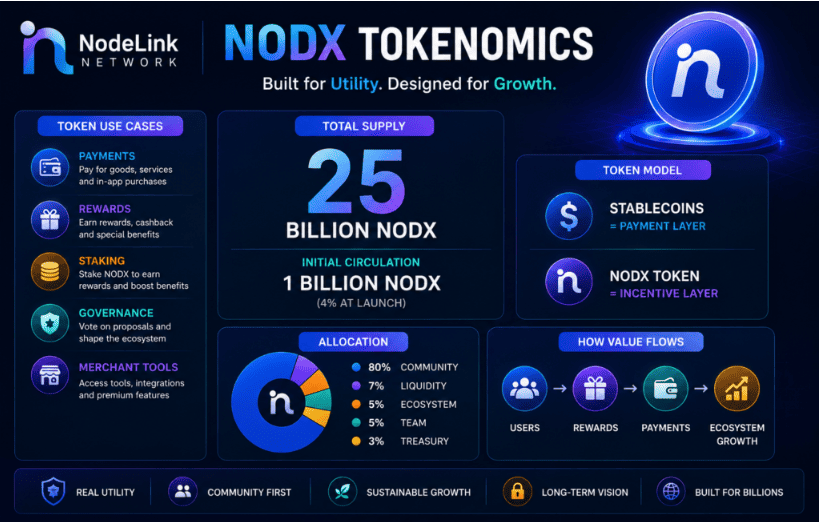
To ensure long-term sustainability and enforce an anti-speculation design, the fixed maximum supply of 25 billion NODX tokens is strategically distributed across five core pillars. Rather than favoring venture capitalists or early speculators, the model is heavily weighted toward progressive decentralization and user adoption, with token minting permanently disabled in the contract code.
Here is the official breakdown of the 25 billion NODX token allocation as per the network's tokenomics blueprint:
Community (80% — 20 Billion NODX): The absolute majority of the supply is reserved exclusively for the community. These tokens are unlocked via an activity-based distribution model, rewarding users for daily node engagement, streaks, and app tasks to ensure the network remains decentralized and driven by real utility.
Liquidity (7% — 1.75 Billion NODX): Allocated to ensure smooth trading, low slippage, and healthy market depth across decentralized and centralized exchanges at launch and during subsequent ecosystem scaling.
Ecosystem (5% — 1.25 Billion NODX): Powers the growth of the super app infrastructure, funding upcoming merchant pilot programs, stablecoin-first integration features, and cross-chain developer tools.
Team (5% — 1.25 Billion NODX): Dedicated to the core developers and contributors maintaining the hybrid server-authoritative architecture. These tokens are bound to a strict unlock schedule to align incentives with the long-term success of the platform.
Treasury (3% — 750 Million NODX): Kept as a strategic financial reserve for future development, operational sustainability, and long-term network security.
Category
Percentage (%)
Token Supply (NODX)
Distribution / Unlock Details
Community
80%
20,000,000,000
Activity-based unlocks via daily node engagement & tasks
Liquidity
7%
1,750,000,000
Exchange depth, low slippage, and market making support
Ecosystem
5%
1,250,000,000
Merchant pilots, stablecoin integration, and developer tools
Team
5%
1,250,000,000
Core contributors, bound to a multi-year strict vesting schedule
Treasury
3%
750,000,000
Strategic financial reserves for future growth & long-term security
TGE and Circulating Supply Dynamics
Managing market impact at launch is vital for a utility token design. When the Token Generation Event (TGE) arrives in Q4 2028, the initial circulating supply at launch will be capped at exactly 1,000,000,000 NODX (4.0%).
By releasing only a tiny fraction of the fixed maximum supply early on and tying the remaining 80% to a gradual, activity-based distribution, NodeLink Network establishes natural scarcity.
As the platform targets its milestone of millions of daily active users, this structure mimics a deflationary token model where demand scales dynamically against a tightly controlled floating supply.
Roadmap and Launch Date
The official roadmap spans five phases leading up to launch.
Phase
Timeline
Focus
Phase 1
Q2 2026 – Mid 2027
Foundation and community engagement
Phase 2
Mid 2027 – Q3 2028
Smart wallets, seamless payments
Phase 3
Q4 2028
Token launch, core utility
Phase 4
2029 – 2031
Advanced features, identity pilots
Phase 5
2031 and beyond
Global scale, full decentralization
Partnerships So Far
No third-party ecosystem partnerships have been confirmed as of this writing. The whitepaper does mention planned merchant pilots and developer tools in later phases, but nothing's been named publicly yet. This section will get an update once official announcements land.
So, Why 25 Billion?
If you're short on time, here's the answer in one place: NodeLink Network locked the supply at 25 billion because it sits right between two failure points.
Go too low, around 5 to 10 billion, and each token becomes too expensive for the very users the app is trying to onboard. Go too high, 50 to 100 billion, and rewards start feeling worthless, which kills the daily-engagement loop the whole product depends on.
Twenty-five billion lets the team do three things at once: keep tokens affordable for beginners, keep enough volume in the pool to fund years of daily rewards and staking, and still create real scarcity once the 80% community allocation unlocks gradually instead of all at once.
Everything below breaks down how each piece of that math actually works.
Final Take
Capping supply at 25 billion tokens reflects an attempt to balance affordability, scarcity, and reward sustainability all at once.
Pair that with 80% community allocation and activity-based unlocks, and the design clearly leans toward rewarding real usage over quick speculation, at least on paper. Whether it holds up is something we'll only know once the Q4 2028 launch actually happens.
Disclaimer: This article is for educational and informational purposes only and should not be considered financial or investment advice. Always conduct your own research before making investment decisions.