Key Takeaways Binance’s 30-day spot share hit 40.1% Selloff lifted turnover at six of seven venues Coinbase traded below Binance for 30 straight days Binance kept about 35% of futures leverag
Bitcoin held for six months or longer has been landing on Coinbase at roughly 25 times Binance’s daily rate, while Binance’s spot share sank to a six-year low.
Key Takeaways
- Older coins reached Coinbase at 25x Binance’s pace
- Coinbase traded below Binance for 30 straight days
- Binance’s 30-day spot share hit 40.1%
- Binance kept about 35% of futures leverage
CryptoQuant analyst Gaah tracked the split in a Nov. 28 Quicktake on exchange deposits sorted by how long the coins had been held.
What arrived at each exchange
In the seven days to Nov. 22, about 87% of the Bitcoin deposited on Binance came from coins that had already moved within the previous 24 hours, the highest share since August 2023. Coins held for six months or longer made up less than 2%. Most of that is fast money: coins shuttling between exchanges, trading desks and traders’ own wallets.
Coinbase drew a different crowd. Coins held six months or more arrived there at about 3,200 BTC a day over the same week, around 16% of its inflows and the most since early July. Binance received roughly 130 BTC a day from the same group.
The older the coins, the clearer the pattern. A separate CryptoQuant analysis by Yavuz Akbay found that coins dormant for 12 to 18 months – bought mostly above $80,000 between May and November 2025 – sent 24,200 BTC to exchanges across Nov. 20, 23 and 24. Coinbase Prime, Coinbase’s desk for large clients, received 102,400 BTC from Nov. 19 to 25, its busiest week in three months.
Why Coinbase gets the older coins
Part of the answer is who uses Coinbase Prime. It serves funds, companies and other large holders, and it offers custody as well as trading, so some of those deposits are institutions moving coins between their own wallets rather than selling them.
Exchange-traded funds add another channel. Coinbase Prime handles cash-redemption sales for BlackRock’s IBIT, and IBIT’s transfers between Nov. 23 and 25 fell inside the same busy week.
Dollar access is a third. Coinbase’s main Bitcoin market trades against U.S. dollars, so a long-term holder can sell straight into dollars in one step. Binance’s main book trades against USDT, a stablecoin.
Binance’s own deposit activity has also been unusually thin since its Oct. 29 hack. CryptoQuant contributor theophiluspep counted an average of 8.6 Bitcoin deposit transactions a day from Oct. 30 through Nov. 22, down 95% from about 160 a day earlier in October, though wallet changes after the incident may explain part of the drop.
None of this shows the coins were sold. That question needs a different measure.
The price gap points to selling on Coinbase
CryptoQuant’s Coinbase Premium Index compares Bitcoin’s price on Coinbase’s BTC/USD market with Binance’s BTC/USDT market. A negative reading means buyers on Coinbase paid less than on Binance. The index was below zero on every one of the 30 days from Oct. 30 to Nov. 28, averaging about −0.14%, and it stayed negative after adjusting for the dollar value of USDT.
The two deepest readings line up with the month’s biggest events. On Oct. 30, the day after Binance’s hack, the index sat near −0.24%. On Nov. 20, when Bitcoin closed at its low for the period, it reached about −0.23%, leaving Bitcoin about $137 cheaper on Coinbase on average that day. The USDT-adjusted reading that day, about −0.27%, was the weakest of the 30 days. The gap had narrowed to about −0.05% on Nov. 14 and 15, then widened again into the Nov. 20 low.
A persistent discount means sellers on Coinbase had to accept lower prices than traders on Binance were paying. Older supply landed on Coinbase, and Coinbase was where Bitcoin traded weakest. The discount does not prove those deposits were sold, but it places the heaviest selling pressure on the venue where they arrived.
Binance’s spot share hit a six-year low
The same shift shows up in trading volume. In a Nov. 29 Quicktake, Gaah reported that Binance’s rolling 30-day share of tracked Bitcoin spot volume fell to 40.1% on Nov. 20, the lowest since November 2020. A year earlier it sat near 50%, and its 2026 median is about 44%. Coinbase’s 30-day share climbed from roughly 16% around Oct. 20 to about 21%, close to its 2026 high of 23% in January.
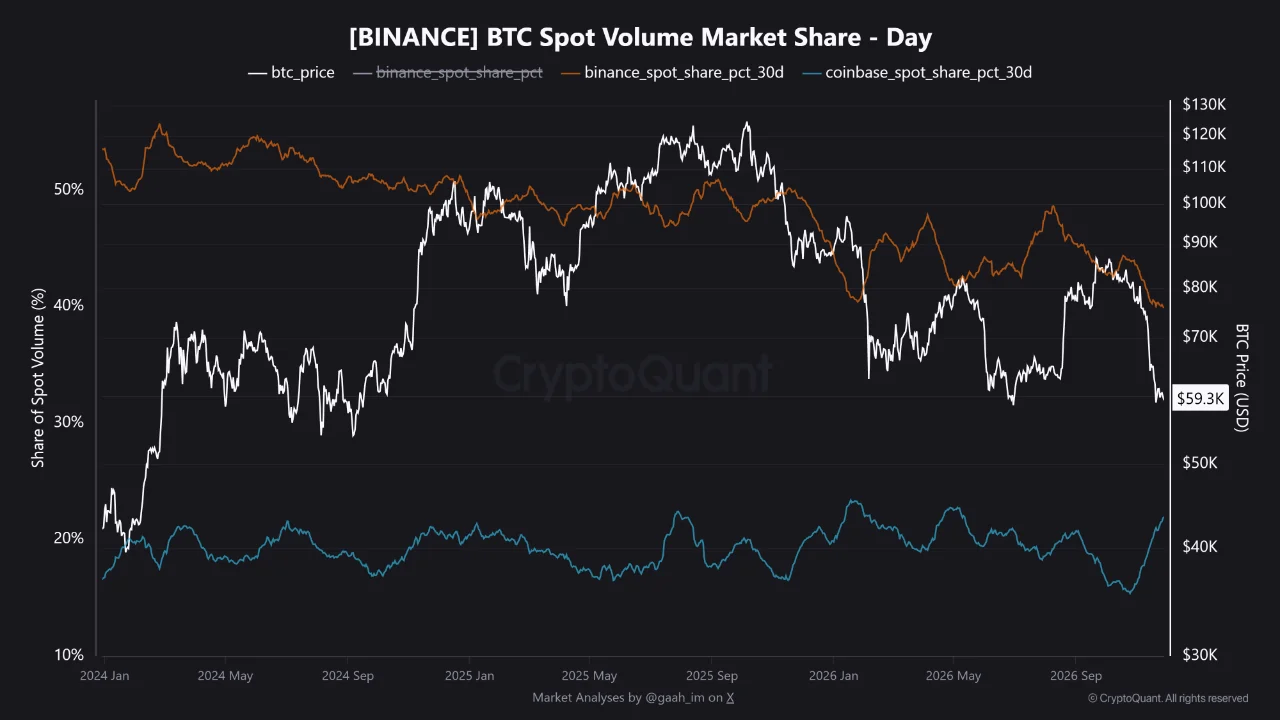
Binance and Coinbase 30-day share of BTC spot volume, with BTC price. Source: CryptoQuant, analysis by Gaah
The longer view changes how the low reads. Binance’s 30-day share has trended down since early 2024, when it sat above 50%, so November extends a two-year decline rather than starting one. Coinbase has moved within a band of roughly 16% to 23% over the same period, and its current reading sits at the top of that band rather than above it.
A share can fall for two reasons: a venue loses business, or other venues gain it faster. Gaah’s note points to the second. Binance’s spot volume did not dry up, and on Nov. 17 it still handled close to half of the tracked total.
A selloff that raised turnover almost everywhere
To check which reason holds, Coindoo pulled CryptoQuant’s daily spot data for seven venues’ main Bitcoin pairs from Oct. 30 to Nov. 28 and split the period in two. The first 14 days end on Nov. 12, when Bitcoin closed near $71,460 on Binance. The next 14 cover the slide to a Nov. 20 close near $58,950 and the days after it. Average daily dollar turnover across the seven venues rose about 39% between the two halves.
Seven-venue check: average daily BTC spot turnover
Venue
Oct. 30–Nov. 12 → Nov. 13–26
Share
Binance
$1.12B → $1.69B (+51%)
39.0% → 42.2%
Coinbase
$0.63B → $0.90B (+44%)
21.9% → 22.6%
OKX
$0.60B → $0.74B (+24%)
20.8% → 18.7%
HTX
$0.24B → $0.24B (−1%)
8.5% → 6.1%
Kraken
$0.21B → $0.31B (+49%)
7.2% → 7.7%
Bitfinex
$60M → $90M (+50%)
2.1% → 2.2%
Gemini
$15M → $18M (+23%)
0.5% → 0.5%
Pairs: BTC/USDT on Binance, OKX and HTX; BTC/USD on Coinbase, Kraken, Bitfinex and Gemini. Turnover is daily BTC volume multiplied by the daily close. Source: CryptoQuant market data; Coindoo calculations.
The crash brought more trading to almost every venue, so Coinbase did not gain ground because Binance went quiet. Within this basket, the venues that lost share in the second half were OKX and HTX, while Binance’s main pair and Coinbase both gained. Binance’s daily share even topped 50% on Nov. 17 and Nov. 26.
That fits with the six-year low rather than contradicting it. CryptoQuant’s index covers more exchanges and more trading pairs, so the levels differ, but the narrower data shows when the shift happened. Coinbase already held close to 22% of this basket in the first half of November, before Bitcoin fell from about $71,460 to $58,950. The change the 30-day index captures appears to have been largely in place by early November, in a window that also covered Binance’s hack and withdrawal suspension. The data used here starts on Oct. 30, so it cannot show whether the hack caused the move, only that the move came before the selloff’s worst days.
READ MORE:
 Bank of England Uses Binance Hack as a Security Warning
The leverage never left Binance
Futures positioning barely moved between venues. Binance’s share of Bitcoin futures open interest stayed between 34.0% and 35.3% across the 30 days, and Gaah put it at 34.6% on Nov. 28, in line with its 2026 median near 35%. Total open interest fell from about $25.9 billion to $19.7 billion, a 24% drop, and Binance’s fell by almost exactly the same proportion. Traders cut positions everywhere; they did not move them away from Binance.
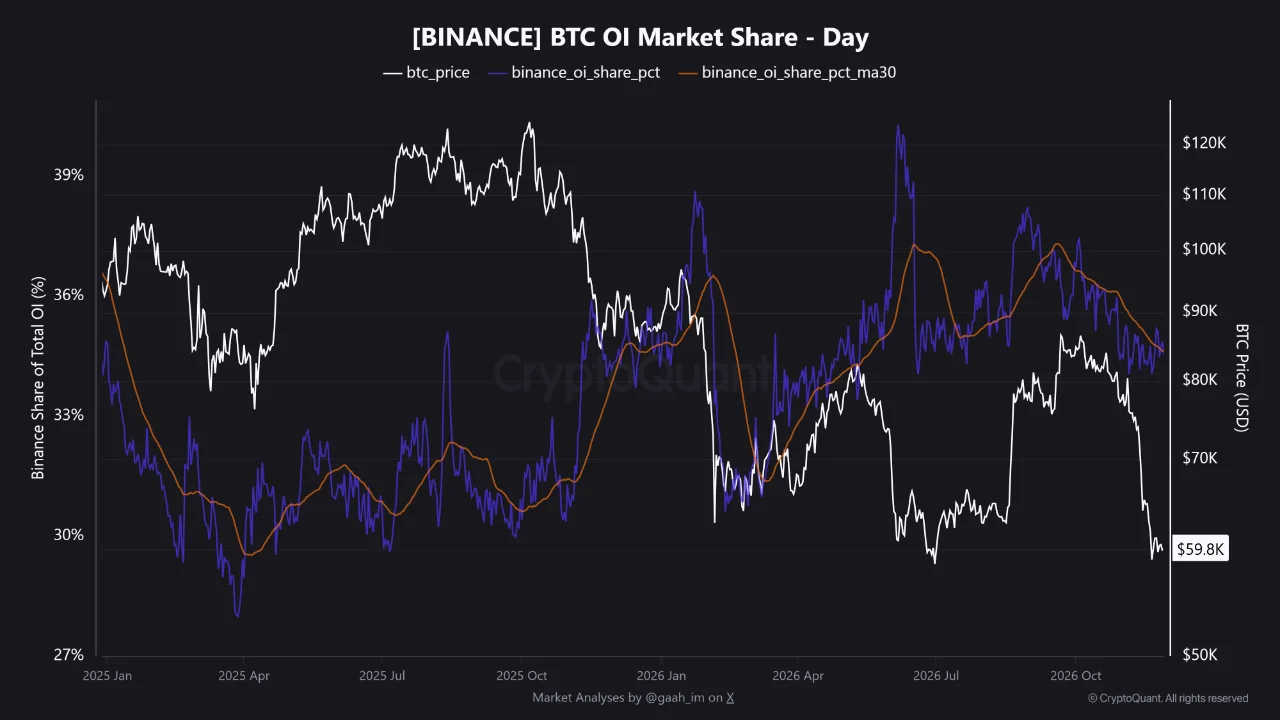
Binance’s share of BTC futures open interest, daily and 30-day average, with BTC price. Source: CryptoQuant, analysis by Gaah
The stability belongs to the selloff month, not the whole autumn. The 30-day average has eased from roughly 37% in September, so Binance’s grip on leverage loosened before November and then held steady through the crash.
Binance has also become more of a derivatives venue. CryptoQuant analyst Amr Taha calculated that Binance’s seven-day average futures volume reached 10.7 times its spot volume on Nov. 25, up from about 9 times in August, in a Nov. 29 Quicktake. Liquidity on its main contract has thinned as well: Gaah estimated in a Nov. 27 note that every $100 million of net aggressive buying or selling on Binance’s BTC/USDT perpetual now moves the price about 61 basis points, against roughly 38 on Nov. 8. Coindoo’s earlier look at Binance futures after the hack covers how that positioning held up in coin terms.
The result is a division of roles. Long-held coins and institutional flows went to Coinbase, where Bitcoin traded at a discount. Binance kept its slice of leveraged bets and the short-term spot traffic that feeds them.
What would separate a rotation from a lasting shift
Gaah’s Nov. 29 note sets out one test. If Coinbase’s share keeps rising, more of Bitcoin’s spot price discovery is happening on the U.S. side. If Binance drifts back toward 44–45% as volatility cools, the move reads as a temporary rotation tied to the selloff.
Two other readings bear on it. A Coinbase Premium Index back at or above zero would show U.S. buyers absorbing supply rather than discounting it. Older-coin deposits are the second: Yavuz Akbay wrote that if those flows drop back under 3,000 BTC a day while Bitcoin holds above its Nov. 20 close, the selling has likely been absorbed, while more days above 8,000 BTC would suggest large holders are still distributing. For now, the older coins are still choosing Coinbase, and Binance’s lower spot share reflects where that supply meets the market more than any loss of Binance’s own traders.
The post Why Old Bitcoin Is Going to Coinbase, Not Binance appeared first on Coindoo.