Most crypto assets are easy to understand at the surface level: you buy a token, hold it, and its market price moves with supply and demand. RAGE adds another layer to that model. RAGE is bac
Most crypto assets are easy to understand at the surface level: you buy a token, hold it, and its market price moves with supply and demand.
RAGE adds another layer to that model.
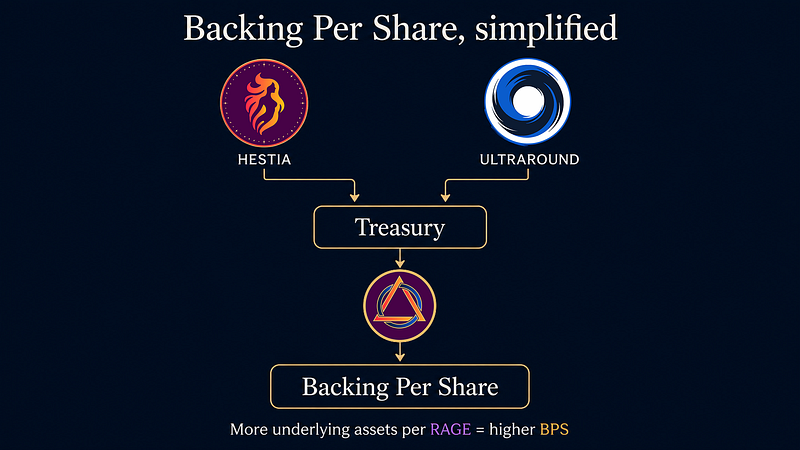
RAGE is backed by a treasury of HESTIA and ULTRAROUND. As the protocol operates, it can accumulate more of these underlying assets. Backing Per Share, or BPS, measures how much underlying treasury backing sits behind each RAGE token.
This creates a simple idea: holding RAGE gives users exposure to a treasury designed to grow through protocol activity.
What does Backing Per Share mean?
Backing Per Share measures the quantity of underlying assets backing each RAGE token.
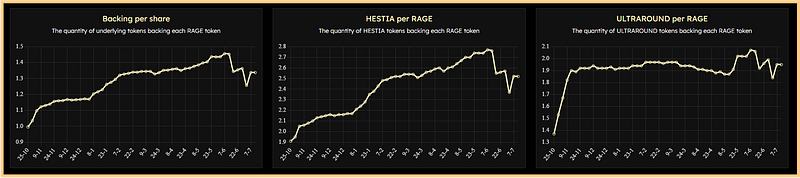
The RAGE dashboard tracks this metric alongside the amount of HESTIA and ULTRAROUND backing each RAGE. This gives holders a direct way to follow how the treasury backing evolves over time.
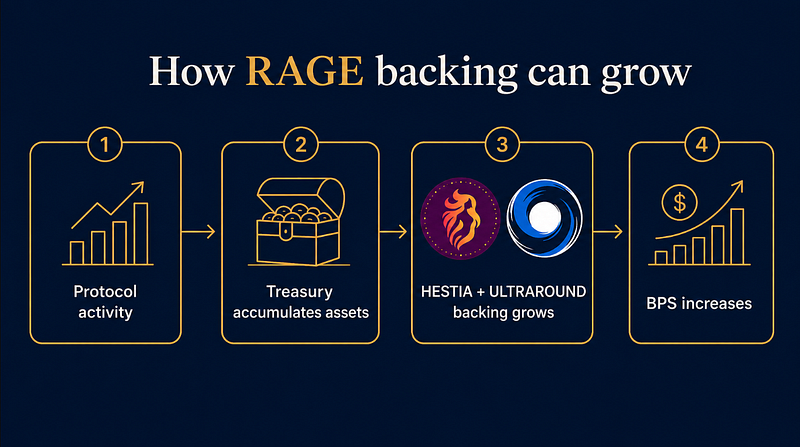
The principle is straightforward. When protocol operations add assets to the treasury, the amount of backing associated with each RAGE can increase.
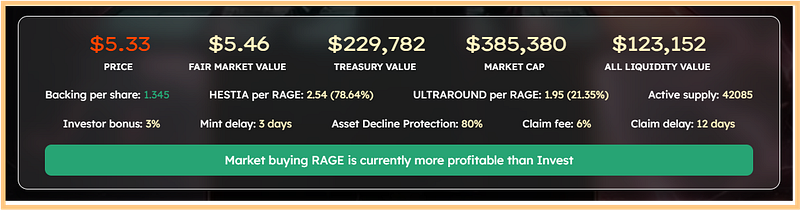
This happens at the protocol level, so holders can participate simply by holding RAGE. There is no additional staking process required to gain exposure to the underlying treasury growth.
What backs RAGE?
The RAGE treasury is built around two underlying assets: HESTIA and ULTRAROUND.
The protocol describes RAGE as a derivative token backed by a self-growing treasury of these assets. Its dashboard makes that relationship visible by tracking HESTIA per RAGE, ULTRAROUND per RAGE, treasury value, fair market value, and Backing Per Share.
Together, these metrics provide a transparent view of what sits behind each RAGE token and how that backing changes as the protocol operates.
How protocol activity can grow the backing
RAGE includes several mechanisms designed to build its underlying treasury.
Through the protocol’s Invest function, users can deposit USDC and receive exposure to RAGE through the protocol’s minting process. Protocol operations then contribute to the accumulation of the assets backing RAGE.
The protocol also includes a claim process through which RAGE can be redeemed for its underlying HESTIA and ULTRAROUND according to the configured rules.
As these mechanisms operate, the treasury and the backing associated with RAGE evolve on-chain.
This is where BPS becomes especially useful. Market price shows what traders are currently willing to pay for RAGE. Backing Per Share provides another perspective by showing the underlying asset backing associated with each token.
How URM adds another growth engine
The wider URM ecosystem introduces another source of activity that can contribute to RAGE’s treasury backing.
When demand pushes URM above its $1 target and the configured conditions are met, the Fortress can sell URM for USDC. Part of those proceeds strengthens protocol-owned URM/USDC liquidity, while another part is used to acquire reserve assets.
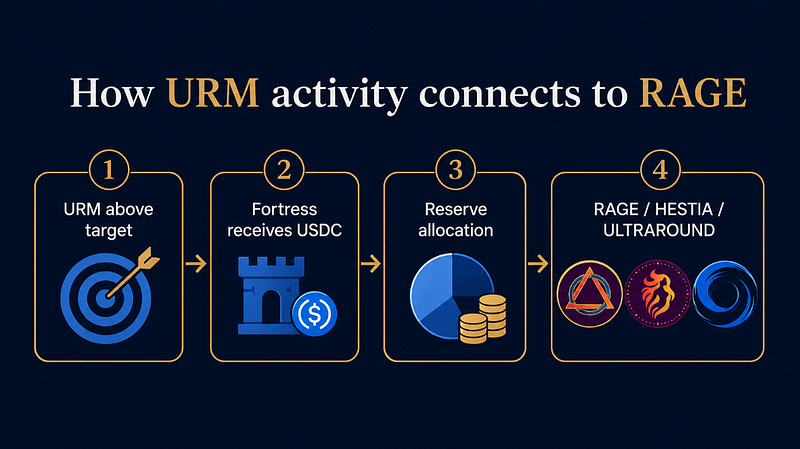
RAGE can be one of those assets.
When RAGE trades below its fair market value, the Fortress can use the reserve allocation to acquire RAGE and deposit it into the RageDepot. Through this process, above-peg demand for URM can feed additional value into the broader ecosystem and contribute to the assets associated with RAGE.
This creates a connection between stablecoin activity and RAGE treasury growth.
As URM usage expands, above-peg activity can generate additional opportunities for the Fortress to strengthen liquidity and accumulate productive reserve assets.
Why fair market value matters
RAGE also tracks a Fair Market Value, or FMV.
The protocol calculates this value from the treasury assets and active RAGE supply. It provides a reference point for evaluating RAGE relative to the assets backing it.
This reference also plays a role in the Fortress routing logic.
When RAGE trades below its fair market value, the Fortress can acquire RAGE during eligible above-peg URM operations. When RAGE trades at or above fair market value, the Fortress can direct reserve purchases toward HESTIA and ULTRAROUND.
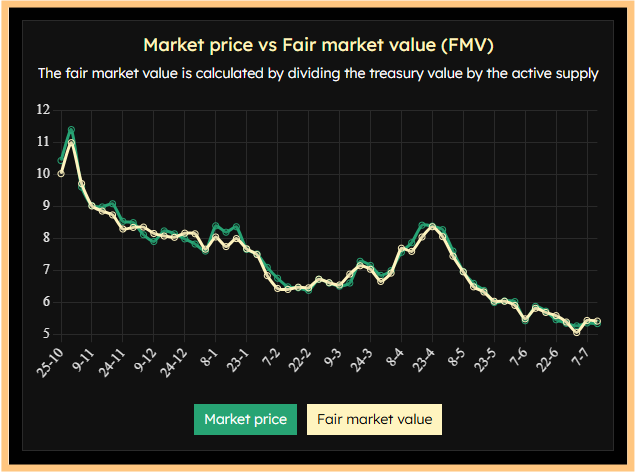
The system therefore uses market conditions to decide where new capital can be allocated across the ecosystem.
Holding RAGE keeps the experience simple
One of the most interesting parts of the RAGE model is how little the holder needs to manage.
The treasury operates through the protocol. Backing Per Share tracks the underlying assets associated with each RAGE. Protocol activity can continue adding assets over time.
A holder can simply hold RAGE and follow the evolution of BPS through the public dashboard.
That makes BPS one of the key metrics for understanding RAGE beyond short-term price movements.
Conclusion
RAGE represents exposure to more than a market price.
Each token is backed by a treasury of HESTIA and ULTRAROUND, while Backing Per Share provides a transparent measure of the underlying assets associated with each RAGE.
Protocol operations can expand that treasury over time. The wider URM ecosystem adds another potential source of activity through the Fortress and its above-peg mechanism.
Together, these mechanisms create a model where protocol activity can translate into growing underlying backing for RAGE.
For holders, the concept stays simple: hold RAGE, track Backing Per Share, and follow the treasury as the ecosystem develops.
Learn more | X | Telegram