SOL traded near $77.80, caught between those two stories: institutional adoption data that keeps setting records, and a market that has stopped believing the records matter. Key Takeaways Sol
SOL traded near $77.80, caught between those two stories: institutional adoption data that keeps setting records, and a market that has stopped believing the records matter.
Key Takeaways
- Solana processed $5.77B in tokenized asset volume in Q2, a quarterly record.
- RWA value crossed $3B; stablecoin supply on Solana passed $16B.
- Morpho arrives with $7.03B TVL and $21.2M in 30-day fees across 39 chains.
- Santiment recorded the largest negative-sentiment day since November 2025.
The Institutional Consolidation Nobody Is Pricing
The market consensus treats Solana as a retail chain having a quiet year. The adoption data describes something else. Solana closed Q2 with $5.77 billion in tokenized asset spot volume, a quarterly all-time high more than seven times the entire second half of 2025. Total RWA active cap on the network crossed $1.8 billion in early July while stablecoin supply passed $14 billion, and the network has handled roughly 97% of all cumulative on-chain tokenized equities trading.
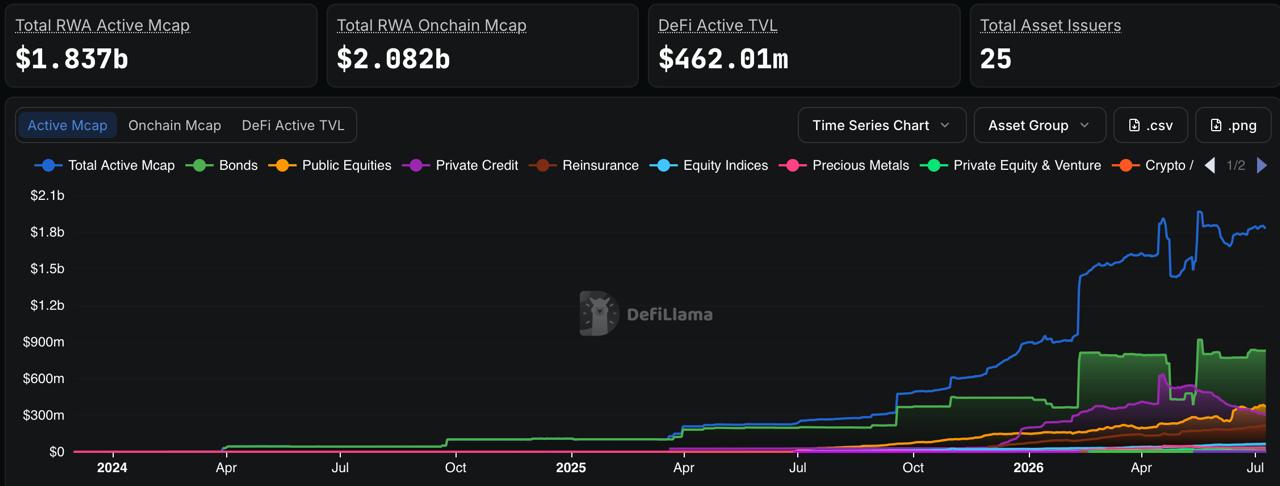
Overview of Real-World Asset (RWA) market metrics and DeFi TVL trends as of July 2026.
The bank roster behind those numbers is the part that would have sounded implausible two years ago. Nick Ducoff, Head of Institutional Growth at the Solana Foundation, counts seven of the 29 global systemically important banks building on the network, naming Morgan Stanley, JPMorgan, Citi, BNY, Societe Generale, and Standard Chartered, and argues “there’s like real consolidation happening around Solana.”
His framing is deliberately not maximalist: institutions can build multi-chain, as long as Solana is in the mix. The data suggests it increasingly is, and BlackRock’s $615 million BUIDL position on the network is the anchor example of regulated capital treating the chain as production infrastructure.
The uncomfortable explanation for why none of this has moved the price could be that it does not have to. Institutions using Solana pay network fees that are deliberately tiny, so record tokenized volume translates into only marginal direct demand for SOL itself. Adoption strengthens the long-term case through fee growth, staking demand, and the network’s claim on future flows, but it transmits to the token slowly, and the market is under no obligation to front-run it. The Q2 records are real. The mechanism that converts them into price is thin, and that gap is where both the bulls and the bears currently live.
What Morpho Actually Adds
Morpho is a lending network: a shared piece of infrastructure where lenders deposit assets into vaults that optimize their yield, and borrowers take loans directly from isolated markets.
Isolated is the key design word. Each lending market on Morpho is walled off from the others, so a bad asset in one market cannot poison the collateral of another, which is what allows higher loan-to-value ratios than pooled-risk systems. The contracts are immutable, meaning nobody, including Morpho’s own governance, can change the rules under an open position.
The protocol arrives on Solana at scale, not as an experiment. Morpho holds $7.03 billion in total value locked, ranking third among all DeFi protocols behind only Lido and Aave, according to DefiLlama data.
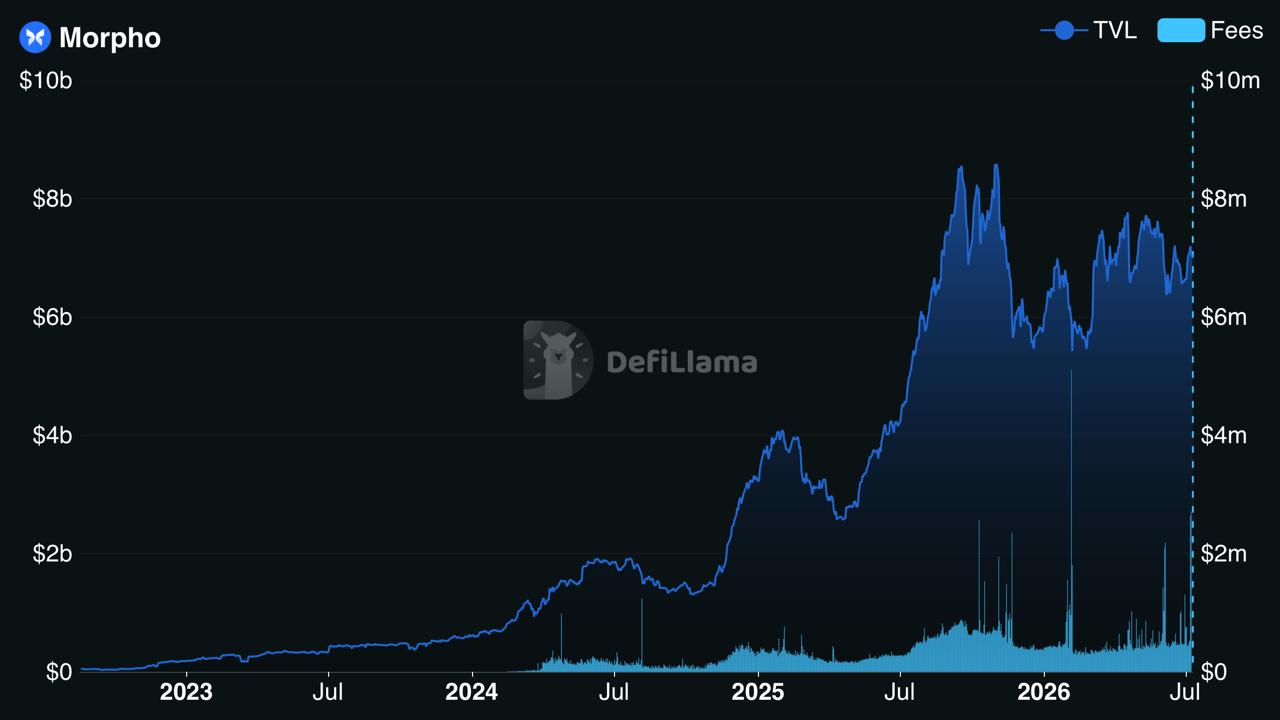
Historical performance chart for the Morpho protocol, displaying trends in Total Value Locked and fees over time.
It generated $21.2 million in fees over the past 30 days, its TVL grew 7.31% over the past month, faster than either protocol above it, and Solana becomes its 39th chain. One detail in that data set explains the institutional appeal: Morpho’s 30-day protocol revenue is zero. Every dollar of fee flow goes to lenders and vault curators rather than being skimmed by the protocol, which is precisely the fee structure a treasury desk comparing venues will notice.
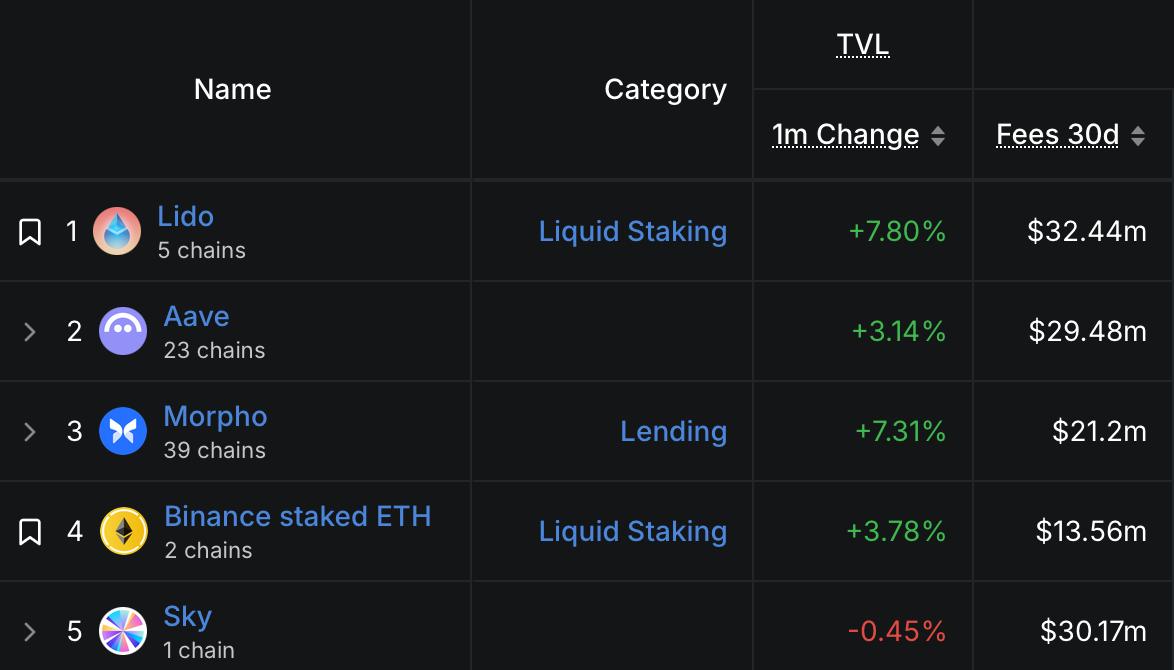
Top 5 DeFi protocols ranked by various performance metrics including TVL change and 30-day fees.
On Solana, that plugs a specific gap. The network now holds $16 billion in stablecoins and $3 billion in tokenized assets, but its lending infrastructure has lagged the asset growth; capital arrived faster than the places to put it to work. Morpho’s model turns idle stablecoins into lending liquidity and, more importantly, gives tokenized treasuries, equities, and credit products a venue to serve as collateral. An institution holding tokenized T-bills on Solana can now borrow against them instead of just holding them. That is the difference between assets sitting on a chain and a functioning capital market, and it is exactly the layer the RWA growth needed next.
The deployment history also carries a signal. Morpho’s TVL sat below $2 billion in mid-2024 before institutions began routing through it, including the infrastructure behind Coinbase’s on-chain lending products, and it peaked above $8.5 billion in late 2025. Chains where it deploys tend to see lending activity consolidate around it. Whether Solana follows that pattern is now a measurable question rather than a pitch.
Rejected at the 100-Day, Holding Above the 50
The daily chart is a clean picture of a market that ran into its first real test and blinked. SOL rallied from the $68 area in late June to $82.50 by July 3, reclaiming the 50-day moving average at $74.87 and pushing through the 100-day at $80.44. It could not hold the level. Four sessions of stalling under $82.50 ended with a heavy red candle on July 8 that closed back below the 100-day, with a wick to $76.30.
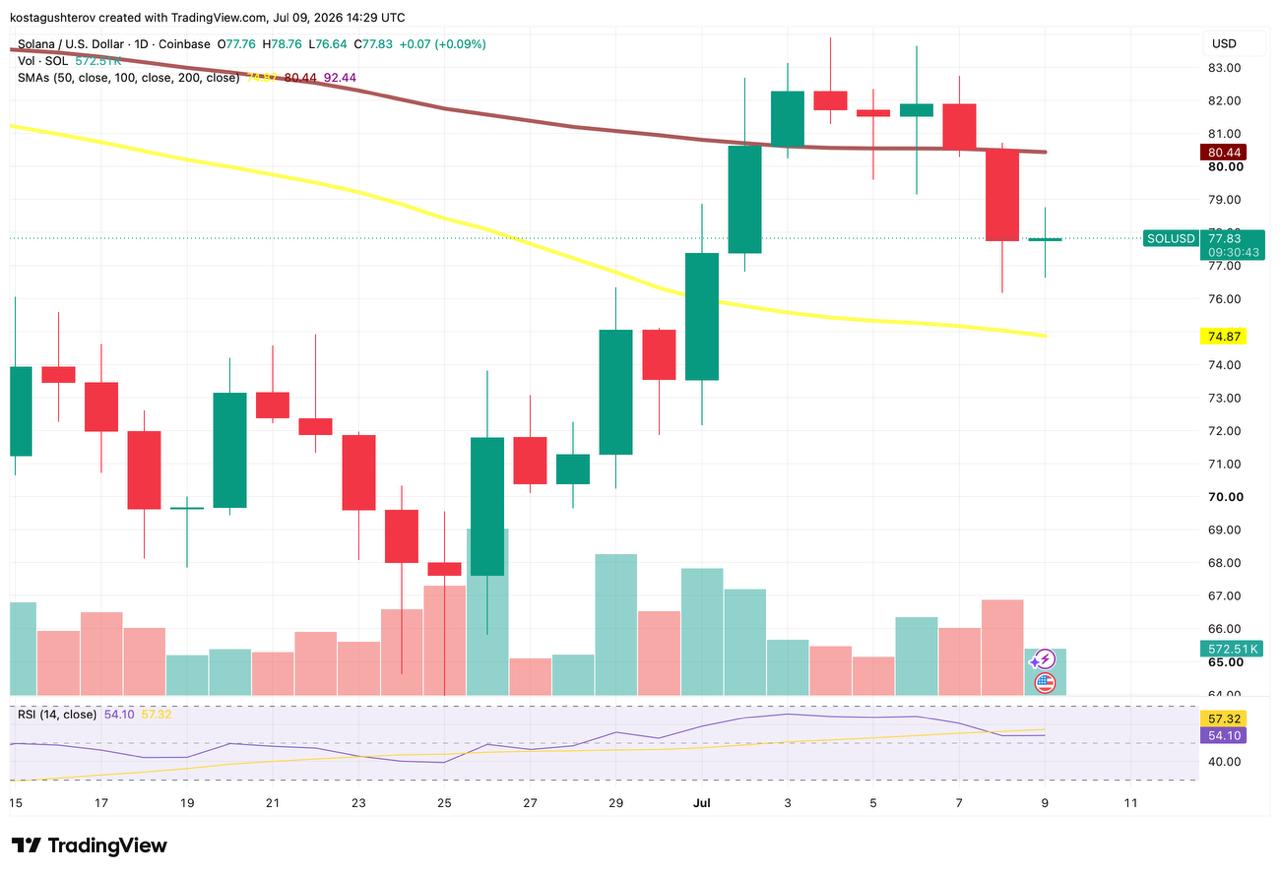
Daily technical chart for SOL/USD, providing a snapshot of current price trends, moving averages, and market indicators.
That leaves the map simple. Resistance is the failed zone: $80.44 at the 100-day average, then the $82.50 July high. Support is the rising 50-day at $74.87, which has not been retested since it was reclaimed; below it, the late-June breakout shelf near $72, and the June low at $63 as the structural floor. The 200-day at $92.44 slopes down far overhead and marks where this stops being a range trade and becomes a trend change. Daily RSI at 54 sits just under its own average, momentum neutral, leaning neither way. A close above $80.44 puts $82.50 and then the high-$80s gap in play; losing $74.87 sends the price back into the June congestion.
READ MORE:
 GRAM at $1.6: Why the Hype Faded and Reality Took Over
Peak FUD Is the Risk and the Setup
On the other side of the institutional story is that the market has heard it all year and refused to pay for it. Santiment data shows SOL trading volume at its lowest level of 2026 while negative social commentary just spiked to its highest single day since November 2025. The frustration is specific: Solana has led on tokenized stocks and RWA narratives for months, and holders have watched the price go nowhere. Narrative fatigue is real, and record adoption metrics do not force a repricing on any schedule.
Santiment’s own read cuts the other way. The firm notes that thin volume plus extreme negativity historically means less retail resistance if large holders push, describing SOL as sitting in a “low-attention, high-FUD zone where sharp moves can happen quickly.” Sentiment extremes are contrarian signals precisely because they mark the point where sellers exhaust themselves. But the signal is symmetric in one respect: it identifies stored energy, not direction, and a chart that just failed at its 100-day average has not yet earned the bullish resolution.
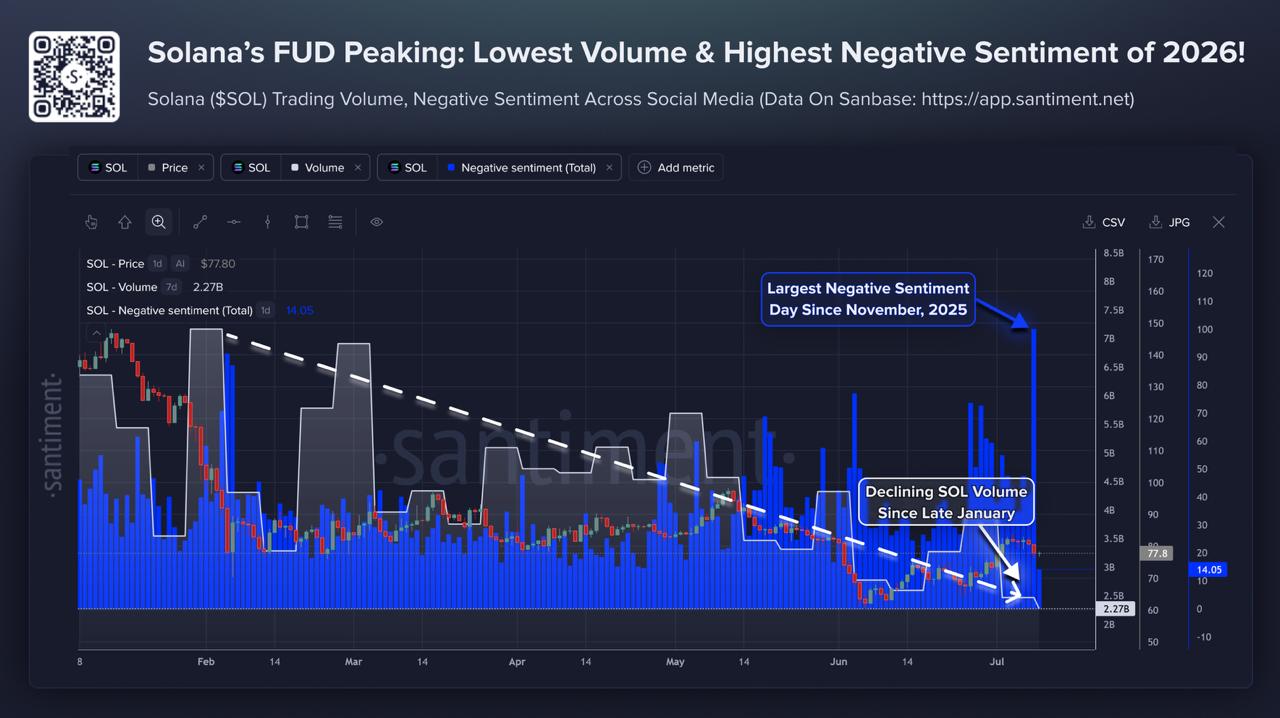
SOL market analysis dashboard highlighting declining trading volume and a recent peak in negative social sentiment.
The technical reality suggests the next move is a fight between positioning and fundamentals with an unusually clear tripwire. Above $80.44, the record Q2 data, the Morpho deployment, and the crowded-short sentiment all start working in the same direction. Below $74.87, the institutions are still building, but the market keeps not caring, and $72 comes first. What the adoption data has already settled is the longer question: the banks stopped debating whether Solana is infrastructure. The price is still deciding what that is worth.
The information provided in this article is for educational and informational purposes only and does not constitute financial, investment, or trading advice. Cryptocurrency markets are volatile and involve substantial risk. Readers should conduct their own research and consult with a qualified financial advisor before making any investment decisions.
The post Why Record Solana Adoption Fails to Lift SOL From $78 appeared first on Coindoo.