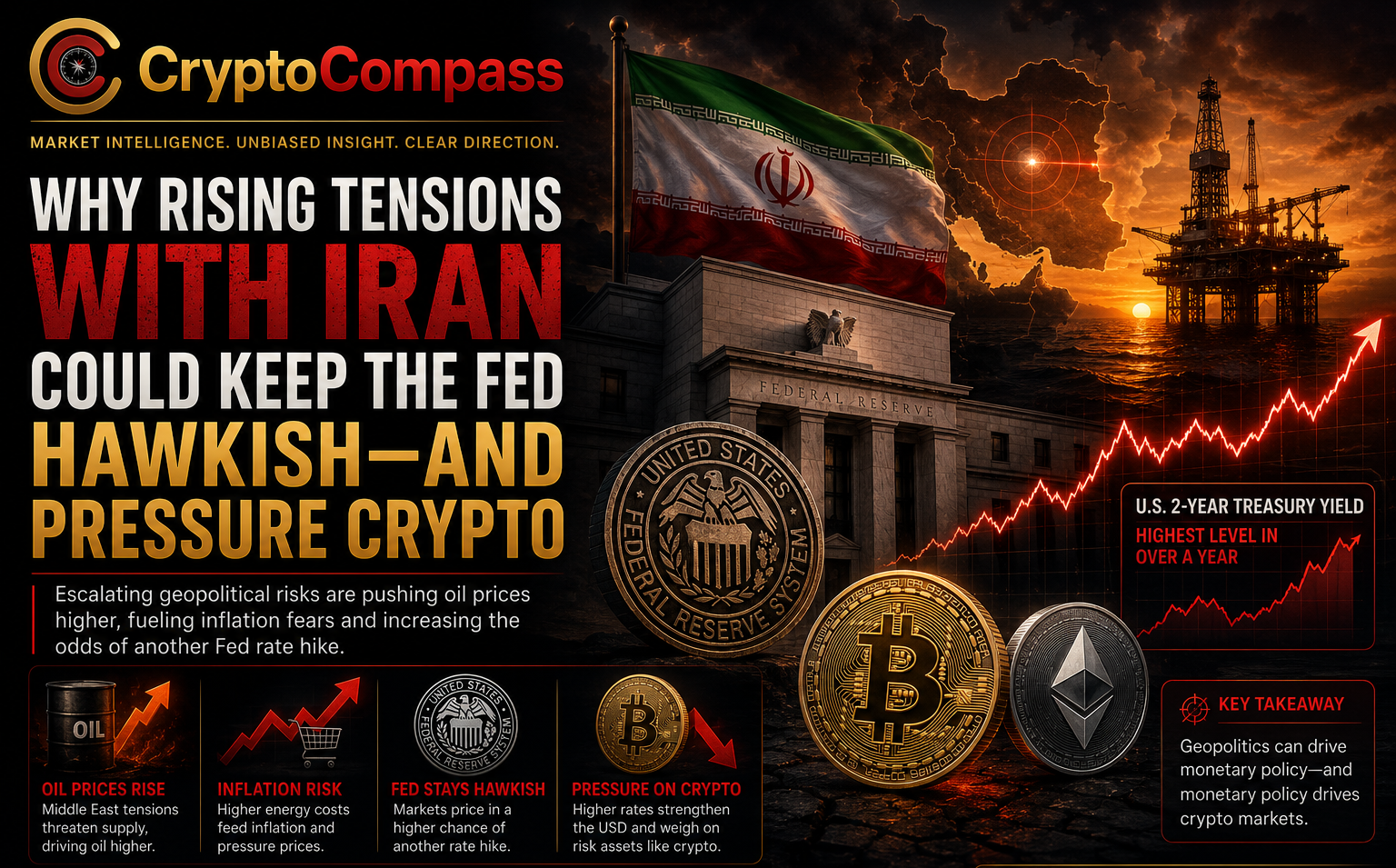
Escalating Iran tensions are pushing oil prices higher, fueling inflation fears and raising expectations that the Federal Reserve could keep interest rates higher for longer.
Geopolitical crises rarely stay confined to politics. For financial markets, they often ripple through commodities, inflation, central bank policy, and ultimately the valuation of risk assets. This week, escalating tensions involving Iran have become the latest reminder that crypto investors cannot ignore macroeconomics.
While Bitcoin and the broader digital asset market remain fundamentally driven by institutional adoption and on-chain activity, the short-term outlook is increasingly being shaped by one question:
Will geopolitical tensions force the Federal Reserve to keep interest rates higher for longer?
Oil Is Once Again Driving the Macro Narrative
The recent escalation in the Middle East has reignited concerns over global energy supplies. Iran's strategic position around the Strait of Hormuz—one of the world's most important oil shipping routes—means that any disruption immediately raises fears of tighter crude supplies and higher energy prices.
Oil is more than just another commodity.
It is one of the largest inputs into global inflation.
When crude prices rise sharply, transportation costs, manufacturing expenses and consumer prices tend to follow, making inflation more persistent than central banks would like.
For the Federal Reserve, this creates a difficult dilemma.
Even if economic growth begins to slow, renewed inflationary pressure could delay interest-rate cuts—or in a more aggressive scenario, even reopen discussions about additional tightening.
Bond Markets Are Already Pricing a More Hawkish Fed
Financial markets have reacted quickly.
The U.S. two-year Treasury yield, widely considered the bond market's best indicator of future Federal Reserve policy, has climbed to its highest level in more than a year.
Interest-rate swap markets have also dramatically shifted expectations.
Just a week ago, markets assigned roughly a 66% probability of another Federal Reserve rate increase later this year.
That probability has now moved close to being fully priced in.
Whether another hike actually happens is less important than what markets believe today.
Asset prices move on expectations—not announcements.
Why Higher Interest Rates Hurt Crypto
Cryptocurrencies are among the world's highest-risk financial assets.
When interest rates rise, investors suddenly have attractive low-risk alternatives.
Government bonds begin offering higher yields with virtually no default risk.
Money market funds become increasingly attractive.
Cash itself generates meaningful returns.
As a result, institutional investors often reduce allocations to speculative assets—including cryptocurrencies—in favor of safer income-producing investments.
This relationship has repeatedly appeared throughout previous Federal Reserve tightening cycles.
Higher yields strengthen the U.S. dollar, tighten global liquidity and reduce risk appetite—all of which historically create headwinds for Bitcoin and the broader crypto market.
The Market Is Already Showing Signs of Caution
The impact is becoming visible across digital assets.
Over the past 24 hours, total cryptocurrency market capitalization declined approximately 1.1%, while Bitcoin traded around $63,100.
Most crypto sectors recorded modest losses.
Interestingly, defensive narratives showed greater resilience.
The Real World Assets (RWA) sector continues to attract institutional attention, while speculative sectors such as meme coins remain under pressure.
This divergence reflects a broader market rotation rather than indiscriminate selling.
Capital is becoming increasingly selective.
Institutions Are Sending Mixed Signals
Despite macro uncertainty, not every institutional indicator is negative.
U.S. spot Bitcoin ETFs recently ended an eight-week streak of net outflows, recording approximately $197 million in weekly net inflows.
Spot Ethereum ETFs also returned to positive territory.
These inflows suggest that long-term institutional investors are beginning to accumulate exposure again.
However, macroeconomic uncertainty continues to limit aggressive positioning.
Large investors appear willing to buy—but cautiously.
Why Crypto Investors Should Watch Oil More Than Ever
Many crypto traders focus almost exclusively on Bitcoin price action.
But the next major market move may not begin on a crypto exchange.
It could begin in the oil market.
If energy prices continue climbing, inflation expectations may remain elevated.
That would increase pressure on the Federal Reserve to maintain restrictive monetary policy.
Higher interest rates would likely tighten financial conditions, reducing liquidity available for speculative assets.
Conversely, if geopolitical tensions ease and oil prices stabilize, markets could quickly revive expectations for future rate cuts—providing a more supportive backdrop for cryptocurrencies.
What CryptoCompass Is Watching
Over the coming weeks, several indicators deserve close attention:
Brent and WTI crude oil prices.
The U.S. 2-year Treasury yield.
Federal Reserve commentary and FOMC communications.
CPI and PCE inflation reports.
Interest-rate futures and swap market expectations.
Capital flows into Bitcoin and Ethereum spot ETFs.
Together, these indicators will offer the clearest picture of whether macro headwinds are intensifying or beginning to fade.
Outlook
Bitcoin's long-term investment thesis remains increasingly tied to institutional adoption, ETF growth and digital asset infrastructure. Yet in the short term, macroeconomics continues to dominate market direction.
The latest escalation involving Iran is not simply another geopolitical headline—it has the potential to reshape inflation expectations, influence Federal Reserve policy and determine global liquidity conditions over the months ahead.
For crypto investors, understanding this chain reaction may prove just as important as analyzing on-chain metrics or technical charts.
Oil → Inflation → Federal Reserve → Liquidity → Crypto.
That sequence could become the defining market narrative of the next quarter.
Disclaimer: This article is for informational purposes only and does not constitute investment advice.