When you swap one token for another, the most obvious route is usually the direct one. Token A goes into a pool. Token B comes out. Simple. But decentralized liquidity rarely works that neatl
When you swap one token for another, the most obvious route is usually the direct one.
Token A goes into a pool. Token B comes out.
Simple.
But decentralized liquidity rarely works that neatly.
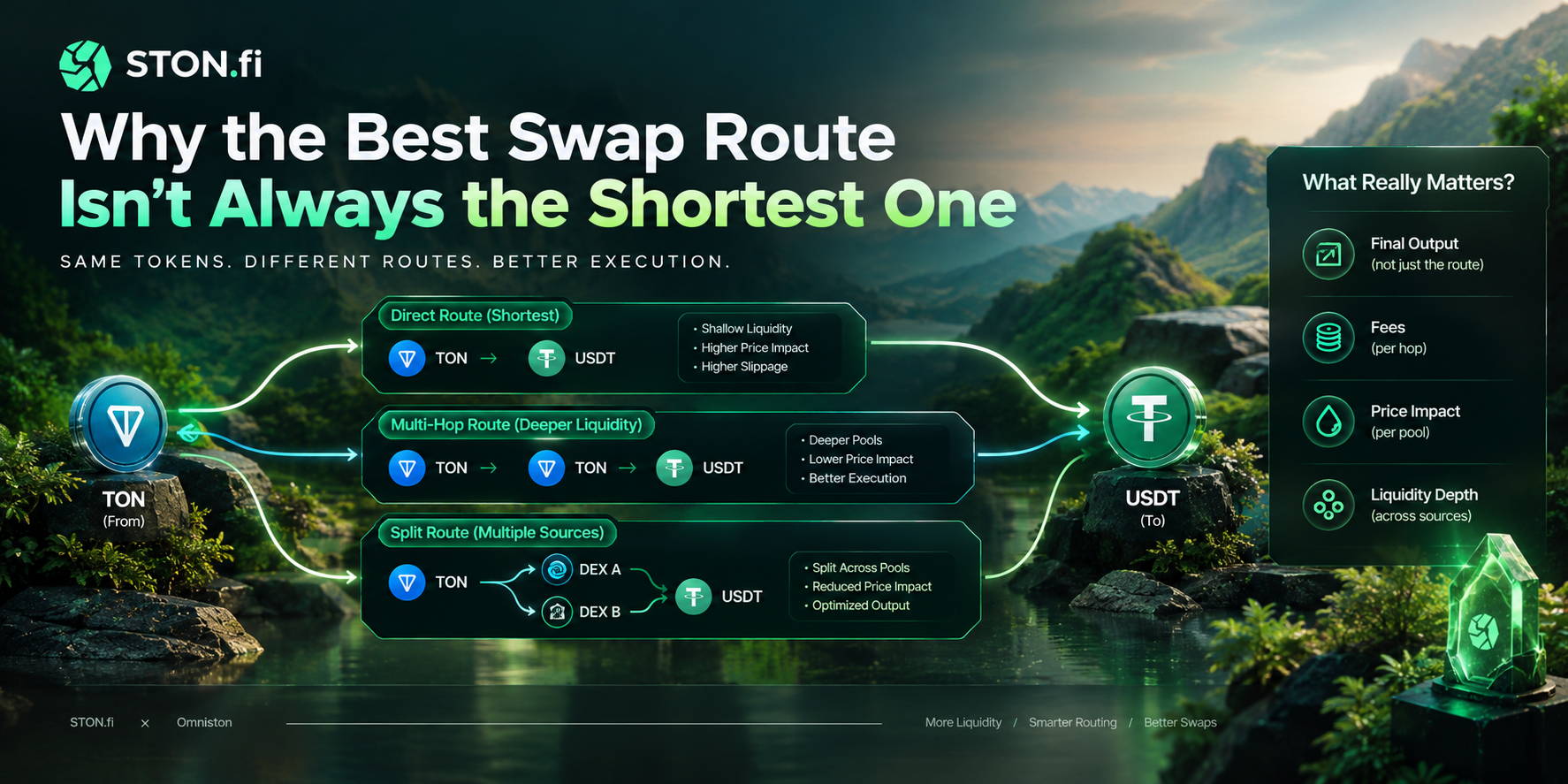
The liquidity you need can be spread across different pools and different protocols, with each source having its own depth and pricing. Once the trade becomes large enough, or the direct pool is relatively thin, the shortest route can stop being the most efficient one.
That is where aggregation becomes interesting.
On STON.fi, Omniston can compare liquidity across connected sources and construct routes that may look unnecessarily complicated at first glance, but can make more sense once you consider liquidity depth, price impact, fees, and the actual output of the trade. STON.fi has described Omniston as a liquidity aggregation layer that brings multiple TON liquidity sources together rather than relying on one pool.
Imagine you want to swap Token A for Token B.
There is a direct A/B pool, so naturally that looks like the obvious choice.
But now imagine that pool is relatively shallow.
Your trade might start at an attractive price, but as more of your order moves through the pool, the pool's pricing curve moves against you. The larger your trade is relative to available liquidity, the more important that effect becomes.
Meanwhile, there might be another route:
A → TON → B
That route has an extra step, but both intermediate pools could have substantially more liquidity.
So the real question isn't:
"Which route has fewer hops?"
It's:
"Which route gives the best overall execution after the route's costs and price impact are considered?"
That is a very different problem.
This is the underlying reason aggregation exists.
A decentralized ecosystem doesn't have one giant pool containing all available liquidity.
Different protocols can have different pools for the same assets. Some may have deeper reserves, some may have more activity, and some may offer better conditions for a particular trade size.
STON.fi has integrated additional TON liquidity sources into Omniston, including Swap.coffee and Tonco, allowing their liquidity to compete alongside other connected sources.
From a trader's perspective, that changes the problem.
Without aggregation, you might check one DEX, see a price, and stop there.
With aggregation, the system can consider a much wider liquidity landscape before producing the route you actually execute.
The important part is that the best visible price on one pool isn't necessarily the best price for your entire order.
This is one of the more interesting parts of routing.
Suppose one pool looks like the best option for the first portion of your trade.
You don't necessarily want to send the entire order through that same pool.
Why?
Because the pool's conditions change as your trade consumes liquidity.
A large order can therefore be divided across multiple liquidity sources instead of forcing the entire amount through one curve.
Think of it like filling a large order from several available shelves instead of taking everything from the first shelf.
The first portion might get a very good rate.
As more of the order moves through that source, the effective price can become less attractive.
At that point, another pool may offer a better marginal execution for the remaining amount.
The result can be a split route where different portions of the same swap use different liquidity sources.
That sounds more complicated.
But complexity isn't necessarily the objective.
Execution is.

Now consider a different situation.
You want to swap Token A directly into Token B.
The A/B pool exists, but it doesn't have much liquidity.
There may also be deep A/TON and TON/B markets.
A routing system can evaluate whether:
A → B
or
A → TON → B
produces the better result.
The second route has an additional swap, which means additional costs can exist.
But if the direct pool creates significantly more price impact, routing through deeper markets can potentially produce better overall execution even after those additional costs.
This is why a route should not be judged by its visual simplicity.
A one-hop route is simpler.
That doesn't automatically make it more efficient.
Omniston takes the aggregation idea further than simply checking one STON.fi pool.
Its purpose is to connect different liquidity sources and allow routes to compete for a swap. STON.fi describes Omniston as a decentralized liquidity aggregation protocol, and current integrations include multiple TON DEX liquidity sources.
More recently, Omniston has also expanded beyond traditional AMM routing by adding escrow swaps as another execution layer. That means the system can evaluate different execution mechanisms rather than treating every swap as a simple journey through public AMM pools.
For the user, this can remain invisible.
You still see a swap interface.
Underneath it, however, the system can be dealing with a much larger execution problem.

Imagine you want to swap a large amount of Token X into USDT.
There are three possible options:
Route 1: X → USDTA direct pool with moderate liquidity.
Route 2: X → TON → USDTTwo deeper pools with more available liquidity.
Route 3: Split between both routes.
A human looking at the interface might immediately choose Route 1 because it is direct.
But if the X/USDT pool is shallow, pushing the entire order through it could create substantial price impact.
Route 2 could reduce that impact by using deeper markets.
And Route 3 could potentially combine the useful liquidity available on both paths.
The correct route therefore depends on the actual trade size and current liquidity conditions.
The point isn't that Route 3 is always better.
It isn't.
The point is that you cannot know which route is better simply by counting the hops.
There is an important trade-off here.
Every additional step can introduce additional costs and another execution point that has to be accounted for.
A route isn't automatically better because it contains more liquidity sources.
The routing process still has to consider the total outcome.
That's why the useful number to focus on is not:
"How clever does this route look?"
It's:
"What am I actually receiving after the route is executed?"
A complicated route that produces a worse final result isn't useful just because the algorithm found it.
Likewise, a three-hop route shouldn't be rejected simply because it looks complicated if it produces better execution for the particular trade.
You don't need to manually reconstruct every route Omniston considers.
That would defeat the purpose of aggregation.
Instead, focus on the information that actually affects your decision.
Check the expected output.
Look at the fees and execution conditions shown by the interface.
Consider whether the trade is large relative to the available liquidity.
And most importantly, don't assume that the shortest route must be the best route.
For larger or less liquid swaps, routing can matter much more because price impact becomes more significant.
The route itself is useful information, but the result of the route is what ultimately matters.
Fragmented liquidity creates a problem that isn't solved simply by having more pools.
More pools also mean more places where liquidity can be distributed.
That creates an optimization problem.
Which source should be used?
Should the trade be split?
Is a direct route actually cheaper after price impact?
Could an intermediate asset provide deeper liquidity?
Could another execution mechanism produce a better result?
These are questions that become increasingly difficult to answer manually as the number of liquidity sources grows.
That is the role aggregation is trying to solve.
Omniston's value isn't that every route will look simple.
It's almost the opposite.
The complexity can stay underneath the interface while the user sees one swap and one execution result.
The first time you see a swap travel through several pools, it can look like the system is taking the long way around.
But routing isn't a navigation problem where the shortest path automatically wins.
It's an execution problem.
The best route depends on where the liquidity is, how much you're trying to trade, how much price impact each path creates, and what the complete route delivers after its costs.
That is why the strange-looking route can sometimes make more sense than the obvious one.
The route is only the path. The final execution is what you're actually trading for.
Omniston Protocol Overview
Omniston now powers every swap on STON.fi
Swap.coffee integrated into Omniston
Escrow swaps: a new execution layer inside Omniston
STON.fi Swap App