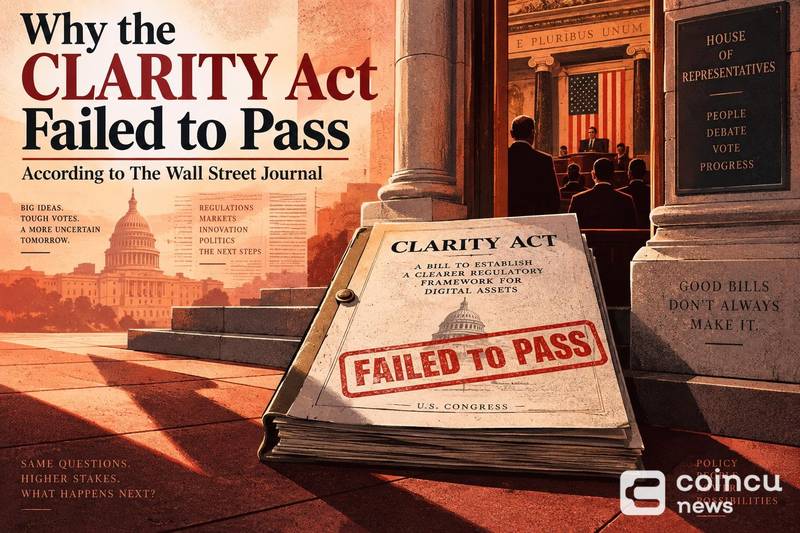
The CLARITY Act failed to advance in the Senate after a cloture vote to end debate did not succeed, according to reporting by The Wall Street Journal, leaving the U.S. digital-asset market-st
The CLARITY Act failed to advance in the Senate after a cloture vote to end debate did not succeed, according to reporting by The Wall Street Journal, leaving the U.S. digital-asset market-structure framework unresolved and major crypto industry stakeholders without the regulatory clarity they sought from Congress.
What the CLARITY Act Was Meant to Address
The CLARITY Act, introduced in the 119th Congress as H.R. 3633, was designed to establish a statutory framework delineating when a digital asset should be regulated as a commodity versus a security, a boundary dispute that has generated years of litigation and enforcement uncertainty between the SEC and the CFTC. The bill represented one of the most substantive attempts by Congress to draw clear jurisdictional lines for the crypto market. For related coverage, see CLARITY Act Procedural Vote Scheduled for September 15.
The legislation's failure carries direct consequences for exchanges, token issuers, and institutional participants who have been operating under regulatory ambiguity while awaiting a congressional answer to questions courts and agencies have been unable to settle definitively. For related coverage, see Clarity Act Vote Slips to September: What to Watch.
Why the CLARITY Act Failed to Pass, According to The Wall Street Journal
The Wall Street Journal identified the Senate's failure to reach cloture as the proximate cause of the bill's collapse. A Senate vote to end debate on the CLARITY Act failed, denying the bill the supermajority threshold required to proceed to a final floor vote. Without cloture, the bill could not advance despite having passed the House.
The timeline leading to this outcome had already been strained. The Senate had declined to schedule a vote before the summer recess, pushing the window to September, when a procedural vote was scheduled for September 15 in what became the bill's final legislative test.
Political and Stakeholder Disagreements
Per WSJ's account, the bill's failure reflected unresolved disagreements over the scope of commodity versus securities jurisdiction, consumer protection provisions, and the degree to which DeFi protocols should be captured under the framework. Those fault lines made assembling a 60-vote Senate coalition structurally difficult, as members skeptical of lighter-touch crypto oversight withheld support while industry-aligned senators could not bridge the gap.
The Issues That Kept the Bill From Moving Forward
Policy Disagreements vs. Legislative Timing
The bill's slow path through the Senate, slipping from earlier target windows to September, reflected both calendar pressure and substantive impasse. The September deadline compressed any remaining room for amendment negotiation, and the cloture failure suggests the compromise language in the bill as written did not satisfy enough swing-vote senators to overcome the procedural hurdle.
Coinbase, one of the most vocal industry advocates for the legislation, had publicly warned that a failure to pass the CLARITY Act could accelerate its offshore expansion, with the CEO stating the company may expand overseas if the bill did not succeed, framing the stakes in terms of U.S. competitiveness rather than regulatory preference alone.
What the Setback Could Mean for U.S. Crypto Policy
What Remains Unresolved
With the CLARITY Act exhausting its legislative runway in the 119th Congress, the SEC-CFTC jurisdictional conflict over digital assets returns to courts and agency rulemaking, neither of which can produce the statutory certainty the bill was designed to deliver. Token issuers and trading platforms remain exposed to the same enforcement-first regulatory posture that preceded the bill's introduction.
The immediate question for market participants is whether the 120th Congress will reintroduce comparable legislation, and whether the cloture failure will prompt sponsors to seek a narrower scope that can attract bipartisan support, or whether a broader political realignment would be required first. Those variables make the timeline for a statutory resolution genuinely unclear as of September 2026.
FAQ: Why Did the CLARITY Act Fail to Pass?
What Does The Wall Street Journal Identify as the Reason the CLARITY Act Failed to Pass?
The Wall Street Journal reported that the CLARITY Act failed after the Senate could not reach the 60-vote cloture threshold needed to end debate and proceed to a final vote, with disagreements over jurisdictional scope and consumer protection provisions preventing the bipartisan coalition needed for passage.
Does the Bill's Failure End U.S. Crypto Regulation Efforts?
No. The CLARITY Act's failure does not foreclose future legislation, but it does return the regulatory question to agency enforcement and litigation for the remainder of this Congress. Any renewed legislative effort would need to address the substantive disagreements that blocked cloture.
What Should Crypto Market Participants Watch Next?
Participants should monitor whether Senate sponsors formally withdraw the bill or pursue a revised version before the 119th Congress concludes, and whether the SEC or CFTC signal any shift in enforcement posture in the absence of a statutory mandate. Congressional reintroduction in the 120th Congress is the next concrete legislative trigger to watch.
Additional source references: source document 1.
Disclaimer: This article is for informational purposes only and does not constitute financial or investment advice. Cryptocurrency and digital asset markets carry significant risk. Always do your own research before making decisions.
The post Why the CLARITY Act Failed to Pass, According to The Wall Street Journal was initially published on Coincu.