Key Takeaways According to Lynx Equity, Nvidia represents a superior investment opportunity compared to investing directly in SpaceX post-IPO Terafab expansion and xAI’s growing AI infrastruc
Key Takeaways
- According to Lynx Equity, Nvidia represents a superior investment opportunity compared to investing directly in SpaceX post-IPO
- Terafab expansion and xAI’s growing AI infrastructure needs are expected to boost Nvidia chip demand significantly
- A three-year GPU leasing agreement between xAI and Google involves approximately 110,000 Nvidia processors
- Storage and memory sector players including Micron, Western Digital, and Seagate identified as indirect beneficiaries
- Lynx Equity establishes $250 target for Nvidia; Street consensus stands at $311.41 average target
The unexpected winner from SpaceX’s market debut might just be Nvidia (NVDA) — despite never going through an IPO process itself. This surprising perspective comes from Lynx Equity, which released research Monday suggesting that investors seeking exposure to SpaceX’s growth story should look at Nvidia instead.
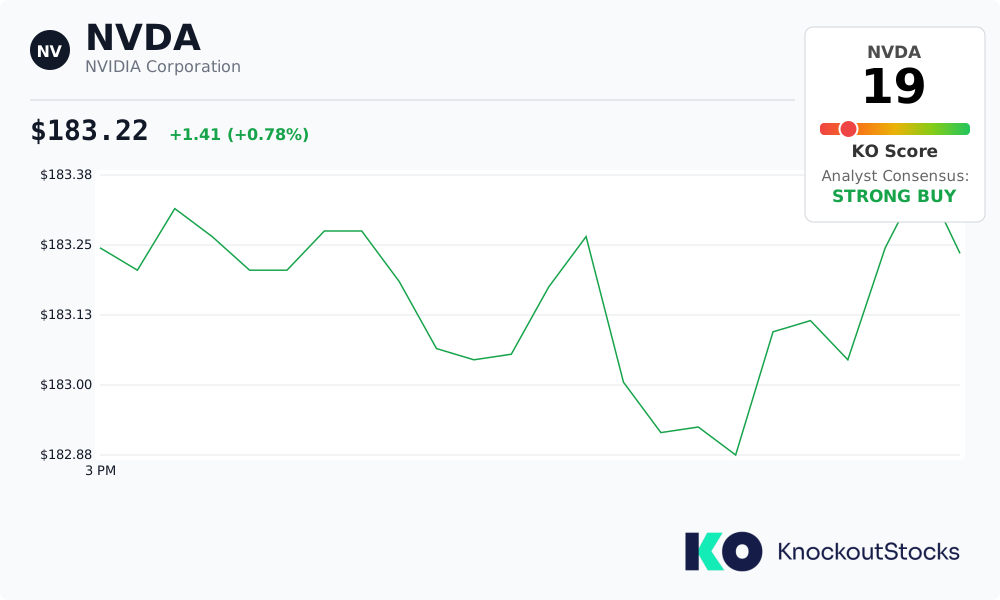 NVIDIA Corporation, NVDA
Following SpaceX’s Nasdaq listing last week, which generated significant investor interest, Lynx Equity is directing attention toward an alternative investment avenue.
Nvidia currently trades near $204, representing substantial room for growth based on Lynx’s $250 target price. The research firm emphasizes that Nvidia’s valuation metrics are more attractive than SpaceX’s, while its growth trajectory appears “considerably more tangible.”
The centerpiece of this investment thesis revolves around xAI. Lynx contends that SpaceX’s market valuation has become increasingly linked to Elon Musk’s artificial intelligence venture, and as xAI expands — especially via initiatives like Terafab — the demand for computational resources will surge dramatically.
This translates directly into increased Nvidia chip purchases.
Google’s GPU Partnership With xAI Strengthens the Thesis
Lynx pointed to a significant supporting factor: xAI maintains a three-year GPU leasing arrangement with Google providing access to approximately 110,000 Nvidia processors. This contract creates a direct revenue stream for Nvidia moving forward.
The firm also observed that this arrangement helps contain Google Cloud Platform’s capital expenditure requirements, thereby supporting Alphabet’s bottom line profitability.
The infrastructure expansion extends beyond processing units alone. Lynx anticipates that escalating AI infrastructure investment will create opportunities for memory and storage sector companies. Micron, SanDisk, Seagate, and Western Digital all received mention as companies positioned to benefit.
Western Digital has delivered extraordinary performance — soaring more than 900% over the past year. Currently priced at $562.92 with a $194 billion market capitalization, the company recently surpassed Q3 2026 earnings projections, reporting earnings per share of $2.72 versus the anticipated $2.36, while revenue of $3.34 billion exceeded the $3.23 billion estimate.
Semiconductor Equipment Manufacturers Also Stand to Gain
Lynx’s analysis extended beyond chip designers themselves. The firm identified semiconductor equipment manufacturers as additional beneficiaries should chipmakers accelerate production to satisfy AI-driven demand.
Lam Research, Applied Materials, ASML, and KLA all received mentions in the research note.
Intel also appeared in Lynx’s analysis. The firm views Intel as another company poised to profit from the expanding AI infrastructure landscape, alongside Nvidia.
Across Wall Street, Nvidia maintains a Strong Buy consensus rating supported by 37 Buy recommendations, one Hold rating, and one Sell rating accumulated over the previous three months.
The consensus 12-month price target stands at $311.41, suggesting approximately 52% potential upside from present trading levels.
While Lynx’s $250 target falls below the Wall Street average, the firm’s analysis focuses less on immediate price appreciation and more on comparative risk-adjusted returns — positioning Nvidia against a newly public SpaceX whose valuation relies heavily on projected future expansion.
Meanwhile, Western Digital recently revealed the incorporation of post-quantum cryptography technology into its Ultrastar UltraSMR hard disk drive lineup, which are presently undergoing qualification testing with several hyperscale clients.
The post Why This Analyst Picks Nvidia (NVDA) Stock Over SpaceX’s IPO appeared first on Blockonomi.