Why TON Message Chaining Matters for DEX UX and Execution Latency TON doesn't process a swap in one step — it processes it in a chain of messages bouncing between contracts. That architecture
Why TON Message Chaining Matters for DEX UX and Execution Latency
TON doesn't process a swap in one step — it processes it in a chain of messages bouncing between contracts. That architecture quietly shapes everything about how STON.fi feels to use.
Most people swapping on STON.fi never think about what happens between clicking "confirm" and seeing tokens land in their wallet. Fair enough — you shouldn't have to. But that gap isn't empty, and understanding what's actually filling it explains a lot about why TON swaps behave the way they do, why certain UX patterns exist, and why "one transaction" is honestly the wrong way to think about what a swap even is on this chain.
I didn't fully appreciate this until I read through how TON's architecture actually works, as opposed to just assuming it behaves like every other chain I'd used before. Turns out the assumption was wrong in a way that matters.
I'd been mentally treating every swap like a single atomic click. Then I found out it's more like a relay race, and suddenly a bunch of small UX quirks stopped feeling random.
Most chains people are used to process a transaction as a single synchronous event — one call, one execution, done. TON works differently. It's built on an asynchronous, sharded architecture, which means a single user action, like swapping on STON.fi, doesn't happen in one atomic step. It happens as a sequence of internal messages passed between different smart contracts, each one triggering the next.
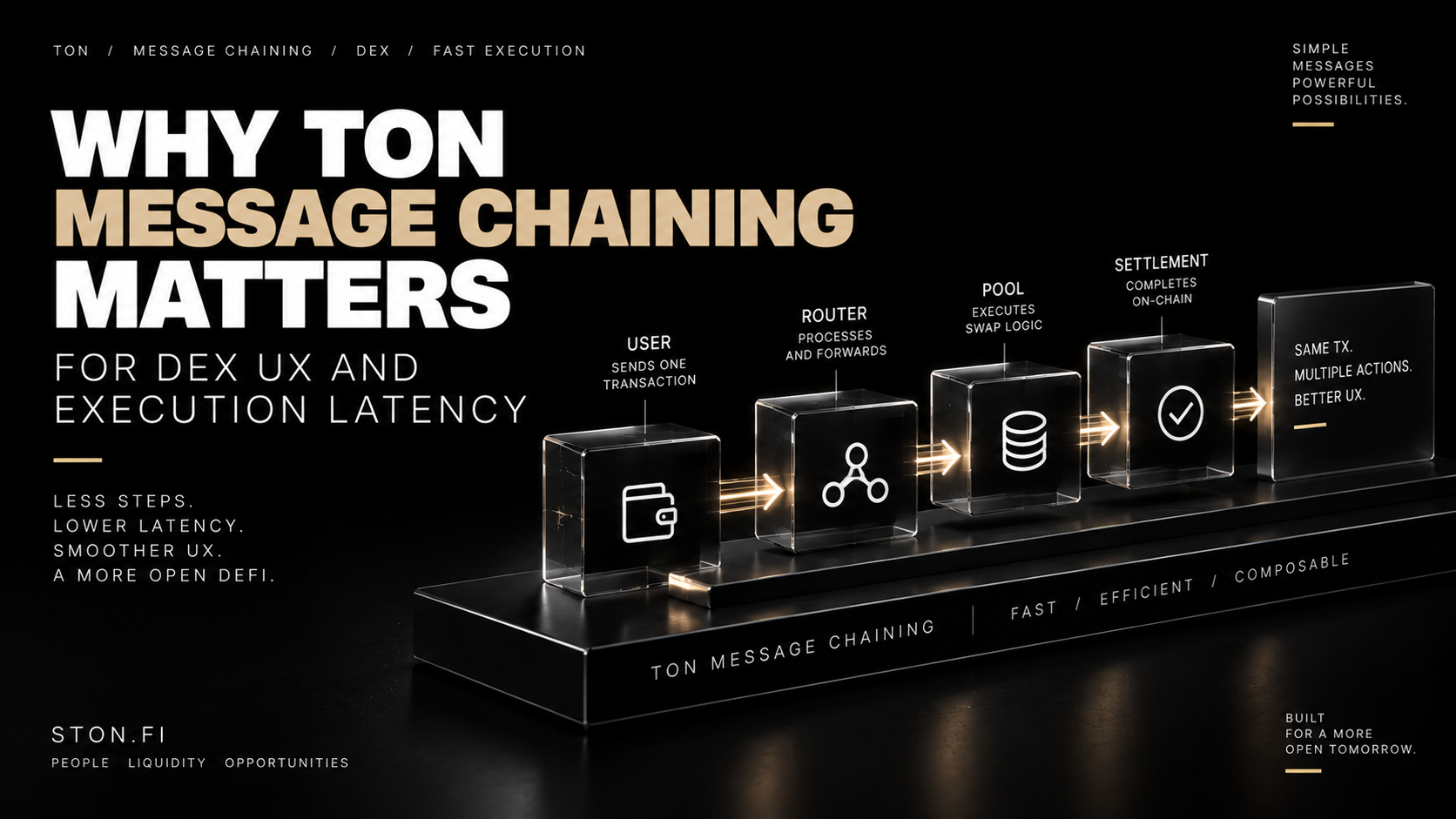
A swap through STON.fi's router touches a chain of contracts: your wallet sends a message to the router, the router sends a message to the relevant pool contract, the pool calculates the swap and sends a message back, and the result eventually reaches your wallet. Each of those arrows is a separate message with its own processing step, not one instruction executing top to bottom in a single breath.

Your wallet's outgoing message triggers the router contract
The router forwards the request to the appropriate liquidity pool
The pool performs its AMM calculation and sends a response message
That response propagates back until your wallet reflects the final result
This isn't a flaw or an inefficiency bolted on afterward — it's the deliberate trade-off TON made to support sharding at scale. But it does mean "my swap is one transaction" was never quite the right mental model to begin with.
Here's where the architecture stops being an abstract diagram and starts affecting how a swap actually feels while you're staring at a loading spinner. Each message in that chain needs to be included in a block before the next one can fire. More messages in the chain generally means more sequential steps before you see a final result — not because anything's broken, but because that's just how many hops the chain of causation has to travel.

For a simple, single-pool swap on STON.fi, that chain is relatively short, and it usually resolves quickly enough that you don't consciously notice the hops happening. But the moment a swap needs to route through multiple pools, or worse, coordinate across chains through Omniston's cross-chain mechanism, the message chain gets meaningfully longer, and that added length is latency you can actually perceive as a user, not just something buried in a technical diagram.
The honest version: it's not that TON is slow. It's that a multi-hop swap is genuinely doing more sequential work than a single-hop one, and pretending otherwise would just be bad UX copy.
This is the part I actually find most interesting, because it explains design choices that otherwise look arbitrary. If a swap resolves through a chain of messages rather than instantly, an interface has exactly two honest options: pretend it's instant and risk misleading the user, or actually communicate the in-progress state clearly. Good DEX interfaces on TON, STON.fi included, lean toward the second option, because the alternative erodes trust the first time someone notices the gap between "confirmed" and "actually done."

That's why you see specific patterns show up consistently:
Clear "pending" states rather than an interface that goes silent between click and completion
Transaction status that updates as messages actually propagate, instead of one binary success/fail flag
Explicit final confirmation only once the whole message chain has genuinely resolved, not the moment the first message fires
None of that is decorative. It's the interface being honest about an architecture where "submitted" and "settled" are genuinely different moments, sometimes by a noticeable margin, and blurring that distinction is exactly how users end up double-swapping because they assumed nothing happened the first time.
Message chaining within TON itself is one thing. Once you add Omniston's cross-chain swaps into the picture, the chain doesn't just get longer — it starts spanning systems that don't know about each other at all, which is a fundamentally different kind of complexity.
A cross-chain swap through Omniston involves TON-side messages coordinating with HTLC settlement on an entirely separate blockchain, one with its own block times, its own confirmation rules, and zero native awareness that TON even exists. The message chain on the TON side has to eventually sync up with confirmations happening on a completely independent chain, and that synchronization is inherently going to take longer than anything resolving purely within TON's own message-passing system.

This is exactly why cross-chain swaps take noticeably longer than same-chain ones, and why good interfaces set that expectation explicitly rather than leaving people staring at a spinner wondering if something broke. The latency isn't a bug in Omniston's design — it's an honest reflection of coordinating two systems that were never built to talk to each other directly in the first place.
Waited on my first cross-chain swap and genuinely thought something had gone wrong. Nothing had. I just hadn't internalized yet that two blockchains agreeing on anything takes actual time, every single time.
None of this is meant to make TON sound worse than chains with simpler, synchronous execution — it's a genuine architectural trade-off, not a flaw. Sharding at TON's scale requires this kind of asynchronous message-passing design; you don't get one without accepting the other. But knowing this changes a few practical habits worth actually adopting.

Expect single-pool swaps to resolve quickly, and multi-hop or cross-chain swaps to genuinely take longer — that's not a red flag, it's the architecture doing real sequential work
Don't resubmit a transaction the moment it looks slow; check the actual status rather than assuming failure from silence alone
Treat "pending" as a meaningfully different state from both "failed" and "complete," because on TON specifically, that middle state can legitimately last a bit
When STON.fi shows a longer expected time for a cross-chain route, that's the interface being honest about real message-chain length, not padding an estimate
Understanding message chaining doesn't make a swap execute any faster. But it does make the waiting make sense, and turns what used to feel like an unexplained delay into a system you can actually reason about.
Why does my STON.fi swap take longer than expected? A swap on TON resolves through a chain of internal messages between contracts rather than a single instant step. More complex routes — multiple pools, or cross-chain swaps through Omniston — involve longer message chains, which naturally take more sequential time to settle.
Is a longer wait time a sign something went wrong? Not necessarily. TON's asynchronous, sharded architecture means messages need to propagate through several steps before a swap fully settles. Check the actual transaction status rather than assuming failure from a longer-than-expected wait.
Why do cross-chain swaps take longer than same-chain swaps on STON.fi? Cross-chain swaps through Omniston require TON-side message chains to synchronize with confirmations on an entirely separate blockchain with its own block times and rules — a fundamentally slower coordination process than resolving purely within TON.
Does message chaining affect swap safety, not just speed? It's primarily a latency and UX consideration rather than a safety one — TON's architecture is designed for this message-passing model at scale. Standard safety practices (checking quotes, minimum output, and slippage) remain the relevant protections regardless of chain length.
TON Documentation — Asynchronous Smart Contracts
STON.fi Developer Documentation — Architecture
Omniston Protocol Overview
STON.fi Swap App