Wintermute Broker-Dealer: What the New License Really Allows Wintermute has crossed a threshold few crypto-native firms have reached. The Wintermute broker-dealer registration became official
Wintermute Broker-Dealer: What the New License Really Allows
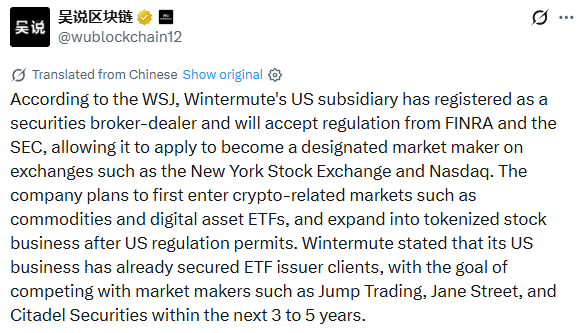
Wintermute has crossed a threshold few crypto-native firms have reached. The Wintermute broker-dealer registration became official August 7, 2026, when the company announced that its New York-based affiliate, Wintermute USA LLC, registered as a broker-dealer with the SEC and became a member of the Financial Industry Regulatory Authority (FINRA) — giving one of crypto's largest liquidity providers a regulated foothold in US securities markets for the first time.
 Source: X (formerly Twitter)
Wintermute Broker-Dealer License: What It Actually Allows
Per Wintermute's official announcement, the registration is scoped specifically to proprietary trading — Wintermute USA can act as principal, providing liquidity in equities, equity options, and other security-based instruments while trading for its own account. It can also self-clear digital asset securities transactions and, notably, act as an Authorized Participant for exchange-traded products, including digital asset ETFs.
Authorized Participants create and redeem ETF shares, the mechanism that keeps an ETF's price aligned with its underlying assets — a role that puts Wintermute directly inside the infrastructure supporting crypto ETFs rather than trading around their edges.
Wintermute said the license reflects several years of engagement with US regulators, backed by groundwork that included opening a New York headquarters in May 2025 and hiring Ron Hammond, previously of the Blockchain Association, to lead policy work. FINRA oversaw 3,184 registered broker-dealers at the end of 2025, down from 3,394 in 2021 — Wintermute is entering a shrinking, not expanding, club of regulated firms.
Wintermute's Five-Year Plan to Rival Citadel Securities
According to reporting on the announcement, Wintermute's stated ambition is to compete with major market makers like Citadel Securities, Jane Street, and Jump Trading within three to five years — a timeline founder and CEO Evgeny Gaevoy reportedly set himself. The rollout runs in explicit stages: Wintermute starts with commodities and digital asset ETFs, markets closest to what it already trades. Tokenized equities follow, contingent on further regulatory approval. Designated market maker (DMM) status on a major exchange sits at the end of the roadmap — and that end goal is a genuinely high bar. Only three firms currently hold DMM status on the New York Stock Exchange under its own market model: Citadel Securities, Virtu Americas, and GTS Securities.
Gaevoy framed the broader strategy around convergence rather than competition for its own sake: "Digital assets and traditional finance will continue to develop in parallel, intersect in new ways, and ultimately integrate more deeply," he said, adding that firms combining technical and operational know-how across both markets are the ones positioned to succeed as the landscape evolves.
Why This Fits a Broader Tokenization Push
Wintermute's US expansion lands alongside real regulatory movement on tokenized securities specifically. The SEC cleared a tokenized share trading rule from Nasdaq in March 2026, and in June, NYSE parent Intercontinental Exchange backed a tokenized equities venture with OKX — signs that the market company is positioning for is actively forming, not purely speculative. Citigroup's Tokenization 2030 research estimates roughly $17 billion in tokenized assets today, projecting a $5.5 trillion base-case market by 2030, while a16z crypto separately estimates tokenized real-world assets, excluding stablecoins, have already surpassed $34 billion.
The firm has already moved into adjacent territory: the firm began OTC market making in tokenized gold products like PAXG and XAUT earlier this year, and separately said it would provide two-way liquidity for prediction markets. Handling more than $10 billion in average daily trading volume across over 60 centralized and decentralized platforms globally, The firm said its US institutional client base already includes ETF issuers, positioning the firm to serve institutional flow that, per its own H1 2026 OTC report, now accounts for roughly 72% of its spot trading volume, up from 59% a year earlier.
Conclusion
The Wintermute broker-dealer registration is a genuine regulatory milestone, not just a headline — it gives a top crypto liquidity provider a licensed path into equities, options, and ETF infrastructure that most crypto-native firms don't have. Whether the firm actually reaches designated market maker status alongside Citadel Securities, Virtu, and GTS within its stated three-to-five-year window depends on regulatory approvals at each stage that remain far from automatic.
Disclaimer
This article is for informational purposes only and does not constitute financial or investment advice. All details are based on Wintermute's official announcement and publicly available reporting as of August 7, 2026, and are subject to change. Forward-looking statements about Wintermute's business strategy and expansion plans are the company's own projections, not guarantees. Always conduct independent research before making any investment decision.