XLM approaches a rising trendline that has supported several major market recoveries since 2017. Stellar's tokenized RWA market reached $4.1 billion, supported by 16 active issuers and expand
- XLM approaches a rising trendline that has supported several major market recoveries since 2017.
- Stellar's tokenized RWA market reached $4.1 billion, supported by 16 active issuers and expanding institutional participation.
- XLM faces selling pressure near $0.134, while $0.135 remains an important short-term recovery threshold.
XLM approaches historical trendline support as Stellar's institutional ecosystem expands. Meanwhile, growing tokenized asset activity provides additional context for its longer-term market position.
XLM Approaches a Major Historical Support Trendline
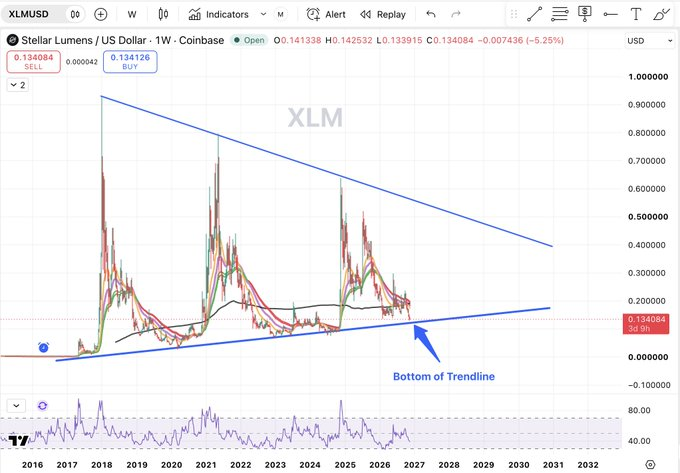
Anonymous Crypto Predictions recently identified an important technical development on XLM's weekly chart. The analyst suggested that the token was approaching its ascending trendline. This structure has influenced market movements across several previous cycles.
Source:
X
The trendline connects progressively higher lows recorded since 2017. Previous encounters occurred around 2019, 2020, and 2023. These historical interactions established the boundary as an important reference.
XLM as of writing trades at around $0.134, following considerable weekly selling pressure. The latest decline has brought the market closer to historical support. However, the trendline has not yet produced a confirmed bullish reversal.
Several moving averages remain above recent price action, reflecting persistent weakness. Meanwhile, the Relative Strength Index indicates weakening momentum without reaching extreme oversold conditions. A stronger recovery requires buyers to reclaim nearby technical resistance.
Stellar's RWA Expansion Strengthens Institutional Participation
Stellar's institutional development provides another important dimension to XLM's market outlook. Its tokenized real-world asset market reached $4.1 billion during Q3 2026. This represented 36.7% quarterly growth and more than sevenfold annual expansion.
The network now hosts 16 active RWA issuers, compared with 12 previously. Meanwhile, the four largest issuers control 81.2% of tokenized assets. Their combined market share declined from 92.5% during Q2.
Tradable introduced $548 million in private credit across 24 instruments. Additionally, State Street launched its Onchain Liquidity Sweep Fund. Galaxy, Anchorage, and Chainlink provided supporting tokenization, custody, and data infrastructure.

Institutional involvement also expanded through Stellar's validator network. MoneyGram, Figure Markets, and Range joined its tier-one quorum set. Their participation increased the validator count from 21 to 30.
Stellar's network activity also recorded growth across several financial applications. Quarterly payment volume increased 77.9% to approximately $29.22 billion. DeFi total value locked climbed 34.5%, reaching $264 million.
Soroban smart contracts accounted for 42.9% of network transactions. These figures indicate expanding activity across Stellar's programmable financial infrastructure. However, ecosystem growth does not automatically translate into stronger token demand.
Meanwhile, the intraday chart shows sellers maintaining considerable market control. XLM initially climbed from approximately $0.1372 toward $0.139. However, subsequent selling pushed the token toward $0.131.
Buyers eventually defended the lower region, supporting a modest recovery. The token subsequently returned toward $0.134 but struggled to reclaim $0.135. Market capitalization stood near $4.74 billion during the reported session.
Trading volume increased 12.84% over the preceding 24 hours. Higher activity indicates greater participation during the latest downward movement. Nevertheless, volume alone cannot establish whether selling pressure will continue.
The immediate resistance levels stand around $0.135, $0.136, and $0.1372. Conversely, support remains near $0.132 and $0.131. A sustained recovery requires stronger buying pressure and improving weekly momentum.
For now, XLM's direction depends on technical support and market participation. Defending the ascending trendline could create conditions for another recovery. However, a decisive weekly breakdown would weaken the existing bullish structure.