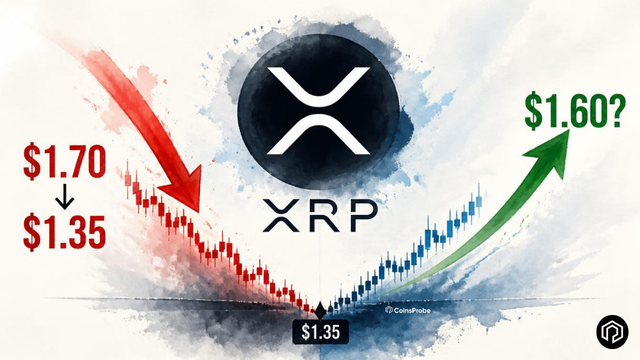
Key Highlights XRP has corrected 20% from $1.70 to $1.35 over three weeks — with whales distributing approximately 90 million XRP and daily active addresses collapsing 90.18% (from 388,492 to
Key Highlights
- XRP has corrected 20% from $1.70 to $1.35 over three weeks — with whales distributing approximately 90 million XRP and daily active addresses collapsing 90.18% (from 388,492 to 38,163) during the decline.
- Analyst Ali Charts (@alicharts) identifies $1.35 as the critical support — where 2.29 billion XRP previously changed hands — with the confirmation path requiring a reclaim of $1.38 before a rebound toward $1.60–$1.68 becomes valid.
- XRP is currently trading at $1.37 — above $1.35 support but below the $1.38 reclaim threshold — meaning the current bounce is a test, not a confirmed reversal.
XRP’s August run from $1.00 to $1.70 has given back 20% — and the token is now sitting precisely at the level that determines whether the last three weeks were a healthy reset or the beginning of a larger decline. At $1.37, XRP is above the $1.35 support that analyst identifies as the key decision zone — but has not yet reclaimed the $1.38 level that would confirm the bounce as a genuine reversal rather than a temporary hold.
Why XRP Dropped — Two Pressures Working Together
Ali Charts’ analysis identifies two distinct forces behind the three-week slide — and their combination explains why a 20% correction developed without a dramatic external catalyst.
Whale Distribution — 90 Million XRP Moved
Over the past week, whales sold or redistributed approximately 90 million XRP — a supply addition that does not require a panic headline to cap a recovery. Coming after a strong August run that took XRP from ~$1.00 to $1.70, large holders taking profit into strength is a standard corrective mechanism. The 90 million figure is significant enough to create consistent sell-side pressure that absorbs any bounce attempt before it can build momentum.
As covered in our XRP macro bottom signals and whale accumulation analysis, the large-holder behavior in XRP has historically been one of the most reliable leading indicators of directional shifts. The current distribution — 90 million tokens — does not represent a full macro exit but is meaningful enough to explain the near-term price pressure without requiring any other catalyst.
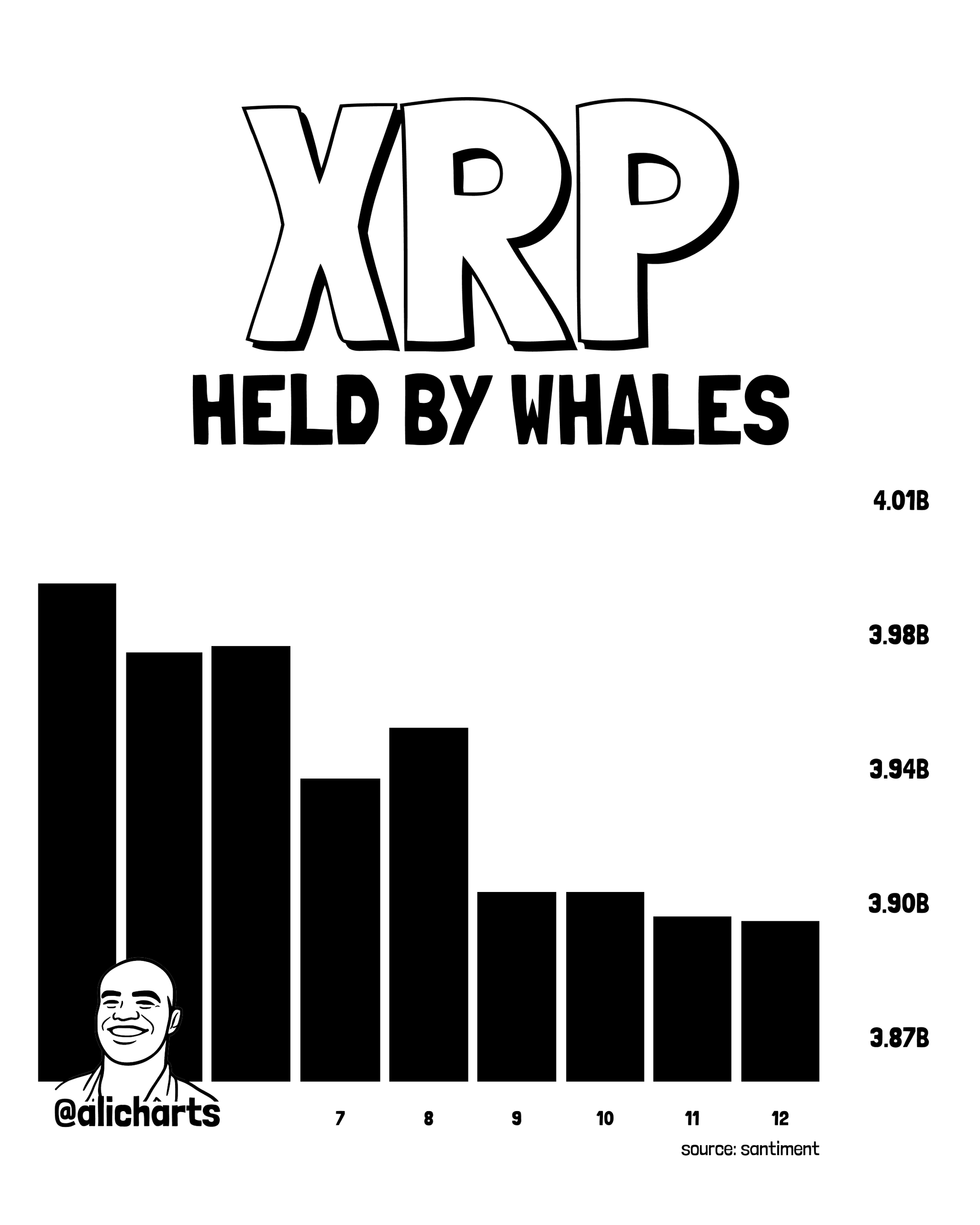 XRP Held by Whales | Source: @alicharts (X)
Network Activity Collapsed 90%
The second pressure is arguably more significant than the whale selling: daily active addresses fell 90.18% — from 388,492 to 38,163 — during the same correction period.
A 90% decline in active addresses is not a marginal slowdown. It reflects a near-complete withdrawal of retail and smaller-scale participation from XRP’s network during the correction. Price declined, engagement declined with it, and the two reinforced each other — fewer active participants reduced the organic demand that would normally absorb selling pressure from large holders.
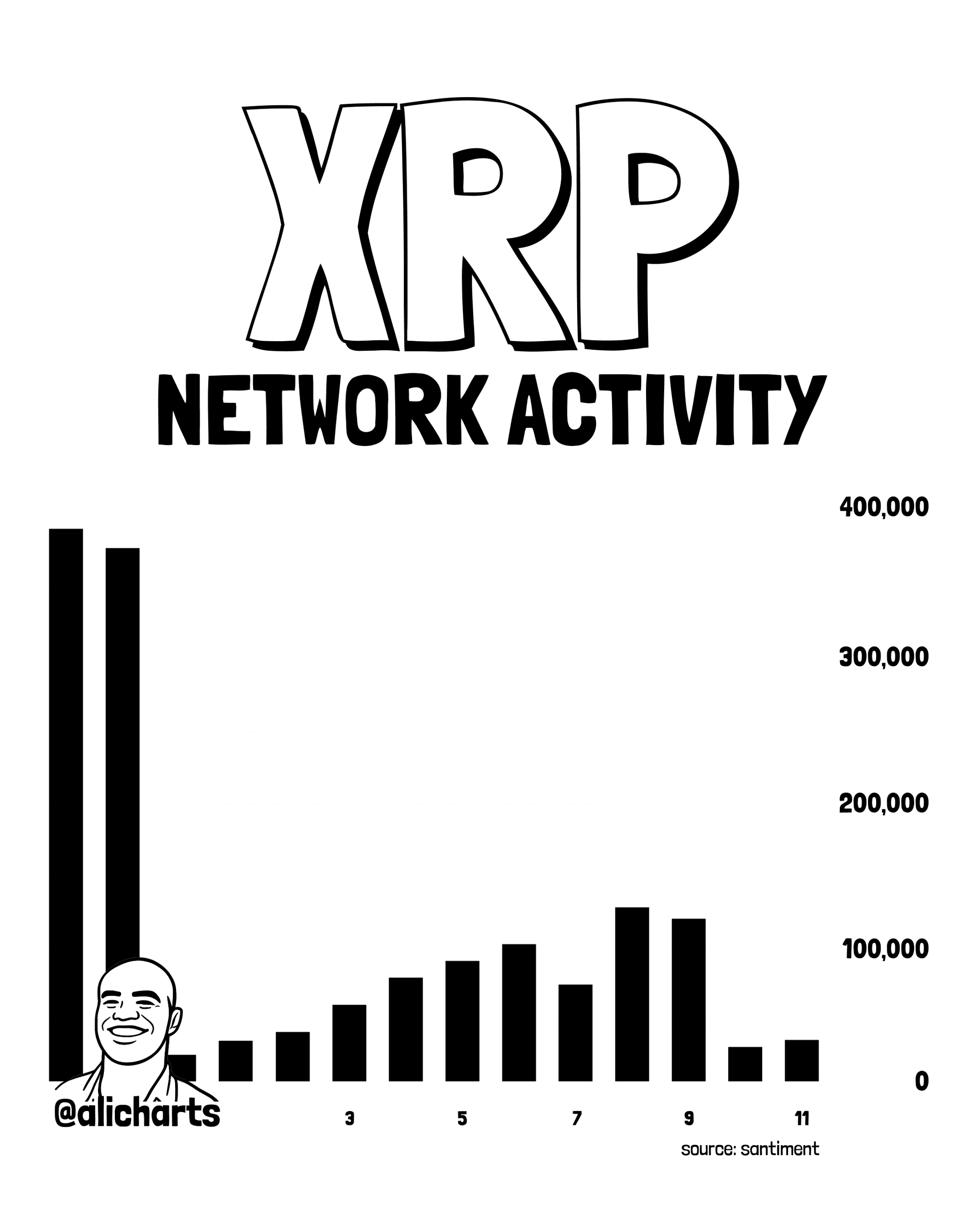 XRP Network Activity | Source: @alicharts (X)
The combination of whale supply hitting a market with 90% fewer active participants than the August peak is the mechanical explanation for the 20% drawdown from $1.70 to $1.35.
The $1.35 Level — Why It Is the Decision Zone
Despite the dual pressure of whale distribution and collapsing network activity, XRP found support near $1.35 — and Ali Charts identifies this level as structurally significant for a specific and verifiable reason.
2.29 billion XRP previously changed hands at the $1.35 zone — making it one of the highest historical transaction volume levels visible on XRP’s on-chain cost basis distribution. High historical volume at a price level creates a structural reference: a large number of holders have a cost basis near $1.35, giving them incentive to defend that level to avoid moving into loss territory.
This is the same on-chain cost basis framework covered in our XRP ascending triangle and futures volume analysis — where the distribution of historical transactions at key price levels determines where structural buying and selling pressure naturally concentrates.
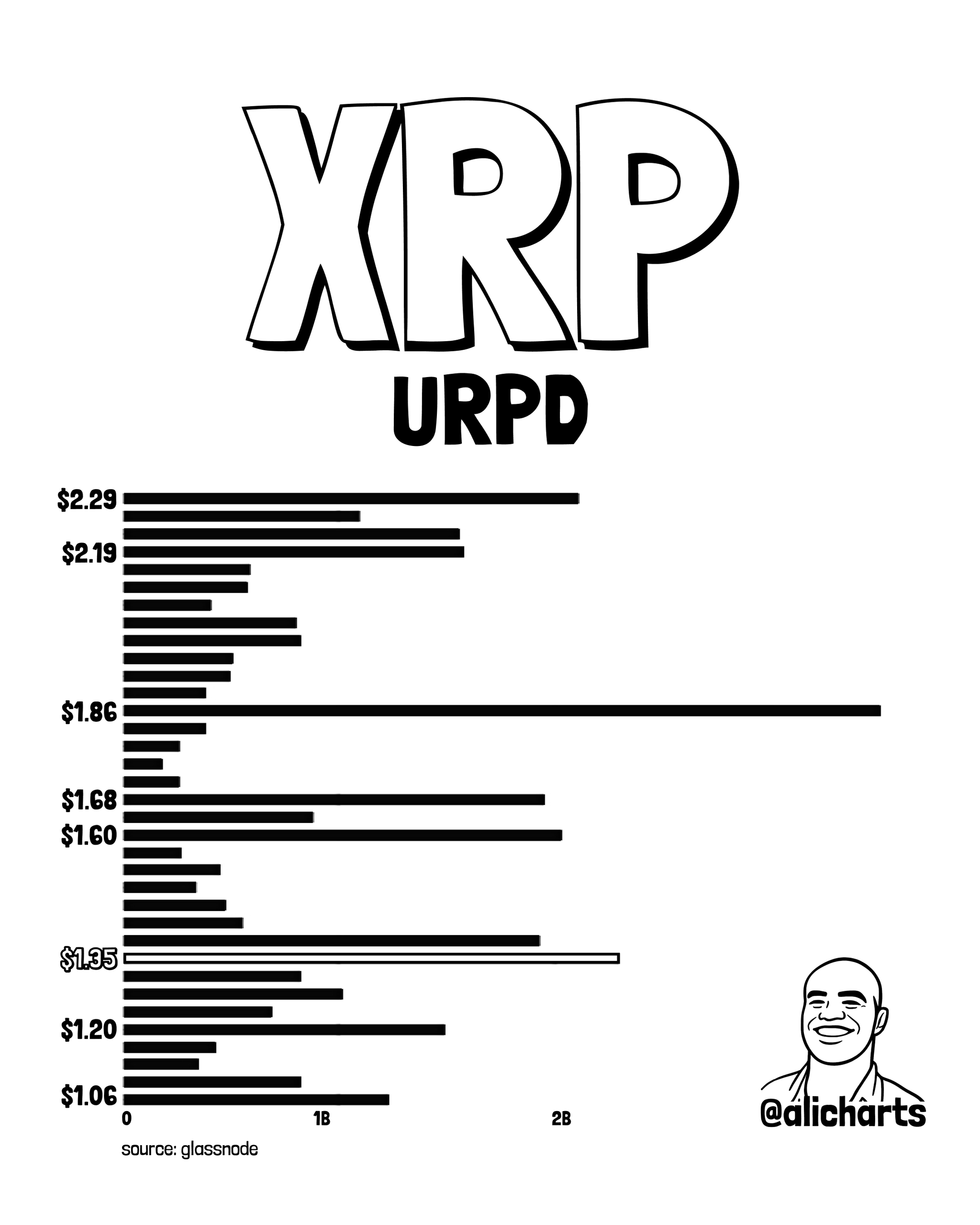 XRP URPD Levels | Source: @alicharts (X)
Ali Charts’ Confirmation Path — Three Steps to a Valid Reversal
Ali Charts has laid out a precise three-step confirmation sequence that distinguishes a genuine reversal from a temporary bounce at support:
StepLevelSignificanceStep 1Hold $1.35Support must not be lost on a sustained closeStep 2Reclaim $1.38First confirmation that buyers are in controlStep 3Rebound toward $1.60Primary recovery target (+17% from $1.37)Stretch$1.68Extended target — prior correction zone
The sequencing matters. At the current price of $1.37, XRP is technically above the $1.35 support — Step 1 is conditionally passing. But $1.38 has not been reclaimed on a sustained basis — Step 2 is pending. Until $1.38 is reclaimed and holds, the bounce from $1.35 is a test of support rather than a confirmed reversal.
This distinction — test vs. confirmed reversal — is the most important analytical framing for the current XRP setup. A hold at $1.35 without reclaiming $1.38 remains fragile. A sustained close above $1.38 shifts the probability toward the $1.60 recovery target.
Bullish vs. Bearish Scenarios
Bullish Scenario
XRP holds $1.35 on a sustained basis — the 2.29 billion XRP previously traded at this level provides the structural bid. Daily active addresses begin recovering from the 38,163 low — the 90% collapse was an extreme reading that typically normalizes as price stabilizes. A sustained daily close above $1.38 confirms that buyers have absorbed the whale distribution and taken back control of the short-term trend. In this scenario, $1.60 becomes the primary recovery target, with $1.68 as the stretch objective if momentum builds. The broader context — XRP up 34.49% over 30 days and the crypto bull cycle ongoing — provides the macro environment for this scenario to develop.
Bearish Scenario
$1.35 fails on a sustained daily close — the 2.29 billion XRP in historical transactions at this level does not provide sufficient buying support to absorb continued whale distribution. In this scenario, the correction that began at $1.70 remains open — there is no clearly defined structural support level between $1.35 and the prior range lows near $1.20–$1.25. The 90% collapse in active addresses would not recover quickly enough to generate the organic demand needed to hold $1.35 against ongoing large-holder selling. This scenario would represent a more significant correction phase rather than a reset before the next leg higher.
Bottom Line
XRP is at the level that decides the interpretation of the past three weeks. A 20% correction from $1.70, 90 million XRP distributed by whales, and a 90.18% collapse in active addresses have brought the token to $1.35 — where 2.29 billion XRP previously changed hands and where structural buying support is concentrated.
At $1.37, XRP is holding above that support but has not reclaimed the $1.38 threshold that Ali Charts identifies as the first confirmation of a genuine reversal rather than a temporary hold. The next meaningful daily closes will answer the question the chart is asking:
Hold $1.35, reclaim $1.38 → $1.60 recovery target opens.Lose $1.35 → correction remains open, structure weakens below.
Disclaimer: The views and analysis presented in this article are for informational purposes only and reflect the author’s perspective, not financial advice. Technical patterns and indicators discussed are subject to market volatility and may or may not yield anticipated results. Investors are advised to exercise caution, conduct independent research, and make decisions aligned with their individual risk tolerance.