XRP trades at $1.3385 on Thursday evening, and the day's most important headline is not about the coin but about the stablecoin standing next to it. On October 15, Ripple opened trading in pe
XRP trades at $1.3385 on Thursday evening, and the day's most important headline is not about the coin but about the stablecoin standing next to it. On October 15, Ripple opened trading in perpetual swaps on more than 100 real-world reference assets to institutional clients. The collateral posted there is RLUSD. XRP does not appear in that structure at all.
For investors in Europe, that is the real question of the day: Ripple keeps winning business, while the coin has been stuck below the $1.40 zone since October 12. This article works out which part of Ripple's business actually creates demand for XRP, where the day's reliable levels sit, and what the holding period, leverage and purchase route make of all this.
XRP price today: $1.3385 after a session low of $1.2827
XRP opened Thursday at $1.3303, slid to $1.2827 during the session and stands at $1.3385 in the evening (price data: Kraken, XRP/USD pair). The session high is $1.3460. Measured from the low, the price has recovered 4.4 percent and trades in the upper third of the daily range.
Over 24 hours the gain is roughly 1.5 percent, market capitalisation stands at $84.7 billion and turnover over the past 24 hours at $2.35 billion (data: CoinGecko). XRP remains the fifth-largest token by market value.
A perpetual swap is a futures contract without an expiry date: buyers and sellers pay each other a running adjustment through the funding rate, so the contract price does not drift away from the spot price. Those are precisely the contracts Ripple has been offering its institutional clients since October 15, on equities, exchange-traded funds, metals, energy and currencies.
Ripple Prime: more than 100 reference markets around the clock, collateral is RLUSD
Ripple Prime, the group's prime brokerage arm, acts as counterparty to the trades. The reference instruments are the perpetual futures that trade.xyz lists on Hyperliquid. Trading runs continuously, weekends included, and clients may net their positions against other asset classes on the same platform. Michael Higgins, international chief executive of Ripple Prime, described the ambition by saying the unit had been built to work in both worlds, meaning traditional finance and digital infrastructure (CryptoPotato, October 15, 2026).
Ripple Prime grew out of the $1.25 billion purchase of prime broker Hidden Road and has carried the Ripple name since. October already added financing for leveraged funds, a business that banks had until then kept among themselves.
What is decisive for the coin is the question of what clients post against their positions. The answer given is RLUSD, the house's dollar-pegged stablecoin. XRP is listed in the announcement neither as collateral nor as a settlement asset.
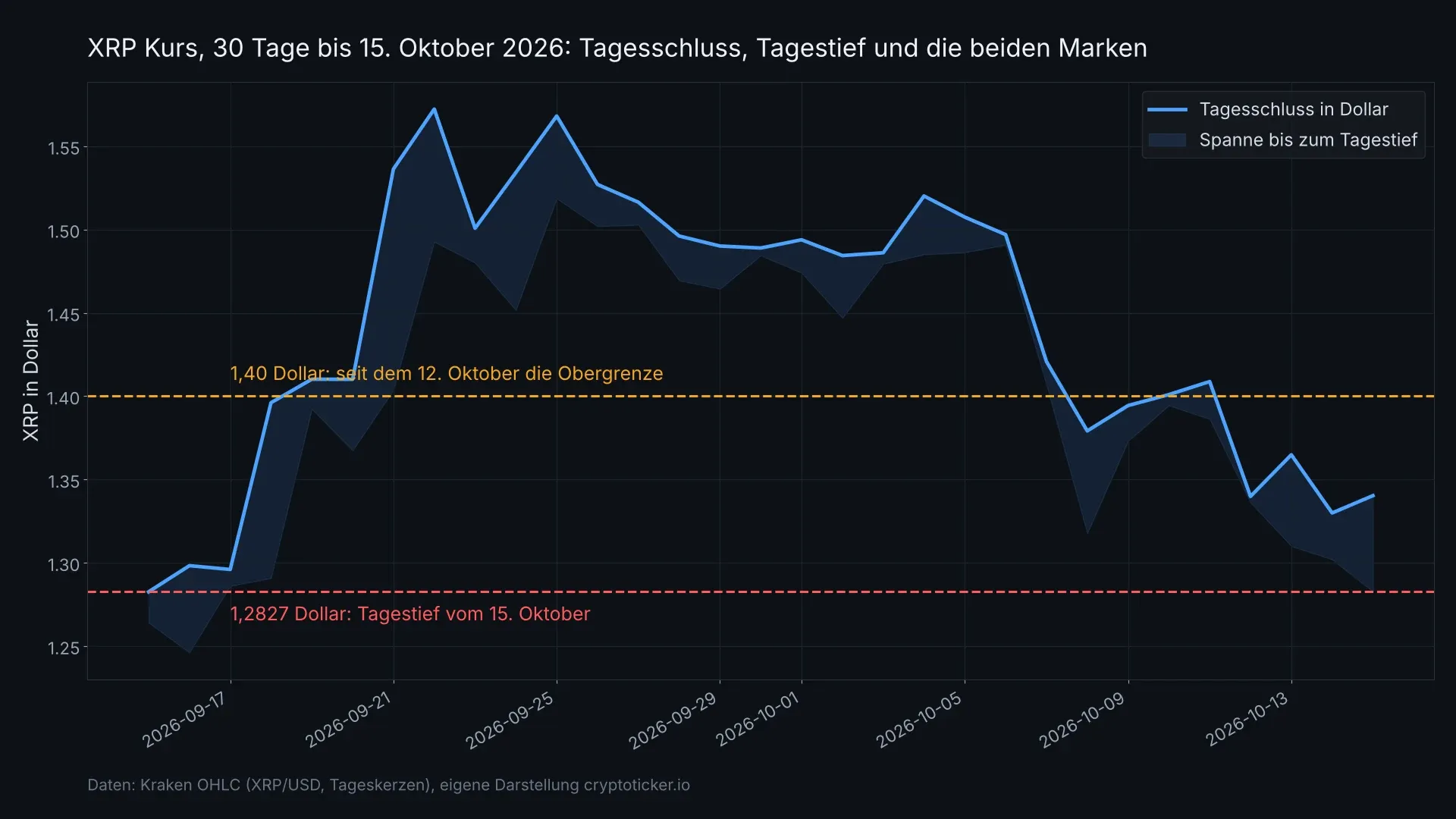
Thirty days of XRP: the $1.40 mark has capped the price since October 12, and the low of October 15 sits at $1.2827. Own chart based on daily candles from Kraken.
What has changed since the Privy agreement of October 14
On October 14, our coverage had XRP at $1.33, prompted by the integration of Privy, the Stripe subsidiary that builds XRP Ledger wallets into third-party apps (XRP price at $1.33 and the Privy deal). Little has moved in the price since: $1.3385 is 0.6 percent above the previous close of $1.3299.
Two things are new. First, the $1.28 level held, with the session low of $1.2827 just above it and comfortably above the monthly low of $1.2461. Second, the swap offering and the DriveWealth settlement deal mean Ripple has announced business twice within two days that runs through RLUSD rather than through the coin. The $1.40 zone that has capped the price since October 12 went untested on both days.
DriveWealth will settle in Europe with RLUSD in future
A day before the swap launch, US financial services firm DriveWealth announced it would integrate Ripple's stablecoin infrastructure for settlement in Europe. RLUSD is to be issued and redeemed on the XRP Ledger, with the same planned for the United States later. Ripple Payments for partners' cross-border transfers and Ripple's custody technology for DriveWealth's crypto business in Europe come on top. Jack McDonald, who runs stablecoins at Ripple, said the agreement came about because DriveWealth had approached the company with a specific cross-border settlement problem (CoinGape, October 14, 2026).
The move matters for the European market because Europe is the starting point here rather than the afterthought. If you trade through a platform that uses DriveWealth in the background, you will see nothing of the change; the settlement rail switches one layer down.
1.05 billion RLUSD sit on the XRP Ledger
How large this stablecoin has become can be read straight off the blockchain. Our own query of the XRP Ledger on October 15, covering the obligations issued by the RLUSD issuer, returns 1,046,787,452 RLUSD in circulation, measured against validated ledger number 107,680,341. A little more than a billion dollars of stablecoin therefore sits on the same blockchain whose native coin has clung below its October range for days.
That figure explains why the debate among holders has run so hot this week. The business is growing visibly; it is simply growing in a unit that is not called XRP.

Settlement needs a rail. At DriveWealth, that rail is to run through the stablecoin in Europe.
XRP Ledger transaction fee: ten drops per payment, and how much of it burns
The most common objection runs that every RLUSD payment travels across the XRP Ledger after all and costs a fee in XRP there, which is destroyed. That is correct, and the order of magnitude can be calculated. A drop is one millionth of an XRP. The base fee for a transaction is ten drops, or 0.00001 XRP, and it is indeed destroyed rather than paid out to a recipient (XRP Ledger documentation). Our own query of the current fee confirms those ten drops on October 15, with the network load factor at one.
That leads to a sobering calculation. One million payments on the XRP Ledger burn ten XRP between them. At $1.3385 a coin, that is worth $13.39. By comparison, $2.35 billion of XRP changed hands this Thursday. Even millions of stablecoin payments a day would move nothing through the fee channel that could show up in a price.
There is a second and larger channel, and it is called the reserve: every account on the XRP Ledger must currently keep one XRP permanently in place to exist at all. If account numbers grow strongly through embedded wallets, that ties up XRP without burning it. The effect is bigger than the fee, but it works slowly and it unwinds again as soon as accounts are closed.
Our assessment: the revenue side runs on RLUSD, the price on fund flows
From the newsroom's point of view, this week's announcements show a clear pattern. The business lines Ripple is building out, namely prime brokerage, settlement and payments, earn revenue in dollars and in RLUSD. The evidence sits above: RLUSD as collateral for the swaps of October 15, RLUSD as the settlement asset at DriveWealth from October 14, a little over a billion RLUSD on the ledger. The coin benefits from that indirectly through reserves and fees, and both channels are small, as the calculation above shows.
One point argues the other way and should not be waved aside: each of these agreements binds partners to the XRP Ledger, and a ledger with volume is better for the native coin in the long run than one without. That, though, is a perspective measured in years, not an explanation for a price on this Thursday. In the short term, what funds buy and what positions the futures market holds are what decide, and both have lately produced pressure rather than demand. No buy or sell recommendation follows from this reading.
Levels above and below: 1.2827, 1.3460 and the $1.40 zone
The day's reliable levels come out of the price data itself, not out of a model. On the downside, the first level is the session low of $1.2827. Below that comes $1.2461, the low of the past 30 days, reached on September 16. If the lower level fails to hold, there is no clear support left before that monthly low.
On the upside, the session high of $1.3460 counts first. Above it begins the zone around $1.40, where XRP failed on October 12 and has not knocked again since. From $1.3385, that leaves 4.6 percent to go. Only above that zone would the picture of the past week be broken; the monthly high of $1.6578 sits a good deal higher still.
To keep an eye on those levels you need no software. Two price alerts, at $1.28 and at $1.40, in your own exchange's app are enough, and if you have no suitable trading venue yet, the crypto exchange comparison lists the providers with their fees and their licensing status.
Leverage and liquidation: what the slide to $1.2827 cost
Thursday works well as a worked example because the range was wide. From the opening price of $1.3303 to the low of $1.2827 is 3.6 percent. Unleveraged, that is a poor morning. At three times leverage, the same move is a loss of 10.7 percent in the portfolio, at five times one of 17.9 percent. At ten times leverage, 35.8 percent would be gone on paper, which would already put the position below the usual margin call threshold, in the range of forced closure.
The sequence matters here: the recovery to $1.3385 came only after the low. Anyone liquidated along the way did not take part in it. That is exactly what separates a leveraged position from a holding in your own wallet, and it is the reason leverage on a coin with daily ranges like these does not suit beginners.
In practical terms: the liquidation threshold of your own position should sit below the $1.2461 level, otherwise a day like this one is enough to catch it. If you cannot arrange that, the leverage is set too high.
Holding period, ETPs and tax: two routes, two calculations
The purchase route is where the tax paths part in Germany, and the difference is larger than any fee. Hold XRP directly, on an exchange or in your own wallet, and a sale counts as a private disposal under Section 23 of the Income Tax Act. After a holding period of one year the gain is tax-free; below that it counts towards your personal income tax rate, and an exemption limit of 1,000 euros a year applies to all private disposals taken together.
Buy an exchange-traded product on XRP instead, an ETP or ETN, and the taxation of investment income under Section 20 of the Income Tax Act applies, with the flat withholding tax of 25 percent plus the solidarity surcharge. There is no holding period after which the gain becomes tax-free. In return, the custodian usually withholds the tax directly. Which product is cheaper in tax terms therefore depends on the intended holding period and on your personal tax rate.
Work on the holding period itself is under way politically, but nothing has been decided: the cabinet date of October 15 passed without a resolution, which leaves the December 31 cut-off standing for now, as we reported the same day (Crypto holding period: cabinet date passed). If you have sold this year or still intend to, keep clean records of your acquisition dates; the common tools for that are in the crypto tax software comparison.
XRP at $1.34: without demand of its own, RLUSD carries the turnover
The day ends with a price in the upper third of its range and with two announcements that enlarge Ripple's business without raising demand for the coin. Three steps make a line out of that for the days ahead:
- Set the two levels. One alert at $1.2827 and one at $1.40 map the range the price has moved in since October 12. Both can be set up in any common app, and an overview of the providers is in the exchange comparison.
- Match the purchase route to the tax treatment. Direct holdings with a one-year period and ETPs with withholding tax lead to different calculations. Documenting the acquisition dates is handled by the tools from the tax software comparison.
- Measure the leverage against the daily range. A liquidation threshold above $1.2461 was tightly set on this Thursday. Running the numbers shows quickly whether your own position would survive a second day like it; which venues apply which leverage and fees is shown by the perp venue comparison.
(As of October 15, 2026. This article is not investment advice. Prices and fee structures change; check the terms with the provider before you buy.)