XRP has fallen to a 20-month low near $1.05, down more than 70% from its 2025 high, in a year-long downtrend. The $1 is the line that matters now. Below it, the charts point to $0.85 and then
XRP has fallen to a 20-month low near $1.05, down more than 70% from its 2025 high, in a year-long downtrend. The $1 is the line that matters now. Below it, the charts point to $0.85 and then $0.70. Yet institutions keep buying the dip, and one Senate vote could change everything.
Summary
- XRP trades near $1.05, a 20-month low, down more than 70% from its $3.66 July 2025 high, in a clean year-long downtrend of lower highs and lower lows.
- The $1 psychological level is the line that matters; below it, technical support sits at $0.85 and then near $0.70, while overhead resistance begins at $1.12 and $1.27.
- A paradox defines XRP: seven spot ETFs have drawn roughly $1.4 billion in cumulative inflows, and whale wallets have hit record counts, accumulating even as the price falls.
- The CLARITY Act is the swing catalyst, with passage potentially codifying XRP’s commodity status and unlocking billions in projected ETF inflows, while failure would remove a key support.
- Whether XRP holds $1 or slides toward $0.70 depends on Bitcoin’s direction, the CLARITY Act vote, and whether the institutional accumulation outweighs the relentless downtrend.
XRP is trading near $1.05, a 20-month low, and the round number just beneath it has become the line that defines the entire debate about where the token goes next.
After reaching a high of $3.66 in July 2025, XRP has spent the better part of a year grinding steadily lower, carving out a textbook downtrend of lower highs and lower lows that has erased more than 70% of its value from the peak. The price now sits just above the psychological $1 level, and the question that matters for the rest of 2026 is simple to state and hard to answer: Can XRP hold the $1, or is it heading toward the next support levels at $0.85 and then $0.70 that the charts identify below it?
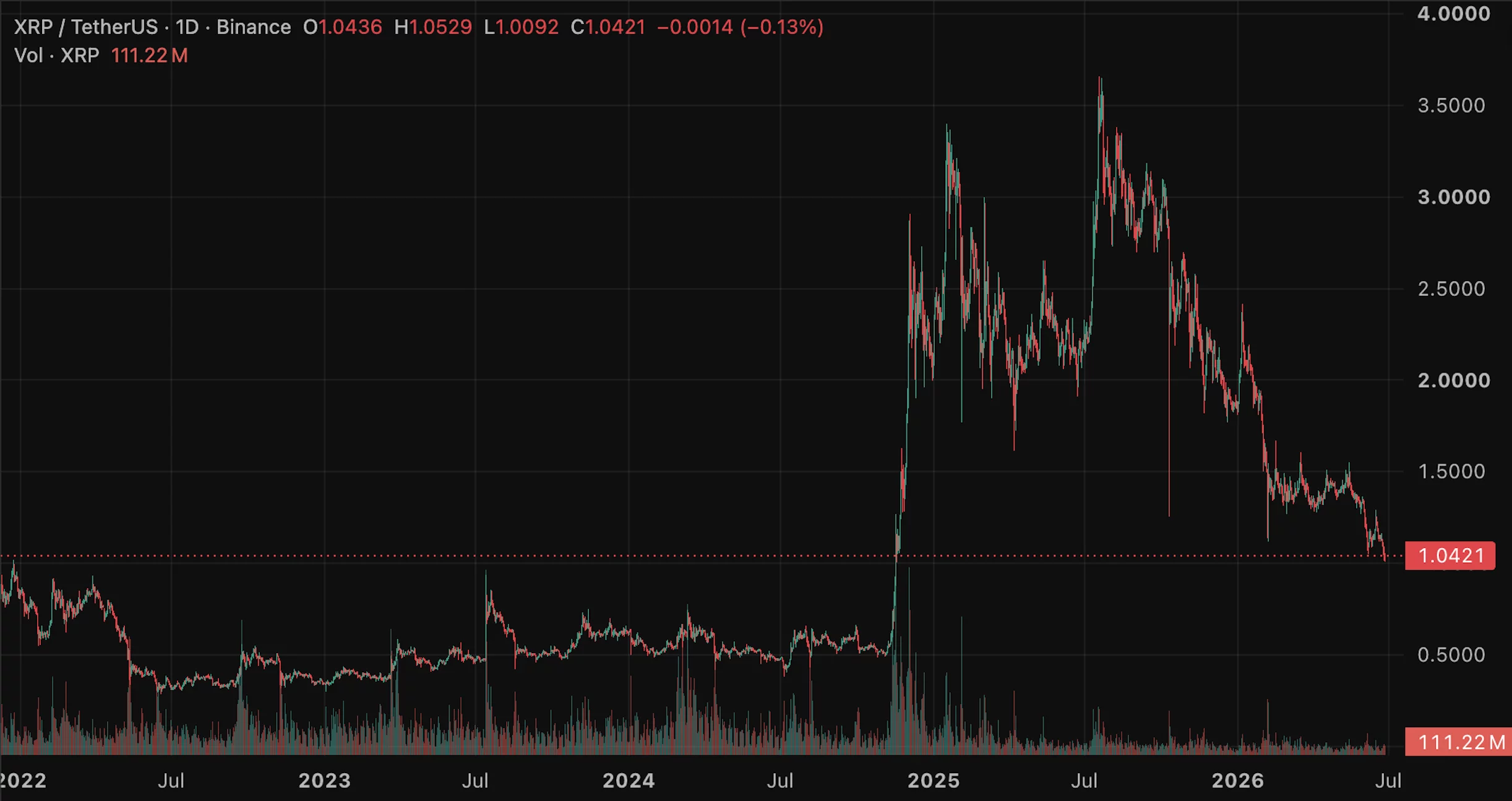
XRP daily price chart | Source:
crypto.newsWhat makes the question genuinely interesting, rather than a one-way bearish story, is a striking contradiction running underneath the falling price. Even as XRP has bled lower, institutions have been buying it, with billions flowing into newly launched exchange-traded funds and large holders accumulating at a record pace, and a single piece of legislation working its way through the Senate could, if it passes, change the token’s trajectory overnight. This piece works through that tension to build an honest prediction.
The reason to frame XRP’s outlook around the $1 line and the contradiction beneath it is that those two things, the technical battle at a key level and the clash between a bearish chart and bullish accumulation, are what will actually decide the price.
A list of multi-year targets, the staple of most prediction pages, obscures more than it reveals, because XRP’s near-term path depends on whether the $1 holds, whether the institutional buying is the leading edge of a reversal or a value trap, and whether the regulatory catalyst lands.
What follows traces the year-long descent that brought XRP here, maps the levels that matter on both sides, examines the paradox of institutions buying into weakness, weighs the CLARITY Act as the swing factor, lays out the bear case for a slide toward $0.70, and translates all of it into concrete bull, base, and bear scenarios anchored to the $1 line.
You might also like: Ripple is quietly becoming a bank. What that means for XRP holders
A year of lower lows
To understand XRP’s predicament, you have to see the shape of its decline, because the chart tells a clear and sobering story. XRP reached its high of $3.66 in July 2025, a level that capped an enormous run and marked the peak of its enthusiasm. From there, the descent began, and it has been remarkably persistent: rather than a single crash followed by recovery, XRP has traced a clean series of lower highs and lower lows for almost a full year, the textbook signature of a sustained downtrend.
Each attempt to rally has been sold into, each bounce has failed at a lower level than the last, and the price has ground inexorably downward, trading below its key moving averages and giving back the vast majority of its gains. By June 2026, XRP had reached a 20-month low near $1.05, with technical analysts describing the chart as an asset still searching for a bottom rather than building toward a breakout.
The most recent leg lower came as the broader crypto market sold off, with Bitcoin crashing toward $60,000 and dragging the major altcoins down with it. XRP, like most large-cap tokens, remains highly correlated with Bitcoin during major market moves, so Bitcoin’s slide to a 20-month low of its own pulled XRP to its lows as well.
The result is a token down roughly 40% year-to-date and more than 70% from its 2025 peak, sitting in oversold territory but with no clear sign that the selling has exhausted itself. The year-long downtrend is the dominant fact of XRP’s chart, and any bullish case has to contend with the reality that, on price action alone, XRP has done nothing but fall for a year, which is exactly why the defense of the $1 level has become so important. It is the line where the year-long decline either pauses or accelerates.
The levels: $1.04, $1, and $0.70
The technical map around XRP is worth laying out precisely, because the levels define the battlefield for the rest of the year. The immediate line in the sand is the area around $1.04, which technical analysts have flagged as the key support holding up the current price, with the round $1 level just beneath it carrying additional psychological weight as a number that tends to attract both defensive buying and, if broken, fresh selling.
Below the $1, the chart identifies the next meaningful support near $0.85, and below that a more significant level near $0.70, with some bearish models pointing even lower toward the fifties in a deeper breakdown. These are the downside markers that matter: holding the $1 keeps XRP in its current range, while losing it opens the door to the $0.85 and $0.70 levels in succession.
On the upside, the resistance is just as clearly defined and just as important. The immediate ceiling sits in the area around $1.11-$1.12, the zone that has repeatedly capped rallies and turned them back, and reclaiming it decisively is the first thing bulls would need to see to suggest the downtrend is weakening.
Above that, heavier resistance waits at $1.27 and then at $1.60, where multiple rejections have piled up historically. The structure this creates is a token boxed between a $1.12 ceiling and a $1 floor, with the year-long downtrend pressing down from above and the psychological $1 level holding up from below.
The prediction, in technical terms, comes down to which of those gives way first: a break above a $1.12 would signal the downtrend may be ending, while a break below the $1 would signal it is accelerating toward $0.70. Everything else, the accumulation and the regulation, feeds into which way that break resolves.
You might also like: Ripple deploys CLARITY truck as Senate delay clouds crypto bill
The paradox: institutions buy as the price falls
Here is the contradiction that keeps XRP’s story from being a simple bearish chart, and it is genuinely striking. Even as XRP has fallen to 20-month lows, institutional and large-holder demand has been growing, not shrinking.
Seven spot XRP exchange-traded funds, launched over the prior months, have collectively drawn roughly $1.4 billion in cumulative inflows, holding over 800 million XRP, and crucially, those inflows have continued even during weeks when the price was falling and when larger cryptocurrencies were seeing outflows.
https://x.com/cryptodotnews/status/2066151671189623092
The funds have, in effect, been absorbing XRP into long-term institutional vehicles throughout the decline, a pattern of demand that runs directly counter to the bearish price action. On-chain data tells the same story, with the number of large holder wallets reaching record levels and tens of millions of XRP moving off exchanges, both classic signals of accumulation instead of distribution.
The interpretation of this paradox is the crux of the bull case. One reading is that sophisticated, long-term buyers see current prices as a value zone and are quietly accumulating ahead of catalysts they expect to materialize, in which case the falling price is a gift to patient institutions and the eventual reversal could be sharp once the selling pressure exhausts.
The other reading, the bearish one, is that the accumulation is premature, a value trap in which buyers are catching a falling knife while the downtrend has further to run, and that inflows into funds do not guarantee a price floor if broader selling overwhelms them.
Both readings are plausible, and the resolution depends on the same levels and catalysts discussed throughout. What the paradox does show is that XRP is not simply abandoned; there is real, persistent demand beneath the falling price, which is exactly why a catalyst that shifts sentiment could move it quickly. The accumulation is the loaded spring; the question is what releases it, and whether it releases up or snaps.
The CLARITY Act wild card
The single most important catalyst hanging over XRP is a piece of legislation, and understanding it is essential to any prediction, because it is close to a binary event with large consequences either way.
The CLARITY Act is a crypto market-structure bill that would, among other things, codify the classification of tokens like XRP as commodities under the jurisdiction of the commodities regulator, providing the legal certainty that has long been the gatekeeper for institutional capital.
For XRP specifically, which spent years under a regulatory cloud before its legal status was resolved, formal codification of commodity status would remove the last major source of regulatory uncertainty and, in the view of many analysts, open the floodgates for institutional allocation.
One prominent bank has projected that passage and the resulting clarity could drive several billion dollars of additional inflows into XRP exchange-traded funds, a demand shock that would dwarf current flows.
The catch is that the passage is truly uncertain. The bill has cleared key committee hurdles and reached the Senate calendar, but it faces a contested floor vote, a tight legislative calendar, and disputes that have nothing to do with XRP, and prediction markets have priced its chances at roughly a coin flip.
This makes the CLARITY Act a wild card in the truest sense: if it passes, XRP gains a powerful fundamental catalyst that could combine with the existing accumulation to drive a significant move higher, validating the institutional buying and likely breaking the $1.12 resistance. If it fails or stalls, a key pillar of the bullish case is removed, the accumulation looks more like a trap, and the downward pressure on the price intensifies.
Because the vote is expected to resolve within the year and the outcome is close to even, the CLARITY Act introduces a large, two-sided risk that sits at the center of XRP’s outlook, and any honest prediction has to treat it as the swing factor it is instead of assuming either outcome.
You might also like: Ripple clears XRP Ledger lending re-audit with no critical flaws
The bear case for $0.70
Fairness and honesty require giving the bearish case its full weight, because it is more than just the year-long downtrend, and it points concretely toward the $0.70 level. The foundation of the bear case is the chart itself: a token in a clean, year-long downtrend, below all its major moving averages, with every rally sold into, is an asset whose path of least resistance is down until proven otherwise, and the technical structure of this kind tends to persist longer than bulls expect.
If XRP loses the $1 level, there is little meaningful support until $0.85 and then $0.70, so a breakdown could move quickly through those levels, especially in a weak overall market.
Several fundamental forces reinforce the bearish technical picture. XRP’s high correlation with Bitcoin means that if Bitcoin continues lower toward or below $50,000, as some traders expect, XRP would likely be dragged down with it regardless of its own developments.
Ripple’s growing emphasis on its dollar stablecoin, which increasingly handles the cross-border settlement role XRP was meant to play, raises a structural question about the token’s core demand source, with the stablecoin arguably cannibalizing XRP’s primary use case.
The large amount of XRP held in escrow and released on a schedule adds a persistent overhang of new supply. Competition from other networks for the cross-border and tokenization business continues to pressure XRP’s long-term thesis. And if the CLARITY Act fails, the regulatory catalyst the bulls are counting on evaporates.
Stack these together: a bearish chart, Bitcoin risk, stablecoin cannibalization, supply overhang, competition, and regulatory uncertainty, and the case for a slide toward $0.70 is coherent and serious. It is not the only possible outcome, but it is a real one, and anyone weighing XRP should take it seriously instead of assuming the accumulation guarantees a floor.
The bull, base, and bear cases for 2026
Tying the scenarios to the $1 line, the accumulation, and the CLARITY Act makes them concrete. These are conditional ranges, not predictions, and each depends on which forces prevail.
- Bull case: XRP holds the $1 level, the CLARITY Act passes and codifies commodity status, the projected wave of institutional ETF inflows materializes, and the existing accumulation releases upward as the catalyst validates the patient buyers. XRP breaks the $1.12 and $1.27 resistance and recovers toward the $1.60 and beyond, with the most bullish bank targets pointing far higher over the year if inflows accelerate and Bitcoin stabilizes.
- Base case: XRP defends the $1 but cannot break decisively higher, chopping in a range between roughly $1 and $1.25 as continued ETF accumulation offsets the downtrend, and the market waits on the CLARITY Act vote and Bitcoin’s direction. In this scenario, XRP grinds sideways near current levels, with the eventual break deferred to the resolution of the catalysts later in the year.
- Bear case: XRP loses the $1 level, the CLARITY Act stalls or fails, Bitcoin drags the market lower, and the year-long downtrend reasserts itself. With little support beneath the $1, XRP slides toward $0.85 and then $0.70, with the accumulation revealed as premature and the bearish technical structure playing out toward the lower end of analyst ranges.
What to watch
For anyone tracking whether XRP holds $1 or heads toward $0.70, the analysis points to a focused watchlist, and the first item is the $1 level itself. Whether XRP defends the $1 and the $1.04 support beneath it, or breaks down through them, is the clearest single signal of which scenario is unfolding, because that level is where the year-long downtrend either pauses or accelerates. A reclaim of the $1.12 resistance above would be the bullish counterpart, suggesting the downtrend is weakening. Those two levels bracket the near-term decision.
The second item is the CLARITY Act vote, the swing catalyst whose roughly even odds make it the largest two-sided risk in XRP’s outlook. Passage would be a powerful bullish catalyst that could combine with the accumulation to drive a sharp move higher; failure would remove a key pillar of the bull case and intensify downward pressure. Watching the legislative calendar and the vote’s progress is essential.
The third item is the flow data, specifically whether the exchange-traded fund inflows and whale accumulation continue, which would support the value-zone interpretation, or whether they stall, which would suggest the buyers are reconsidering. The fourth is Bitcoin, given XRP’s high correlation; a stabilizing or recovering Bitcoin would relieve pressure on XRP, while a further Bitcoin decline would likely drag XRP down regardless of its own catalysts.
The honest synthesis is that XRP sits at a genuine crossroads, with persistent institutional demand and a powerful potential catalyst on one side and a relentless year-long downtrend and real structural risks on the other, balanced precisely at the $1 line. Watch the $1, watch the vote, watch the flows and Bitcoin, and resist the temptation to assume either the accumulation or the downtrend must win, because the outcome is truly unresolved.
Frequently Asked Questions
Why is the $1 level so important for XRP?
Because it is the psychological line where XRP’s year-long downtrend either pauses or accelerates. XRP currently trades just above it near $1.05, with technical support around $1.04. Round numbers like $1 tend to attract defensive buying when approached from above and trigger fresh selling if broken, so the $1 carries weight beyond its technical significance. Below it, the chart shows little meaningful support until $0.85 and then $0.70, which is why holding or losing $1 is the central near-term question for XRP’s price.
How far has XRP fallen?
XRP reached a high of $3.66 in July 2025 and has since traced a clean year-long downtrend of lower highs and lower lows, falling to a 20-month low near $1.05 by June 2026. That is a decline of more than 70% from the peak and roughly 40% year-to-date. The most recent leg lower came as Bitcoin crashed toward $60,000 and dragged the major altcoins down with it. Technical analysts describe the chart as an asset still searching for a bottom instead of building toward a breakout.
Why are institutions buying XRP if the price is falling?
That is the paradox at the heart of XRP’s story. Seven spot exchange-traded funds have drawn roughly $1.4 billion in cumulative inflows, continuing even as the price fell and even when larger cryptocurrencies saw outflows, and on-chain data shows record numbers of large-holder wallets and tens of millions of XRP moving off exchanges. One reading is that long-term buyers see current prices as a value zone and are accumulating ahead of catalysts; the bearish reading is that the buying is premature, a value trap while the downtrend continues. Both are plausible, and the catalysts will decide which is right.
What is the CLARITY Act and why does it matter for XRP?
The CLARITY Act is a crypto market-structure bill that would codify the classification of tokens like XRP as commodities, providing the legal certainty that gatekeeps institutional capital. For XRP, which spent years under a regulatory cloud, formal codification would remove the last major source of uncertainty, and one prominent bank has projected it could drive several billion dollars of additional ETF inflows. But the passage is uncertain, with a contested floor vote, a tight calendar, and prediction markets pricing roughly even odds. That makes it a two-sided wild card: passage is a powerful bullish catalyst, while failure removes a key pillar of the bull case.
Could XRP fall to $0.70?
It is a real possibility in the bear scenario. If XRP loses the $1 level, the chart shows little support until $0.85 and then $0.70, so a breakdown could move quickly. The bear case is reinforced by XRP’s high correlation with a falling Bitcoin, Ripple’s stablecoin increasingly handling the settlement role XRP was meant to play, the persistent supply released from escrow, competition, and the risk that the CLARITY Act fails. This is not the only outcome, and the bull case in which XRP holds $1 and recovers is equally coherent, but $0.70 is a serious downside risk instead of a remote one.
What would it take for XRP to recover?
The clearest bullish path runs through holding the $1 level, reclaiming the $1.12 resistance, and the CLARITY Act passing to codify commodity status and unlock the projected wave of institutional inflows. If that catalyst lands and combines with the existing accumulation, the patient institutional buying could be validated and release upward, driving XRP through its overhead resistance toward the $1.60 egion and beyond. A stabilizing Bitcoin would help by relieving the correlation-driven pressure. The recovery case is coherent and supported by real accumulation, but it depends heavily on the CLARITY Act vote and on Bitcoin, neither of which is yet resolved.
This article is information, not investment advice. The scenarios described are conditional ranges that depend on unresolved questions, not predictions, and XRP is highly volatile. Prices, flows, holdings, and the status of legislation reflect reporting available as of June 26, 2026, and can change quickly. Nothing here is a recommendation to buy or sell. Verify current data from primary sources and consider your own circumstances before making any decision.
Read more: Was XRP created before Bitcoin? David Schwartz responds