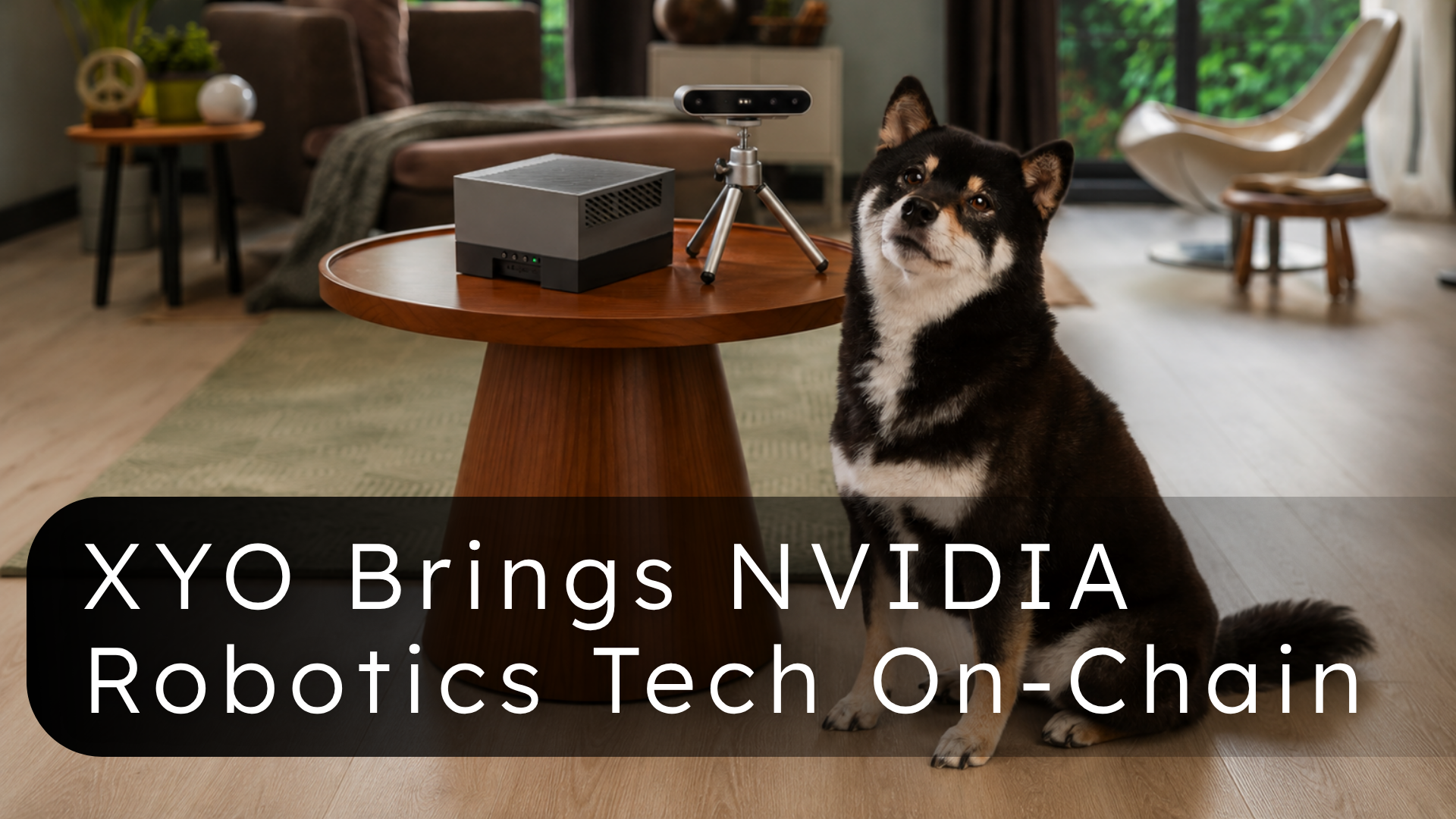
XYO Brings NVIDIA Robotics Tech On-Chain Jun, 30 2026 At 7:42 on a Tuesday morning, a dog pads across a living room, her nails softly tapping across the wooden floor. A camera catches it, and
XYO Brings NVIDIA Robotics Tech On-Chain
Jun, 30 2026
At 7:42 on a Tuesday morning, a dog pads across a living room, her nails softly tapping across the wooden floor. A camera catches it, and the NVIDIA Jetson Orin Nano behind that camera decides what it saw. It classifies the visitor as a dog, attaches a confidence score of 86.4 percent, signs the event cryptographically, and writes it to the XYO Layer One blockchain. A few seconds later the record is permanent, and because this camera's owner chose to publish it, anyone on Earth can verify the moment happened exactly as recorded, years from now as easily as today. An event can just as well stay private, visible only to its owner, and the chain still proves the record exists and has never been altered. Nobody reviewed the footage, and no company had to vouch for it. The machine witnessed the event, and XYO Layer One now carries its testimony.
XYO is one of the largest networks of its kind in the world, with more than 10 million devices already feeding it real-world data. XYO Layer One is the chain that carries it, designed for heavy data, fast and cheap enough to write to constantly and able to keep records for good. NVIDIA’s Orin Nano joins that network as its newest kind of witness.
That is what an on-chain eyewitness looks like, and we’re building one right now.
What we're shipping
The pipeline runs end-to-end on NVIDIA robotics tech, from the moment light hits a sensor to the moment a signed record lands on the XYO Layer One blockchain. The hardware is refreshingly simple: an NVIDIA Jetson Orin Nano, a camera, and a home server. The Orin runs computer vision inference directly on the device, with no cloud round trip and no third party touching the data between observation and record. Detection happens at the edge, signing happens at the edge, and XYO Layer One receives a finished, verifiable event.
Inside the system, XYO handles:
- Event Witnessing. On-device computer vision watches the live feed and detects events in the physical world the moment they happen, with the Orin doing all inference locally.
- Object Classification. The system identifies what it detected, telling a person apart from a dog or a passing car, with the classification recorded as part of the event itself.
- Confidence Scoring. Every event carries the model's confidence level as a first-class field, so each record states how certain the witness was rather than pretending to be perfect knowledge.
- Cryptographic Signing. Each event is signed on the device that observed it, binding the record to its origin so provenance can be verified by anyone, at any point in the future.
- On-Chain Recording. The home server relays each signed event to the XYO Layer One blockchain, where it becomes a permanent, tamper-evident record that its owner can keep private or make public.
The result is NVIDIA robotics hardware that can:
- Witness real-world events and produce proof that they happened, rather than footage someone has to trust.
- Publish object classifications with confidence scores attached, on-chain, in near real time
- Generate verifiable data streams that AI systems, autonomous agents, and robots can act on without trusting the device's owner.
- Serve as the brain behind nearly any sensor, whether mounted on a wall, carried by a drone, or riding on a robot.
- Rehearse a deployment inside a simulated version of the real environment before any hardware is installed.
The living room example is the smallest possible version of this pipeline, and every part of it scales.
Autonomous Witnessing in a Living Room
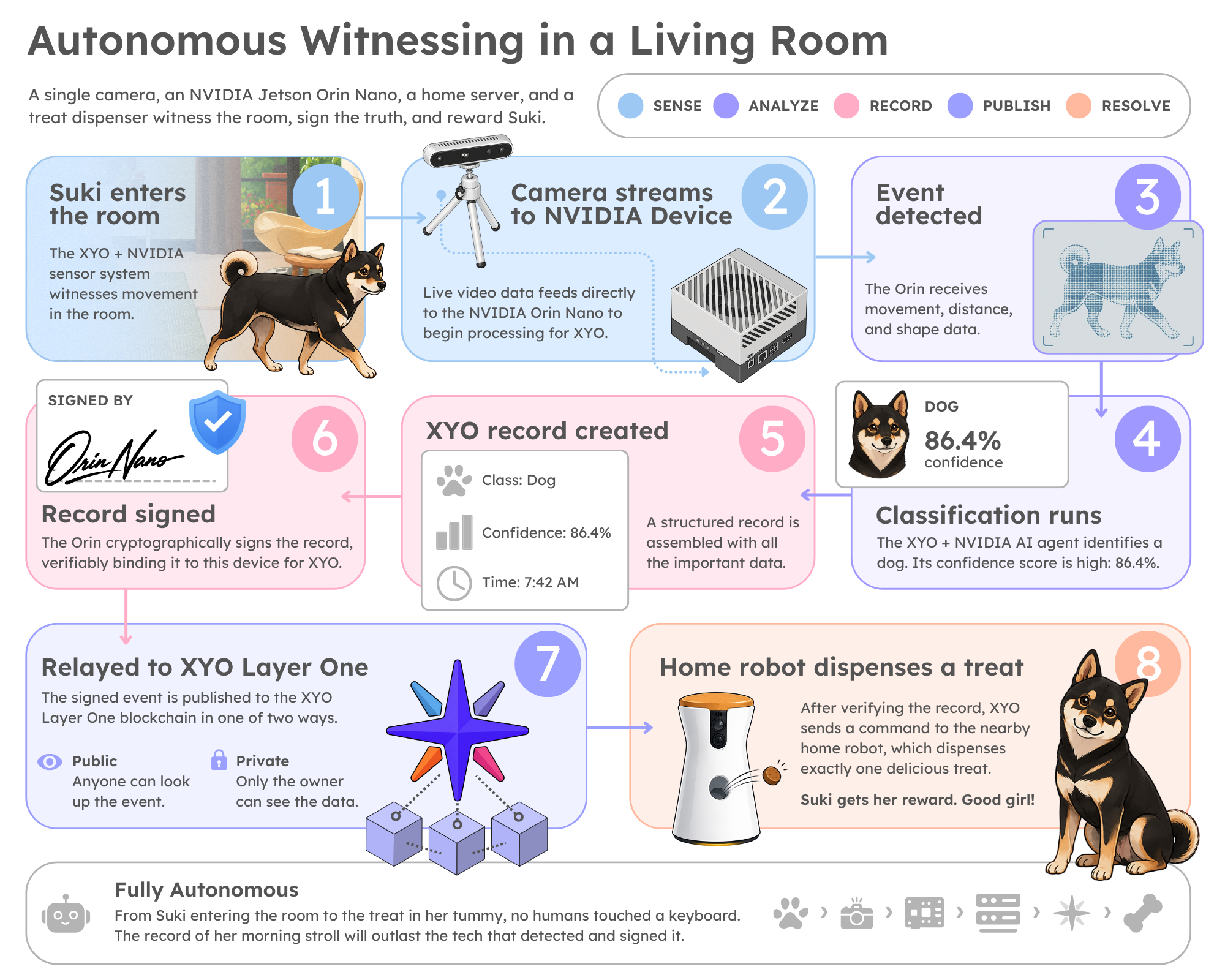
The scene: an ordinary living room, watched by a single camera wired to an NVIDIA Jetson Orin Nano and a home server. From there, every step is autonomous:
- Suki enters the room. The XYO and NVIDIA sensor system witnesses movement as Suki, a black and tan Shiba Inu and the household's most dependable source of detectable events, ambles into the frame.
- The camera streams to the NVIDIA device. Live video feeds directly to the Orin, which runs computer vision inference entirely on the device, with nothing sent to a cloud.
- An event is detected. The Orin picks up movement, distance, and shape data, and registers that something has happened in the room.
- Classification runs. The XYO and NVIDIA AI agent sorts the shape from the background and identifies a dog, with a high confidence score of 86.4 percent.
- The XYO record is created. A structured record is assembled carrying the classification, the confidence score, and the timestamp of the observation.
- The record is signed. The Orin cryptographically signs the record, verifiably binding it to the exact device that witnessed it so its origin can be checked by anyone.
- The event is relayed to XYO Layer One. The signed event is published to the XYO Layer One blockchain in one of two ways: public, so anyone can look up the event, or private, so only the owner can see the data, with the chain proving its existence and integrity either way.
- The home robot dispenses a treat. After verifying the record, XYO sends a command to the nearby treat dispenser, which confirms a dog was witnessed and dispenses exactly one treat. Suki gets her reward.
Nobody touched a keyboard between Suki entering the room and the dispenser paying her in a mini biscuit. The record of her morning stroll will outlast the tech that detected and signed it.
Any sensor can take the stand
All of the intelligence here lives in the Orin. The camera contributes nothing but raw input, which means the witness is not the camera at all. Swap in a different sensor, mount it on a wall, hang it from a drone, or bolt it to a robot rolling through a warehouse, and the pipeline holds: a sensor observes, NVIDIA robotics tech evaluates and signs, and XYO Layer One records.
The Orin already speaks the language of nearly every sensor robotics uses today, and each one is a different kind of testimony:
- A thermal imager catching a motor running hot, with a signed record for the maintenance log and the insurance claim.
- A depth camera over a loading dock proving a pallet left the building at 4:17 PM.
- A microphone array witnessing breaking glass and recording it on-chain before anyone checks the footage.
- A trail camera producing conservation data researchers can verify without trusting whoever maintains it.
- A drone signing crop-condition events a lender or insurer can act on from anywhere in the world.
The pattern is the same in every case. Somewhere, a sensor observes something that somebody else needs to believe, and today that belief rests entirely on the word of whoever owns the hardware. This architecture replaces that word with cryptographic proof, and it does it with devices that already exist. One Orin turns nearly any machine into an on-chain eyewitness for XYO Layer One.
Rehearsing the real world
Alongside the physical build, we are working with NVIDIA Isaac, the simulation and robotics platform behind much of the industry's current momentum, to construct simulations of real environments before a single device is mounted. Isaac Sim, built on NVIDIA Omniverse, produces physically accurate digital twins of real spaces, down to how light moves through a room and how a camera, a depth sensor, or a LiDAR unit would actually perceive it. That means a deployment site can exist as a faithful virtual copy first, and the witnessing pipeline can run against it as if it were already installed.
Inside that rehearsal space, the practical questions get answered cheaply. Where should the camera sit to see the whole room, and what blind spots does that leave. How does the detection model behave at dusk, or when the heater kicks on, or when Suki sprints through at full speed. Isaac Sim can also generate synthetic sensor data from these virtual environments, which means detection models can be tuned against thousands of simulated events for a specific site before the real sensor records its first one. The witness shows up to its post already knowing the territory.
Isaac then carries the work across the gap from virtual to physical. The same NVIDIA stack that runs the simulation feeds deployment through Isaac ROS on the Orin, so what was rehearsed is what ships. Simulation does the preparing, and real hardware does the witnessing.
The witnesses are already installed
The hardware for a planet-scale witness network already exists.More than a billion surveillance cameras are installed worldwide according to IHS Markit estimates, and the video surveillance market isprojected to grow from $35 billion to over $62 billion by 2027, with millions more sensors riding on robots, drones, vehicles, and infrastructure every year. Nearly all of them produce data that vanishes into private servers, where it can be edited, deleted, or simply disbelieved. Meanwhile AI systems, autonomous agents, and robots are being asked to act on real-world data they have no way to verify, and that gap between how much the world is sensed and how little of it can be proven is the market this architecture opens.
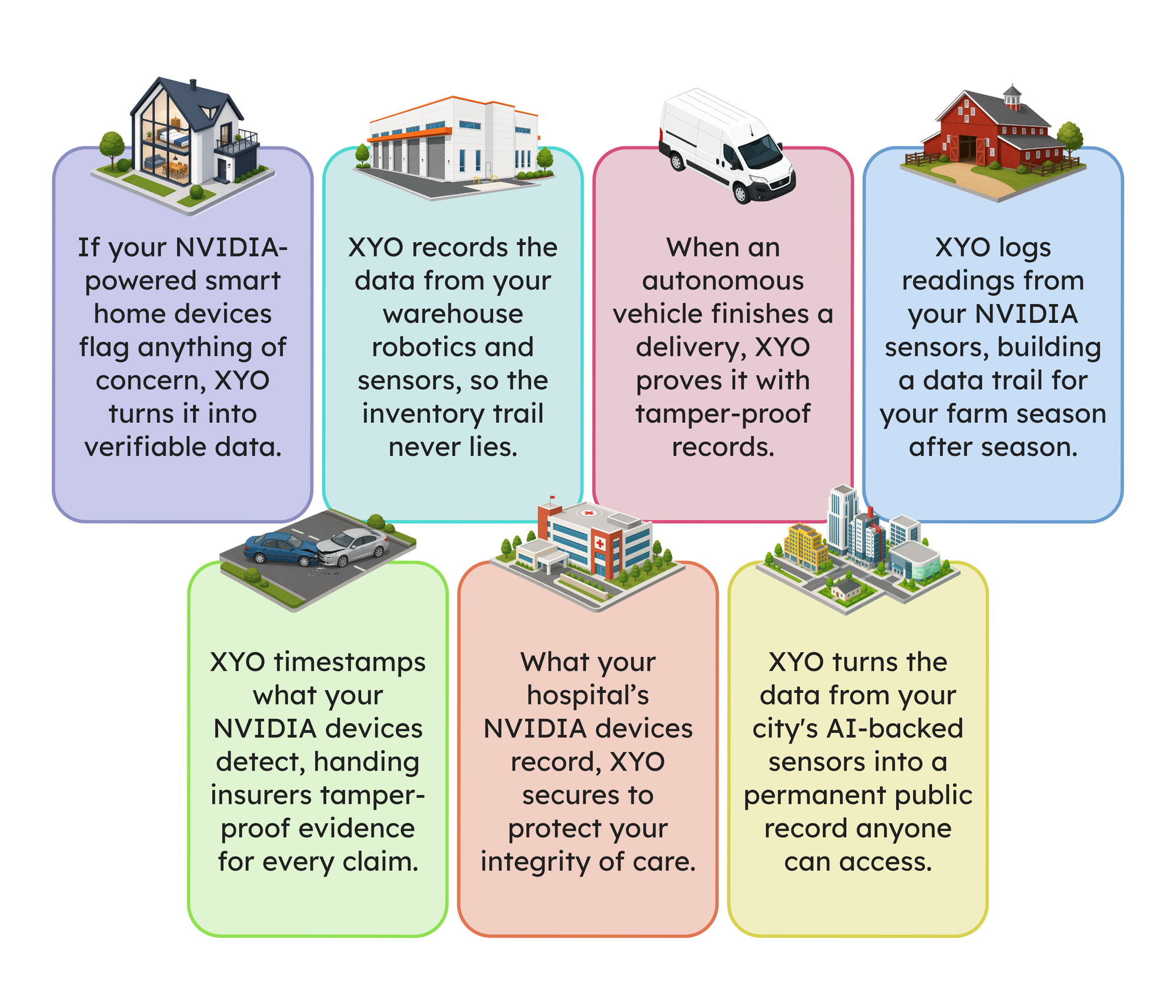
Every one of those existing devices is a potential on-chain eyewitness, and the bar for joining is a compact edge computer and a sensor. The same pipeline running in our living room example extends to:
- Smart homes and security systems
- Warehouses and logistics networks
- Autonomous delivery fleets
- Agriculture and environmental monitoring
- Insurance and claims verification
- Healthcare facilities
- Smart cities and public infrastructure
Any environment where a machine observes something that somebody else needs to believe can run on the same stack. Virtually anyone could build what we are building on XYO Layer One, and that has been the XYO design philosophy since 2018: a network of real-world data only means something when real people can contribute to it.
What comes next
Our next step is support for NVIDIA Isaac ROS, the GPU-accelerated implementation of the ROS 2 standard that runs natively on hardware like the Orin across NVIDIA's robotics platform. That opens this same pipeline to robots already operating in the world, so the machines everyone expects to run the next economy can witness events, sign them, and record them where no one can rewrite them: XYO Layer One.
The machine economy will run on data, and that data is only worth something if it can be trusted. The physical world is coming on-chain, and XYO is where it lands.
Jump into the XYO AI SDK by joining Early Access. Learn more about how XYO and XYO Layer One work by checking out our documentation. Join the XYO community or find out what XYO is all about at xyo.network!