What Does YeBlock's YBT Tokenomics Reveal About Its Future YeBlock's whitepaper, published in 2026, sets a fixed YBT-supply, splits it across eight allocation categories, and attaches a vesti
What Does YeBlock's YBT Tokenomics Reveal About Its Future
YeBlock's whitepaper, published in 2026, sets a fixed YBT-supply, splits it across eight allocation categories, and attaches a vesting schedule to the largest insider shares.
This article breaks down that model: total supply, allocation, vesting, circulating supply, token utility, and the roadmap tied to it. Every figure below comes from YeBlock YBT Tokenomics and official site unless marked otherwise. Readers should treat early-stage numbers as the project's stated plan, not a guarantee.
What Is YBT and How Does It Work Within YeBlock?
YBT is the native token of YeBlock, a decentralized AI network that pools idle compute, storage, and fine-tuned AI models into one protocol.
Inside that network, YBT isn't just a tradeable asset. It's the unit used to pay for AI inference calls, reward node operators, and — eventually — vote on protocol decisions through a DAO.
That's why the tokenomics design matters here more than usual. It tells you who gets paid to build the network YeBlock is describing, and on what terms.
YBT Tokenomics at a Glance
Metric
Details
Token
YBT
Total Supply
121,000,000 (fixed)
Status
Pre-mainnet; token not yet issued (as of this writing)
TGE Allocation
21,000,000 YBT (17.4%)
Largest Allocation
Distributed Referral Mining — 30,000,000 YBT (24.9%)
Foundation & VC Vesting
3 years, linear, with a 1-year cliff
Burn Mechanism
40% of net protocol ecosystem revenue used to buy and burn YBT
Source: YeBlock whitepaper and official tokenomics page
What Is the Total Supply of YBT?
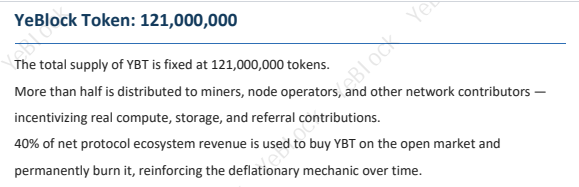
YeBlock YBT has a fixed total supply of 121,000,000 tokens, according to the whitepaper's published tokenomics section. That's a capped figure — YeBlock isn't designing for open-ended inflation.
Layered on top of that cap is a deflationary mechanism: 40% of net protocol ecosystem revenue is meant to be used to buy YBT on the open market and burn it permanently.
That burn only activates once the network is generating real fee revenue. As of this writing, YeBlock has not reached mainnet, and YBT itself has not been issued. The burn plan is a stated design goal, not something happening today.
How Is YBT-Token Allocation Distributed?
The published breakdown splits the 121 million YBT-supply across eight categories:
Allocation
Tokens
Share
Distributed Referral Mining
30,000,000
24.79%
TGE (Token Generation Event)
21,000,000
17.36%
YeBlock Foundation
15,730,000
13.0%
VC (Venture Capital)
14,520,000
12.0%
Node
14,000,000
11.57%
Staking Mining
12,000,000
9.92%
Contribution Mining
9,000,000
7.44%
Partnerships, Grants, Growth
4,750,000
3.93%
Source: YeBlock whitepaper and official tokenomics page.
Distributed Referral Mining
At 24.79%, this is the largest single allocation. It's designed to reach the network gradually, through participation, rather than sitting with a single party from day one.
TGE Allocation
The 21,000,000 YBT (17.36%) set aside for the Token Generation Event covers the tokens tied to the network's initial launch event, separate from the mining-based categories.
Foundation Allocation
At 13%, the Foundation share is the second-largest fixed allocation. It's also one of only two categories with a disclosed cliff-and-vesting structure, covered below.
VC Allocation
Venture capital holds 12% of supply. Combined with the Foundation share, insider allocations total 25% of the fixed supply.
Node Allocation
Node operators are allocated 11.57% of supply, rewarding the hardware side of the network — the GPUs and storage that keep the protocol running.
Staking Mining Allocation
9.92% is set aside for staking rewards, incentivizing token holders to lock YBT in support of network security and operations.
Contribution Mining Allocation
7.44% goes to Contribution Mining, aimed at rewarding broader participation in building out the network beyond running nodes.
Partnerships, Grants & Growth
The smallest slice, at 3.93%, is reserved for partnerships, grants, and general ecosystem growth initiatives.
Put together, Node, Staking Mining, Contribution Mining, and Distributed Referral Mining add up to just under 54% of total supply — more than half the token set aside for people actively running or contributing to the network, rather than the team or investors.
YBT-Vesting and Unlock Schedule
Vesting is the schedule that controls when locked tokens actually become available to sell or use. A large allocation that unlocks all at once can flood the market and push the price down, so the schedule matters as much as the percentage.
Foundation and VC Vesting
According to the whitepaper, the Foundation allocation (13%) and the VC allocation (12%) both vest linearly over three years, with a one-year cliff. None of those tokens unlock during year one; the remaining balance releases gradually over the following two years.
The whitepaper adds a specific detail here too: unlocked team tokens are expected to be re-staked back into the network rather than sold. If they aren't, the whitepaper states that a DAO vote can burn a portion of the unspent team YBT instead. That's a firmer commitment than most projects publish, though it remains a stated intention rather than a coded, on-chain enforcement mechanism as of this writing.
Mining-Based Token Distribution
The mining-based categories — Referral, Staking, Contribution, and Node — work differently. The whitepaper doesn't attach the same fixed-cliff schedule to these allocations. Based on how they're named and described, they appear to be earned through ongoing network activity rather than released on a fixed calendar, though the whitepaper doesn't spell out exact emission rates.
That's a useful distinction to hold onto: calendar-based vesting for insiders versus activity-based distribution for network participants.
YBT-TGE and Circulating Supply
The TGE allocation of 21,000,000 YBT (17.4% of supply) represents tokens tied to the network's Token Generation Event — the point at which YBT is first issued.
As of this writing, that event hasn't happened. YeBlock remains pre-mainnet and the token is unissued, which means circulating supply currently stands at effectively zero.
Once TGE occurs, circulating supply would start with whatever portion of the TGE allocation enters the market at launch, then grow over time as mining-based categories distribute through network activity and as the Foundation and VC allocations pass their one-year cliff. The whitepaper doesn't publish a specific circulating-supply curve beyond the vesting terms already covered above, so exact early-circulating figures aren't available yet.
What Is YBT Used For?
Beyond the supply math, it is designed to do four jobs inside the network, per the whitepaper:
Network incentives — rewarding compute, storage, and AI contributors
Call-fee settlement — the currency used to pay for AI inference calls on the network
Staking — required for node operators and LoRA (fine-tuned AI model) creators
Governance — voting rights once the DAO structure activates
That governance piece isn't live yet. The whitepaper places the first phase of DAO governance at 2027-Q2, tied to the roadmap below.
YeBlock Roadmap: Key Milestones Through 2027
The project's roadmap is broken into quarterly milestones, each with a specific, checkable target rather than a vague promise.
Timeline
Stated Milestone
2026-Q3
Five seed nodes live; single-LoRA inference loop working; core protocol open-sourced under Apache 2.0
2027-Q1
Public test of the Privacy Protocol's TEE (Trusted Execution Environment) channel
2027-Q2
Monthly inference calls above one million; at least five TEE nodes; first phase of DAO governance
2027-Q4
Real call-fee revenue must reach at least 50% of total node income, within 18 months of launch
YeBlock Crypto Reality Check
Just under 54% of supply goes to node operators, stakers, referrers, and contributors, not the team. Foundation and VC tokens vest over three years with a one-year cliff, giving the network time to build usage first. The main risks:
Pre-token, pre-mainnet. No YBT is live on-chain yet.
Undisclosed team. Identities stay private until shortly before mainnet.
No confirmed partnerships. Funding is just the team plus one unnamed VC so far.
Compute verification isn't collusion-proof yet.
Regulatory exposure from mixing DePIN, AI, and a token in one protocol.
The real test: getting call-fee revenue to cover half of node income by 2027-Q4.
Conclusion
YeBlock's tokenomics model centers on a capped 121 million YBT-supply, a burn mechanism tied to real revenue, and a vesting schedule that avoids dumping insider tokens early.
Just under 54% of supply is set aside for network participants — referrers, node operators, stakers, and contributors — while Foundation and VC allocations total 25% and vest over three years with a one-year cliff.
What's still unproven is everything downstream of the token design: whether the network attracts real compute and storage contributors, whether AI developers route paid inference calls through it, and whether the 2027-Q4 revenue milestone gets hit on schedule.
Disclaimer
This article is for informational purposes only and does not constitute financial or investment advice. Crypto assets, especially pre-launch and pre-mainnet tokens, carry high risk. Always do your own research and verify current details on yeblock.com before making any decisions.