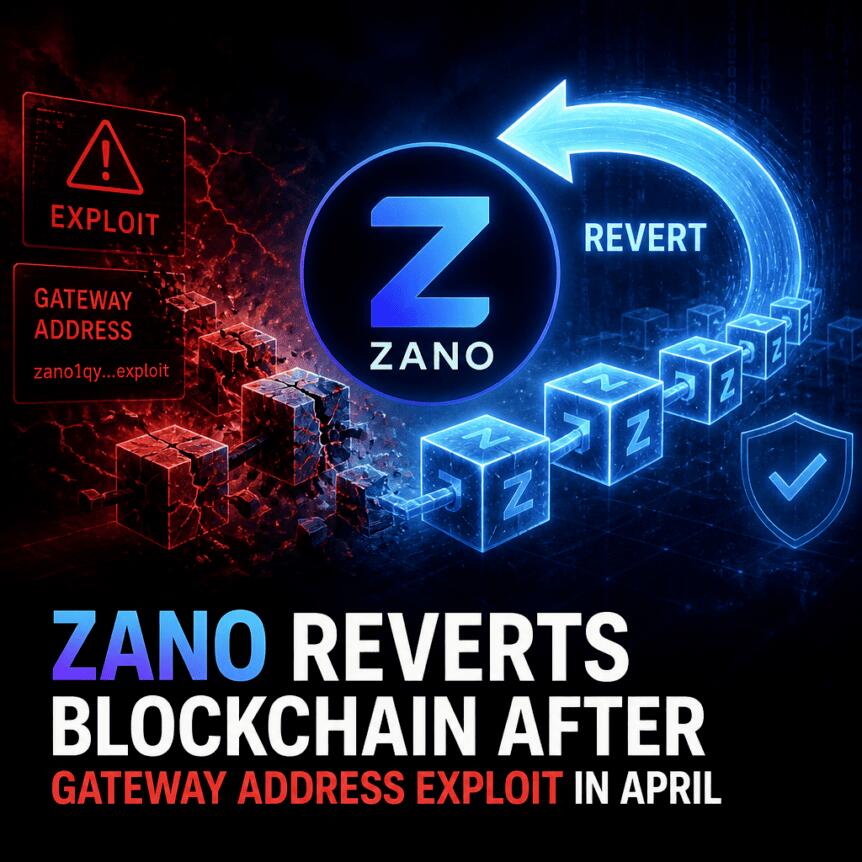
Zano has rolled back roughly a month of blockchain history after it identified a vulnerability tied to “Gateway Addresses” that, according to the project’s core team, enabled unauthorized ZAN
Zano has rolled back roughly a month of blockchain history after it identified a vulnerability tied to “Gateway Addresses” that, according to the project’s core team, enabled unauthorized ZANO and Freedom Dollar (fUSD) to enter circulation.
In an update shared Sunday, Zano said the network was restarted at block 3,833,000—immediately before Hard Fork 6, which introduced the affected functionality. The recovery now depends on ecosystem participants, including nodes, miners, stakers, exchanges, and other services, upgrading to the revised software.
Key takeaways
- Zano restarted the chain at block 3,833,000, rolling back about a month of activity tied to an exploit linked to Gateway Addresses.
- The rollback removes both legitimate transactions from that window and the unauthorized ZANO and fUSD that entered circulation.
- Payments already completed on other blockchains cannot be undone, limiting how far the recovery can reverse real-world settlement.
- Zano says it will handle remediation for affected parties through a reimbursement and claims process, though details have not yet been published.
- The fix requires coordinated adoption by infrastructure operators and service providers, including exchanges and other third parties that integrate with Zano.
Hard Fork 6 and the Gateway Address vulnerability
Zano has not published a full post-mortem as of publication, but it has confirmed that the problem originated with Gateway Addresses—a feature designed to simplify how external platforms such as bridges, exchanges, and payment services integrate with the Zano network.
According to the project’s explanation, Gateway Addresses enable these services to manage funds using a single “account-style” balance rather than handling payments as scattered transaction outputs.
Before Gateway Addresses existed, Zano wallets operated using separate transaction outputs (UTXOs). For exchanges and similar services, that meant incoming funds required blockchain scanning to identify which outputs belonged to a platform, followed by selecting specific outputs for withdrawals.
The introduced feature changed that workflow by offering a different way to account for funds—one that, in Zano’s view, became the pathway for the vulnerability that allowed unauthorized tokens to be minted or otherwise introduced into circulation.
What the rollback does—and what it cannot fix
Zano’s rollback invalidates the on-chain record of the affected period. The project states that transactions processed during that time will no longer appear on the restored chain. It also says the unauthorized ZANO and fUSD created or introduced through the exploit will be removed from the recovered ledger.
However, Zano cautioned that the rollback cannot reverse payments already settled on other blockchains. That distinction matters for users and service operators: if cross-chain transfers or off-chain settlements were completed before the restart, those transfers may not be recoverable even if the originating chain history is rewritten.
Zano also indicated that it is working to account for losses and will publish a reimbursement and claims process. The project did not provide the mechanics of how losses will be calculated or what documentation will be required within the material available at the time of writing.
Why Zano chose to restart the network
Zano’s head of marketing and growth, Quinten van Welzen, framed the decision as a trade-off between restoring the integrity of the currency supply and accepting a painful loss of history.
In statements shared alongside the rollback announcement, van Welzen argued that “doing nothing” would have allowed unauthorized ZANO and fUSD to remain in circulation without limits—effectively diluting holders and breaking what he described as the basic promise a currency makes: a fixed supply. He also suggested that allowing the attacker to retain value would set a dangerous precedent.
He acknowledged that restarting the chain from before Hard Fork 6 carries costs, including the disappearance of about a month of transaction history. At the same time, van Welzen said the rollback restores the supply that users expected and leaves a path for rebuilding trust.
Gateway Addresses and the risks of integration features
Zano’s broader context helps explain why the exploit mattered. The project launched in May 2019 as a layer-1 blockchain focused on private payments. Standard private transactions are designed to conceal senders, receivers, transferred amounts, and asset types.
Beyond its native token (ZANO), Zano allows users to deploy and mint custom digital assets. Freedom Dollar (fUSD) is one such token operating on the Zano blockchain. The vulnerability therefore wasn’t confined to a single token: unauthorized issuance affected both ZANO and an issued asset tied to the same underlying system.
Gateway Addresses were created to make integrations easier—especially for services that need to handle deposits and withdrawals without scanning UTXOs manually. But Zano’s response underscores a central theme in blockchain security: features that simplify custody and balances for third parties can also concentrate risk if they introduce new assumptions or pathways an attacker can abuse.
In that light, the coordination requirements for the restart carry practical weight. Zano said the recovery requires participating nodes, miners, stakers, exchanges, and other services to adopt the update. Without broad adoption, the network could split between versions, complicating settlement and increasing operational risk for trading venues and custodial providers.
For users, the rollback also highlights a limitation that extends beyond Zano itself: even if the originating chain is corrected, downstream effects—especially those involving cross-chain transfers or already-completed settlement—may remain permanent.
Looking ahead, attention should focus on the reimbursement and claims process Zano said it will publish, as well as how quickly exchanges and infrastructure operators finalize adoption of the restart. The project’s next security communications—whether it eventually releases a deeper technical post-mortem—will also be important for assessing whether Gateway Addresses will be reworked to prevent similar failures.
This article was originally published as Zano Reverts Blockchain After Gateway Address Exploit in April on Crypto Breaking News – your trusted source for crypto news, Bitcoin news, and blockchain updates.