Zcash (ZEC) has climbed 8.34% in the past 24 hours to approximately $1,325 on October 12, with trading volume rising 175.80% as traders assess whether the cryptocurrency can overcome resistan
Zcash (ZEC) has climbed 8.34% in the past 24 hours to approximately $1,325 on October 12, with trading volume rising 175.80% as traders assess whether the cryptocurrency can overcome resistance near $1,330 and extend its recovery toward $1,400.
Summary
- Zcash gained 8.34% over 24 hours, trading around $1,325 as investors watched nearby resistance levels.
- ZEC trading volume climbed 175.80% from the previous day, according to CoinGecko market data figures.
- Analyst Austin Barack identified $1,330 as an important trendline level following Zcash’s recent price recovery.
- Eric Van Tassel warned that a possible head and shoulders pattern still needs neckline confirmation.
- Zakura expects postquantum signature instructions in January, while its privacy focused wallet development continues separately.
According to CoinGecko, which recorded ZEC trading near $1,325.39, the cryptocurrency posted a modest 0.92% gain over seven days despite its strong daily performance. Trading volume reached approximately $971.8 million, while its market capitalization stood near $22.51 billion, placing Zcash tenth among tracked cryptocurrencies.
The latest advance followed a correction from September highs near $1,700, with technical indicators offering different readings on whether buying momentum can continue.
You might also like: Zcash plans quantum-safe upgrade: Will ZEC price recover?
Zcash price recovers as trading volume jumps 175%
Zcash has attracted increased trading activity following several weeks of price fluctuations. CoinGecko reported that daily volume rose from the previous day’s level by approximately 175.80%, reaching nearly $972 million during the October 12 market snapshot. The increase accompanied an 8.34% price advance, although the figures alone do not establish whether the activity came primarily from new purchases, existing holders selling or short-term traders adjusting their positions.
With roughly 17 million ZEC circulating, the cryptocurrency’s market capitalization reached approximately $22.5 billion. CoinGecko’s historical data placed the token’s record high at $3,191.93 and its lowest recorded price at $16.08. At the reported October 12 price, ZEC remained approximately 58.30% below its historical peak despite recovering substantially from earlier lows.
Recent trading has taken place after Zcash reached approximately $1,700 during its September rally. The subsequent correction brought the cryptocurrency toward $1,200 before buyers returned. Although ZEC has recovered above $1,300, the October 12 reading remains below the price reached during September’s strongest advance.
A previous Zcash price assessment on October 9 examined the token’s recovery above $1,200 and identified easing selling pressure on shorter trading intervals. The analysis found that ZEC remained above its 50-day exponential moving average, although the 20-day average continued to present resistance at that earlier snapshot.
Zcash price faces resistance near $1,330 and $1,400
Crypto analyst Austin Barack has identified the $1,330 area as a level to watch following Zcash’s rebound from its recent correction. In an October 12 assessment, Barack said ZEC had defended its 50-day moving average and was approaching a descending trendline that could influence its next move. He placed that trendline near $1,330 and described a sustained recovery above it as a possible signal of renewed upward momentum.
Barack stated that holding above the trendline could create a favorable setup for another attempt at Zcash’s historical highs. However, the prediction depends on the cryptocurrency maintaining that level and attracting sufficient buying interest. The analyst further pointed to a reduction in leveraged market positioning, saying open interest had returned toward a lower range of approximately 1.1 million ZEC after the recent correction.
TradingView daily chart showed ZEC near $1,329.35, with the 20-day exponential moving average at $1,321.64. The 50-day average stood at $1,194.97, followed by the 100-day average at $981.82 and the 200-day average at $755.99. Since the price remained above all four averages, the chart maintained a positive longer-term moving-average structure, although ZEC had only a narrow margin above the shortest of those indicators.
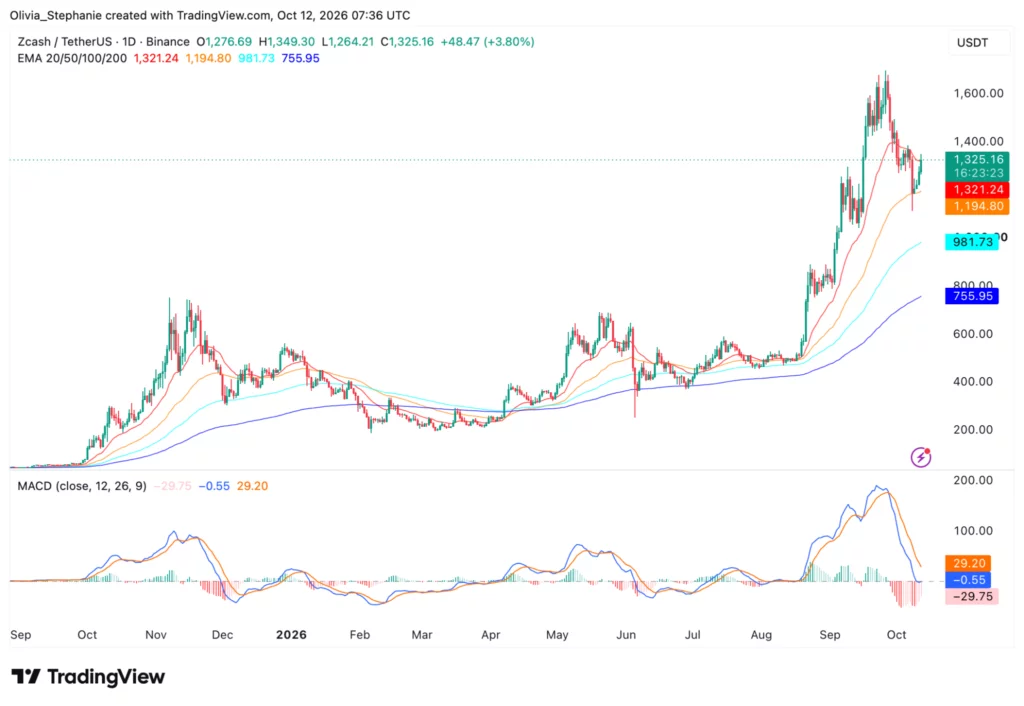
Zcash (ZEC) price chart, source: TradingView
For a stronger recovery, the technical assessment identified $1,350 as the first resistance area, followed by $1,400. A sustained move beyond both levels could bring $1,500 into focus, with further resistance between $1,550 and $1,700. Those figures represent conditional technical reference points, not confirmed future prices.
The earlier October Zcash outlook identified resistance around 1,420–1,500 after the token’s pullback from its September peak. That assessment examined a possible recovery but acknowledged the risk of another decline if buyers failed to maintain nearby support.
Analysts disagree on whether ZEC’s recovery will last
Although Zcash has recovered above $1,300, crypto analyst Eric Van Tassel has raised concerns about a possible head-and-shoulders chart pattern. In an October 12 post, Van Tassel said the cryptocurrency had reached approximately $1,298 during the formation of a potential right shoulder before facing selling pressure. He compared that level with the left shoulder’s high near $1,297, identifying a close match between the two price areas.
A head-and-shoulders pattern typically consists of three price peaks, with the middle peak higher than those on either side. Technical traders often watch for a move below a connecting support line, known as the neckline, before treating the pattern as a possible bearish signal. Van Tassel stressed that the formation remained incomplete and that a temporary move below the neckline would not provide sufficient confirmation.
The analyst explained that the setup would require ZEC to remain below the head of the pattern before breaking beneath its neckline and holding below that level. He cautioned that there was “no guarantee this pattern plays out”, describing it as a risk-management observation rather than a prediction. The supplied October 12 price readings above $1,300 show why the pattern should not be presented as an already confirmed reversal.
The daily MACD indicator offered another cautious signal. Its MACD line stood at -0.21, below the signal line at 29.27, while the histogram remained negative at -29.48. According to the chart interpretation, the negative reading suggested that upward momentum had weakened despite the latest daily price increase.
If selling resumes, the technical assessment identified initial support between $1,300 and $1,322, followed by the 50-day exponential moving average near $1,195. A sustained decline below that longer-term support could bring the $1,000 area into focus, with the 100-day moving average near $982. Alternatively, continued trading between $1,200 and $1,400 would fit the consolidation scenario described in the supplied analysis.
Zcash developers target January for quantum-resistant signatures
Away from market trading, Zcash infrastructure developer Zakura has outlined plans to introduce additional protections against future quantum-computing threats. In an engineering update, developer Roman Akhtariev said the team expects post-quantum signature instructions to become available in January 2027. The proposed technology would allow transparent Zcash transactions to use hash-based signatures as an alternative security mechanism.
Zcash supports transparent transactions, which reveal payment information publicly, and shielded transactions, which protect transaction details through privacy technology. Zakura’s proposal focuses on transparent wallets, where public keys can become visible when users spend funds. The team recommends moving remaining funds to fresh addresses and using hash-based signature techniques to reduce exposure to future attacks against existing cryptographic systems.
According to Akhtariev, the design combines rotating addresses with a technology called private information retrieval, or PIR. The system allows wallet software to search transaction records without revealing every address being checked to the server handling the request. Zakura said the approach could help users track balances across multiple transparent addresses while reducing the amount of wallet information disclosed during synchronization.
The developer identified Winternitz One-Time Signatures, commonly called WOTS, as a possible hash-based backup signature method. Unlike conventional elliptic-curve signatures, hash-based approaches rely on cryptographic hash functions. Zakura described its proposed implementation as part of an effort to prepare transparent transactions for advances in computing capabilities, although the January schedule remains a development target and does not establish that a mainnet upgrade has been approved.
Separately, Zcash developers have continued work on the NU7 network upgrade. The project’s official protocol repository records a testnet activation height of 4,465,026, while the mainnet activation schedule remains subject to the required development decisions.
The Zcash Foundation’s Zebra release documentation identifies November 5 as a tentative mainnet target for NU7, with a network upgrade intended to reduce the target block interval from 75 seconds to 25 seconds. Developers have instructed affected node operators to prepare compatible software ahead of the proposed activation, while the final rollout remains dependent on testing and release readiness.
Zakura’s engineering update states that experimental private queries are already available through Vizor wallet settings. The team plans to expand the feature while continuing development of the proposed January signature support, with the experimental option accessible through a setting labeled Private queries.
Disclosure: This article does not represent investment advice. The content and materials featured on this page are for educational purposes only.
Read more: Jeonbuk Bank becomes first South Korean lender to offer Bitcoin backed loans