Zebec Network Tokenomics: How ZBCN Utility, Staking and Supply Work Zebec started as a payment-streaming protocol on Solana. Today it runs payroll, crypto cards and a consumer app, and one to
Zebec Network Tokenomics: How ZBCN Utility, Staking and Supply Work
Zebec started as a payment-streaming protocol on Solana. Today it runs payroll, crypto cards and a consumer app, and one token ties those products together. This guide covers Zebec Network tokenomics in plain language: what ZBCN is used for, how it is staked and governed, how its supply was split at launch and what has changed since. The facts come from Zebec’s own website and docs.
Key Takeaways
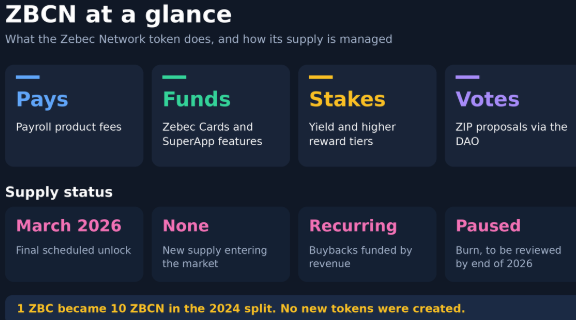
ZBCN pays for payroll products, funds cards, earns staking benefits and carries votes.
The launch supply totals 100 billion, and the final scheduled unlock landed in March 2026.
The switch from ZBC to ZBCN added no new tokens, and buybacks are funded by product revenue.
About Zebec Network
Zebec has been building decentralized payment infrastructure since 2021. It began with real-time payment streaming and now covers stablecoin payroll, crypto debit cards, a DePIN payments pilot and a consumer app. Payroll lets staff get paid by the second, and the cards let holders spend crypto at merchants worldwide.
The site lists $500M in annual payroll volume, 250+ enterprise clients, 50K+ monthly users on- and off-chain, and 20+ chains with 150+ tokens integrated. Listed partners include Solana, Algorand, Mastercard, Circle, Stellar and Deutsche Bank.
Source: official website.
About the Zebec Network Token
ZBCN is the Zebec Network token and its governance and utility token. It is not a separate asset. It is the new ticker of the original ZBC, and it is the exclusive native token of the network. It keeps the original supply and tokenomics framework set under ZBC, while its uses have widened across payroll, cards, governance and ecosystem incentives.
Zebec says demand for ZBCN should come from real product use, such as payroll fees, app features, staking, incentives and card spending. It says this demand does not come from base-layer gas.
ZBC to ZBCN Migration and the 1:10 Token Split
In mid-2024, each ZBC was swapped for 10 ZBCN. Zebec compared it to a stock split. A lower unit price makes the token easier to access, and fees can use whole numbers, such as 1 ZBCN instead of 0.1 ZBC.
No new supply was created. The old ZBC was burned by smart contract during the swap, and vesting and lock-up schedules stayed the same. The swap ran from April to May 2024 on a dedicated migration portal, and holders on exchanges needed to do nothing because the platforms handled it.
ZBCN Supply: How the 100 Billion Was Split
The launch chart sets out how supply was shared and vested. It adds up to 100,000,000,000 tokens, and half of it went to the community.
Allocation
Amount
Share
Lockup
Vesting
Seed Round
9,283,333,330
9.28%
6 months
3 years
Private Round
10,973,095,240
10.97%
6 months
3 years
Public Sale
5,743,571,430
5.74%
Variable
Variable
Market Making
4,000,000,000
4.00%
None
3 years
Contributors
20,000,000,000
20.00%
6 months
3 years
Community and Rewards
50,000,000,000
50.00%
None
4 years
Source: official tokenomics documentation.
The public sale terms vary. About 165M was fully unlocked, and the rest stayed locked for the next 6 and 12 months. Zebec points readers to its tokenomics post for current figures.
ZBCN Token Utility: What It Pays For
Use
How it works
Payroll fees
Employers pay in ZBCN, held or converted from stablecoins
SuperApp
Holding, using and staking unlock features and lower fees
Cards
It can fund every Zebec Card
DeFi collateral
Supported integrations allow payroll-based borrowing
Ecosystem rewards
ZePIN pilots, developer grants and community work
The payroll row matters most. Fee demand follows payroll volume, so it grows only if enterprise adoption grows. Beyond fees, holders may unlock reduced or zero fees on select products, priority access to premium cards, eligibility for partner airdrops and invitations to Zebec events.
Zebec SuperApp
The app is an early-access consumer product for earning, spending and staking, available on the App Store and Google Play. It stays a core access and incentive asset across payroll, treasury, card and rewards features.
Holding and using ZBCN inside the app can unlock enhanced features, preferential pricing, and reduced or eliminated fees on select products.
Zebec Card Rewards
Zebec offers Silver, Carbon and Black cards. From mid-2026, ZBCN balances and participation inside the SuperApp unlock tiered rewards on card spend, with higher tiers earning more.
Older Zebec material cited up to 5% ZBCN back on spending. Current tiers should be checked in the app before relying on any rate. Holders also get priority access to premium cards.
ZBCN Staking
Holders can stake ZBCN to earn yield and keep their governance rights. Staking also lifts a wallet into higher incentive tiers in the SuperApp, which means lower fees, extra features and better card rewards.
Staking is one of several routes to those benefits. Holding and active product use can also qualify, so employers and employees can take part in different ways. From January 2026, staking moved into a SuperApp module with updated terms. The tokenomics post names no fixed yield, so the terms in the app are the ones that count.
ZBCN Governance
Zebec runs a hybrid model. Holders vote on-chain, and the discussion happens off-chain first.
Proposals can come from the community, contributors, partners or investors. Briefings and consultations are published, and proposals with enough support go to an on-chain vote. Zebec Improvement Proposals (ZIPs) run for 24 hours to 7 days, and a simple majority decides. Votes are recorded on-chain at dao.zebec.io.
One example is ZIP-4, approved in January 2024 with 90.52% of more than 200 votes. It paused the burn mechanism, kept recurring buybacks and freed more treasury resources for product development and growth.
Unlocks, Buybacks and Burns
The final scheduled unlock landed in March 2026, four years after the original token launched. No new supply enters the market, and Zebec says the early backers have already realized returns.
Buybacks began in late 2023 with the card program. They are funded by revenue from payroll, cards and partner contracts, and annualized buyback volume has grown by over 70%. Zebec’s buyback report lists about 456 million repurchased after the migration across 10 rounds. Tokens bought back are held in an on-chain buyback treasury wallet and with Uphold Institutional.
Burns are paused. The DAO expects to review by the end of 2026 whether to bring them back alongside buybacks.
What to Check Before Relying on These Numbers
Zebec Network tokenomics has shifted since 2024, so a few points need a second look.
The allocation chart shows launch figures, not today’s circulating supply.
The tokenomics post is dated January 2026, so reward tiers and staking terms may have changed.
Buybacks depend on revenue and are not a guarantee of price or supply.
The SuperApp is in early access, and not every product is available in every country.
Final Thoughts
Zebec Network tokenomics ties one token to payroll fees, card rewards, staking and votes, with a fully distributed supply and revenue-funded buybacks. The design is clear, but rewards and terms change, so readers should confirm them on zebec.io before acting.
Disclaimer: This article is for information only and is not financial advice. Crypto is volatile, so readers should do their own research before they buy, stake or hold any token.
