Zebec Protocol: How Real-Time Payroll and ZBCN Work Together Most payment systems move money in lumps. A salary lands once a month, and a transfer waits for a bank to clear it. Zebec was buil
Zebec Protocol: How Real-Time Payroll and ZBCN Work Together
Most payment systems move money in lumps. A salary lands once a month, and a transfer waits for a bank to clear it. Zebec was built around a different idea, where money flows continuously.
The engine behind that idea is Zebec Protocol, and the name causes more confusion than it should. It sits beside Zebec Network, the Zebec Super App and Zebec Enterprise Payroll, and many readers cannot tell which is which.
This guide covers what the protocol does, how streaming works, where ZBCN fits and what developers can build.
Key Takeaways
Zebec Protocol is the on-chain layer that Zebec's payment products are built on.
Payments stream per second, and developers can build with SDKs for Solana, Stellar and Aleo.
The latest published whitepaper is version 3.1, with a revised edition in progress, so the tokenomics and developer docs are the current sources.
What Is Zebec Protocol and How Does It Work?
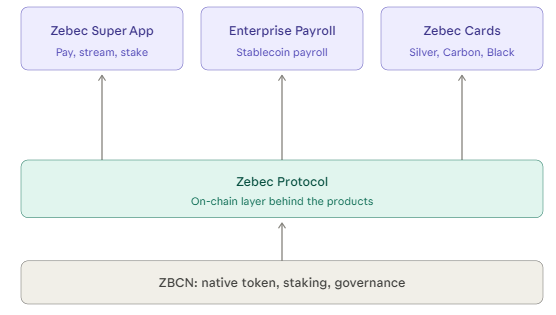
According to the docs, Zebec Protocol is the on-chain layer behind Zebec's payment products. Its docs section covers the protocol design and the economics of ZBCN, the network's native token.
Zebec has been building since 2021 and started as a payment streaming protocol on Solana. Today it supports real-time payroll, crypto cards and a consumer app.
The homepage lists $500M in annual payroll volume, 250+ enterprise clients, 50K+ monthly users, and 20+ chains with 150+ tokens integrated. These are project-stated figures.
Source: official website.
How Do Zebec Streaming Payments Work?
Zebec streaming payments replace the lump-sum transfer with a steady flow. The sender locks funds and sets the terms, and the receiver can claim what has flowed so far.
The earlier Zebec docs describe the cycle below. Those pages now sit in the archive, but they show the logic clearly.
Step
What happens
Deposit
Funds move into a Zebec wallet
Start
The sender sets a start time, end time, amount and receiver
Flow
Tokens build up for the receiver as time passes
Control
The sender can pause, resume or cancel
Withdraw
The receiver takes out what has streamed
Only the receiver can withdraw streamed tokens. The sender can cancel at any point within the stream period.
The streaming logic runs in smart contracts, which is why the same idea can sit behind very different products.
Zebec Protocol Streaming Payments in Everyday Products
Most users never touch the protocol directly. They meet it through apps.
Zebec Enterprise Payroll is stablecoin payroll that settles in seconds and streams by the second. That makes real-time payroll possible, with earnings building up per-second instead of at month end.
The Zebec Super App brings cards, streaming payments, staking, yield and fiat off-ramps into one place. It runs on the web, iOS and Android.
Zebec cards come in three types:
Silver: a single-use prepaid card
Carbon: a reloadable prepaid card
Black: a premium reloadable card with higher limits for enterprises and invited users
The graphic below shows how the layers stack.
Role of ZBCN in Protocol
ZBCN is the native token. Zebec's own tokenomics post calls it the governance and utility token of the network. It is also the next generation of ZBC, the original token from the protocol's early days.
Zebec Protocol ZBCN ties into two features named in the docs and on the site. Staking happens in the Web SuperApp, and governance runs through the Zebec DAO, where holders vote on proposals.
Exact supply, distribution and vesting figures live in the tokenomics post on zebec.io, which the docs name as the canonical source.
Zebec Protocol vs Zebec Network
The official documentation describe the protocol, the network and the ZBCN token as the layers behind Zebec's products. The names overlap, so the table separates them.
Name
What it covers
Zebec Protocol
The on-chain layer the payment products are built on
Zebec Network
The wider platform and brand, including the apps people use
ZBCN
The native token tied to staking and governance
In short, the protocol is the foundation, the network is the whole house, and the token is one part of how it is run.
Zebec Protocol SDK: What Developers Get
The docs list several developer tools. The Protocol SDK family covers streaming, staking and cards.
Tool
What it does
Chains
Streaming SDK
Programmable real-time payment streams
Solana, Stellar, Aleo (public and private)
Staking SDK
ZBCN staking, reward tracking, tier calculations
Solana
Partners Card SDK
Virtual card purchases and Carbon top-ups
EVM, Solana
Partner API
Top-ups for existing Carbon cards
Examples for EVM, Solana, Canton, Zano
The Solana version of the Streaming SDK uses Anchor, and the Stellar version uses Soroban. All are TypeScript SDKs.
Zebec Protocol Whitepaper: What to Know
Version 3.1 is the latest published edition of the Zebec Protocol whitepaper. The docs add a warning: parts of it predate the current network, product suite and token model.
A revised edition is in progress. Until it arrives, the docs say to treat the Tokenomics page and the developer docs as current.
Final Thoughts
Zebec Protocol is easiest to understand as a foundation. It is the on-chain layer where money flows per second, and the Super App, payroll tool and cards are the doors people use to reach it.
Anyone researching it should start with the current docs, not the older whitepaper. This article is for information only and is not financial advice.
Disclaimer: This article is for information only. It is not financial, investment or legal advice. Plans and figures may change, and crypto carries a risk of loss.