How Does the Zebec Super App Connect Payroll, Cards and ZBCN Staking? Crypto users lose half their day hopping between tabs. One site streams the salary. Another issues the card. A third hand
How Does the Zebec Super App Connect Payroll, Cards and ZBCN Staking?
Crypto users lose half their day hopping between tabs. One site streams the salary. Another issues the card. A third handles staking.
The Zebec Super App tries to end that routine. It puts stablecoin streaming, Mastercard cards and staking behind one login.
This guide covers what the app does, how a first session works, and what to check before depositing anything.
Key Takeaways
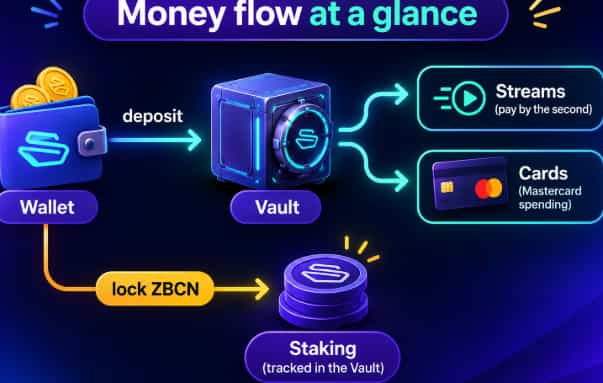
Streams and cards draw from one Vault balance, and the Vault also tracks staked ZBCN. The wallet always stays in the user’s own hands.
The app supports 21 chains, but staking needs a Solana wallet.
Staked ZBCN stays locked until the lockup ends, and Zebec’s own site still tags the app as early access.
What Is the Zebec Network and Who Is Behind It?
Zebec has been building decentralized payment infrastructure since 2021. The Zebec network is the on-chain layer under its products, and ZBCN is its native token, used for staking and governance votes.
The stated mission is simple: blockchain apps that make financial transactions easy and open to everyone. The company’s official site shares a few headline numbers.
Metric
Figure
Annual payroll volume
$500M
Enterprise clients
250+
Monthly users, on- and off-chain
50K+
Chains integrated
20+
Tokens integrated
150+
Partners listed there include Mastercard, Circle, Solana, Stellar and Deutsche Bank.
Source: official website.
How Does the Zebec Super App Combine Payroll, Cards, and ZBCN Staking?
Zebec describes the product as a Web3-native consumer financial management app. In practice, it is a Zebec financial app with one deposit point and three main uses.
The core Zebec Super App features look like this:
Feature
What it does
Where it lives
Streaming payments
Pays recipients by the second, shown as Payroll in the Vault
Stream tab
Cards
Mastercard cards funded from crypto
Cards tab
Staking
Locks ZBCN for a fixed period to earn yield
Staking tab
Fiat off-ramp
Redeems tGBP to a UK bank account
tGBP button
Vault
Deposits, withdrawals and balances
Vault tab
Two yield products, Dolomite and Blend, also sit inside the web version. Put together, this works as a unified finance platform for people who would rather not manage five separate accounts.
How Does the Setup Work, Step by Step?
Here is how Zebec Super App works from the first click:
Open superapp.zebec.io and verify an email address with a 6-digit code.
Connect an existing wallet. Solana is the default, and “Switch Network” opens other chains.
Add a legal name and address. Cards and fiat off-ramps need both.
Deposit assets into the Vault to fund streams and cards. Staking uses ZBCN straight from the wallet.
Keep a little native token, like SOL on Solana, for network fees. The mobile app on iOS and Android covers cards, top-ups from 150+ cryptocurrencies, and Apple Pay or Google Pay. Large treasury work stays on the web.
Money flow at a glance
Where Do Deposits Go Inside the Vault?
The Vault is where money enters and leaves. The treasury balance is whatever a user moved over from the wallet. Under it, three figures show payroll, staking and cards, so the Zebec Super App payroll and staking numbers sit side by side.
For basic crypto asset management, the Assets table lists wallet balance next to treasury balance. A “Hide zero balances” switch cleans up the list.
Both directions are on-chain payments. A network fee applies, and balances update after confirmation. Withdrawals also need enough native token to cover that fee. Full steps sit on the Vault dashboard and in the official docs.
Can Money Really Stream by the Second?
Yes. Instead of sending 1,000 USDC on the last day of the month, a sender opens a stream. The recipient’s balance grows by the second and can be withdrawn any time. Senders can pause, resume or cancel.
The Stream tab doubles as a payment dashboard. It shows incoming and outgoing streams, top disbursed assets, a six-month payment summary and recent payments. People who remember the older Zebec Pay app will spot the same streaming idea here.
Two catches. A stream stops when its funding runs out, and recipients must withdraw what they have earned. Companies that need full payroll runs use the separate Enterprise Payroll portal instead.
How to Choose Between Zebec Silver, Carbon and Black Cards?
A crypto payment app only matters if the money can leave crypto. Zebec cards run on Mastercard, so they work wherever Mastercard is accepted, subject to regional limits.
Card
Type
Max balance
Best for
Silver
Single-use prepaid
Up to $1,000
One-off online purchases
Carbon
Reloadable prepaid
$10,000 / £5,000 / €5,000
Daily spending and subscriptions
Black
Premium reloadable
Up to $50,000
High spenders, enterprises, invited users
All three support Apple Pay and Google Pay. Availability depends on the user’s country. A card also spends from its own balance, so it needs a top-up before use.
Is Locking Up ZBCN Worth It?
That depends on how long a user can leave tokens untouched. ZBCN staking is simple on paper: pick an amount, choose a lockup duration, and watch the APY and total rewards update before confirming.
The rules matter more than the pitch:
No unstaking before the lockup ends, not even in part.
The maximum stake is 5,000,000 ZBCN per wallet.
Nothing happens automatically at maturity. The user unstakes manually, which returns the principal plus the yield earned.
The APY shown applies only to the stake being opened. Later positions can get different rates.
What Should Users Check Before Depositing?
Start small. Anyone testing the Zebec Super App should confirm three things first. Is early-access status acceptable for their risk level? Does their country qualify for the card they want? Can they afford to lock ZBCN for the full term?
One safety note stands out. Zebec support never asks for a full card number, CVV or PIN. Zebec’s own footer also warns that digital assets carry risk and funds can be lost. Questions go to [email protected].
The Bottom Line: Is One Dashboard Enough?
The Zebec Super App will not replace every wallet or bank, and it does not claim to. What it does is cut the tab-hopping between streaming, spending and staking.
For freelancers paid in stablecoins, crypto spenders and ZBCN holders, one login for all three is a practical idea. Whether it earns a permanent spot depends on how the early-access product matures. Start small, read the rules, and let the numbers decide.
Disclaimer: This article is for information only and is not financial advice. Digital assets are volatile and carry risk. Do your own research before depositing or staking.