Markets7 min read
Why Is Dash (DASH) Price Down Today?
TLDR Keypoints Dash (DASH) is trading at $35.38, down 4.09% in the past 24 hours, according to CoinGecko data as of 08:52 UTC on November 28, 2026. The decline comes after MEXC delisted both
ZelleUSD vs USDC: Key Questions About Access, Freezing and Regulation In the ZelleUSD vs USDC contest, Circle's coin is far larger and more open. The Zelle token is tiny but tied to a bank pa
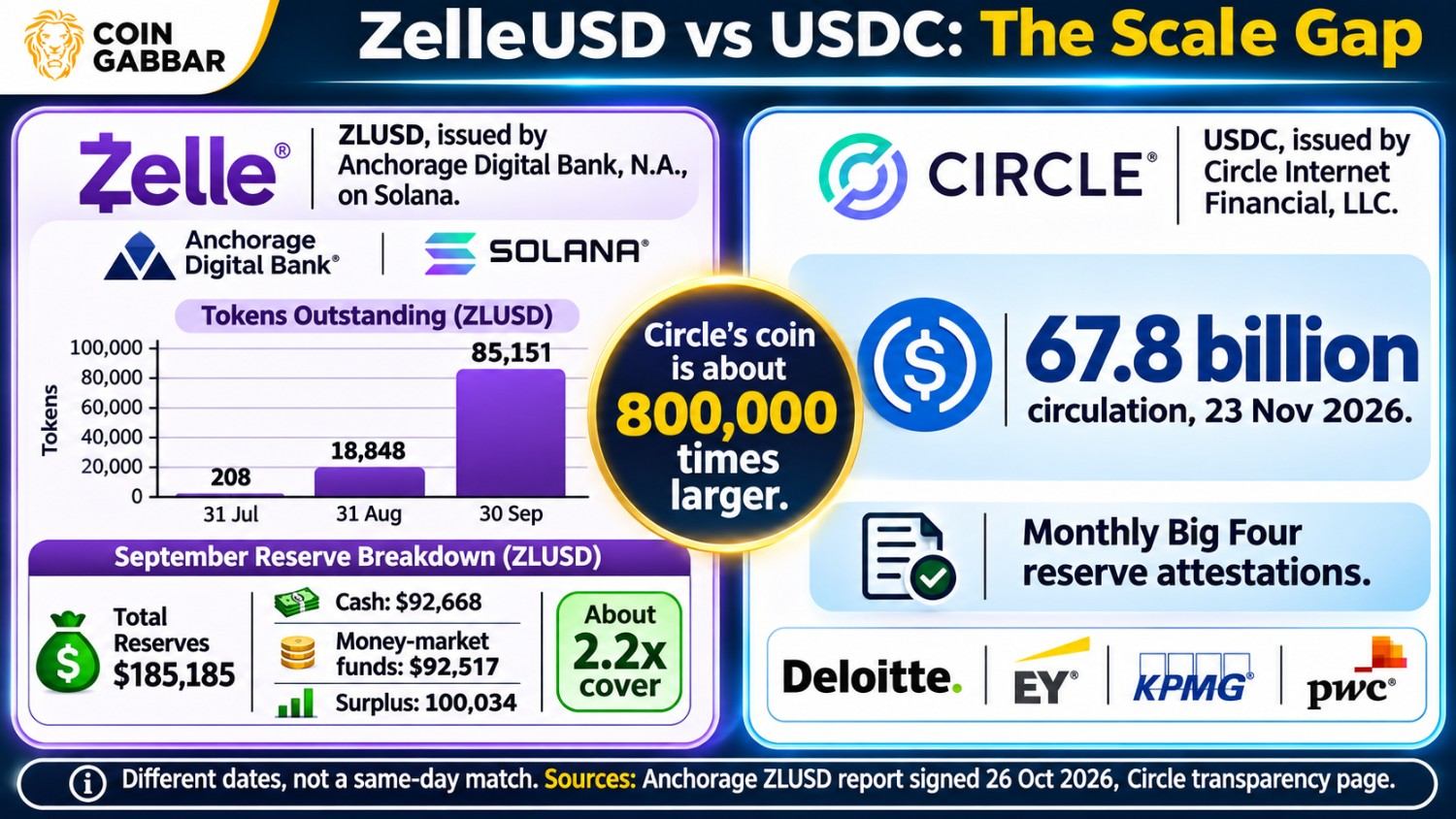
In the ZelleUSD vs USDC contest, Circle's coin is far larger and more open. The Zelle token is tiny but tied to a bank payment network. Circle reported $67.8 billion in circulation on 23 November 2026, while ZLUSD had 85,151 tokens in its latest reserve report. The GENIUS Act starts on 18 January 2027, so both issuers will face the same federal rules.
The ZelleUSD vs USDC question matters because two digital dollars are entering the same payments market from opposite sides. One comes from a network owned by large US banks. The other already runs across exchanges, wallets, and blockchain apps.
What Are ZelleUSD and USDC in Simple Terms?
ZelleUSD, also called ZLUSD, was announced by Early Warning Services on 11 June 2026. Early Warning runs Zelle. The legal issuer is Anchorage Digital Bank, N.A., and the token lives on Solana. Its first announced cross-border target was a single overseas market, with more planned later.
USDC is issued by Circle Internet Financial, LLC, and has been around since 2018. People reach it through exchanges, wallets, payment firms, and finance apps. Both coins aim to hold a value of $1. In ZelleUSD vs USDC terms, their paths to users are very different.
How Do ZelleUSD vs USDC Compare on Reserves and Supply?
Anchorage'sreserve reports show the early scale, and a guide to how reserves are checked explains the method. On 31 July 2026, only 208 tokens were outstanding. By 31 August the count was 18,848, and by 30 September it was 85,151. The September report listed $185,185 in reserves, made of $92,668 in cash and $92,517 in money-market funds.
Circle'stransparency page shows $67.8 billion in circulation on 23 November 2026. Circle also publishes monthly reserve attestations from a Big Four firm. The two figures come from different dates, so they are not a same-day match.
A worked example shows what the numbers mean. September reserves of $185,185 against 85,151 tokens gave a cushion of about 2.2 times, or $100,034 in extra assets. That looks safe, yet the whole supply was tiny. Circle's coin is roughly 800,000 times larger.
Which Blockchains Does Each Stablecoin Use?
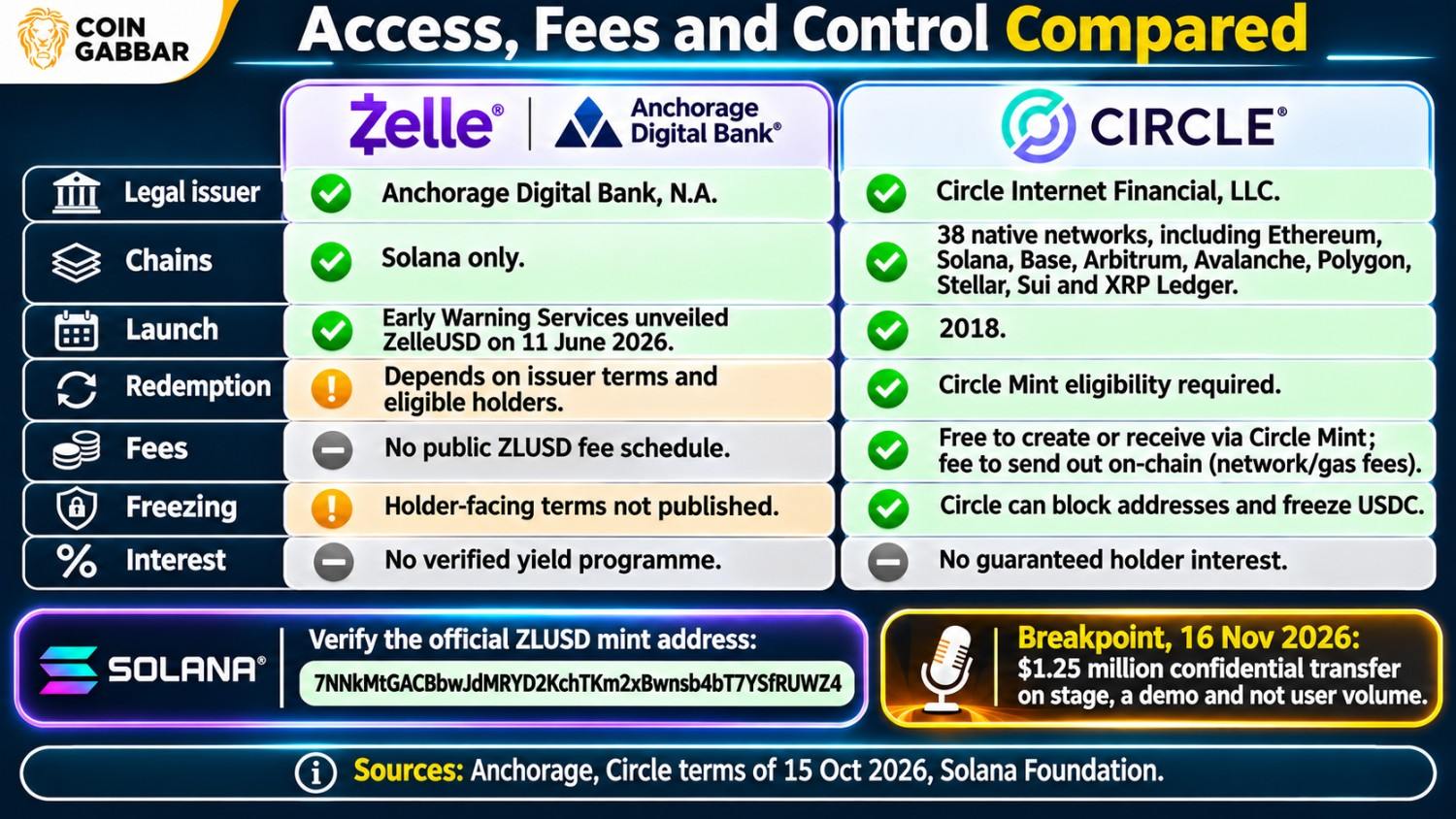
Anchorage's report names Solana as the only chain for ZLUSD and gives one official token address. Anyone looking for the token should verify that address against the report, because names and tickers are not unique.
Circle'sproduct page lists 38 native networks, including Ethereum, Solana, Base and Arbitrum. That reach lets the coin move between many wallets, exchanges and lending apps. A wider network also means more places where a mistake can happen. For ZLUSD, no other native chain has been confirmed. The ZelleUSD vs USDC gap in reach is therefore large today.
Who Controls the Two Coins, and Can Either Be Frozen?
Zelle is run by Early Warning Services, which seven large US banks own. Those banks are Bank of America, Capital One, JPMorgan Chase, PNC, Truist, U.S. Bank, and Wells Fargo. Anchorage, a national trust bank supervised by the OCC, issues the token. Circle won approval in July 2026 to set up a trust bank, but that is separate from who issues USDC.
In ZelleUSD vs USDC terms, Circle's rules let it block addresses and freeze coins linked to illegal activity or a breach of its rules. The public reserve report for ZLUSD does not spell out holder-facing freeze rules, so no one should assume the token cannot be frozen. Both coins have legal issuers. The real difference is the fine print in each contract.
What Do Fees and Redemption Mean for ZelleUSD vs USDC Payments?
Three costs matter: the blockchain fee, the exchange or wallet fee, and the cost of turning dollars into local cash. Circle says eligible Circle Mint users pay nothing to create or receive the coin, but it charges to send it out on-chain. No public ZLUSD fee schedule exists yet, and old Zelle pricing should not stand in for it.
Redemption also needs care. The accountant's report on ZLUSD checks the reserve claim and is not a full legal audit. It points readers to the issuer's terms to see who may redeem. Holding a token is not the same as having a right to redeem it for $1 directly.
On 18 November 2026, theSolana Foundation reported a live $1.25 million confidential transfer of ZLUSD on stage. That was a demonstration and not real user volume.
Which Stablecoin Suits Cross-Border Payments Better?
In ZelleUSD vs USDC payments, Early Warning described ZLUSD as the base for future overseas payments through participating banks. It did not publish a consumer fee, an exchange rate, or a recipient rule. Circle says its coin is available in more than 185 countries, yet real use depends on local exchanges, wallets, and bank links.
A low Solana fee does not make a transfer free in ZelleUSD vs USDC or any other test. Currency conversion and cash-out charges often cost more than the network fee. Neither coin should be called cheaper until one real transfer is priced from end to end.
What Changes When the GENIUS Act Takes Effect on 18 January 2027?
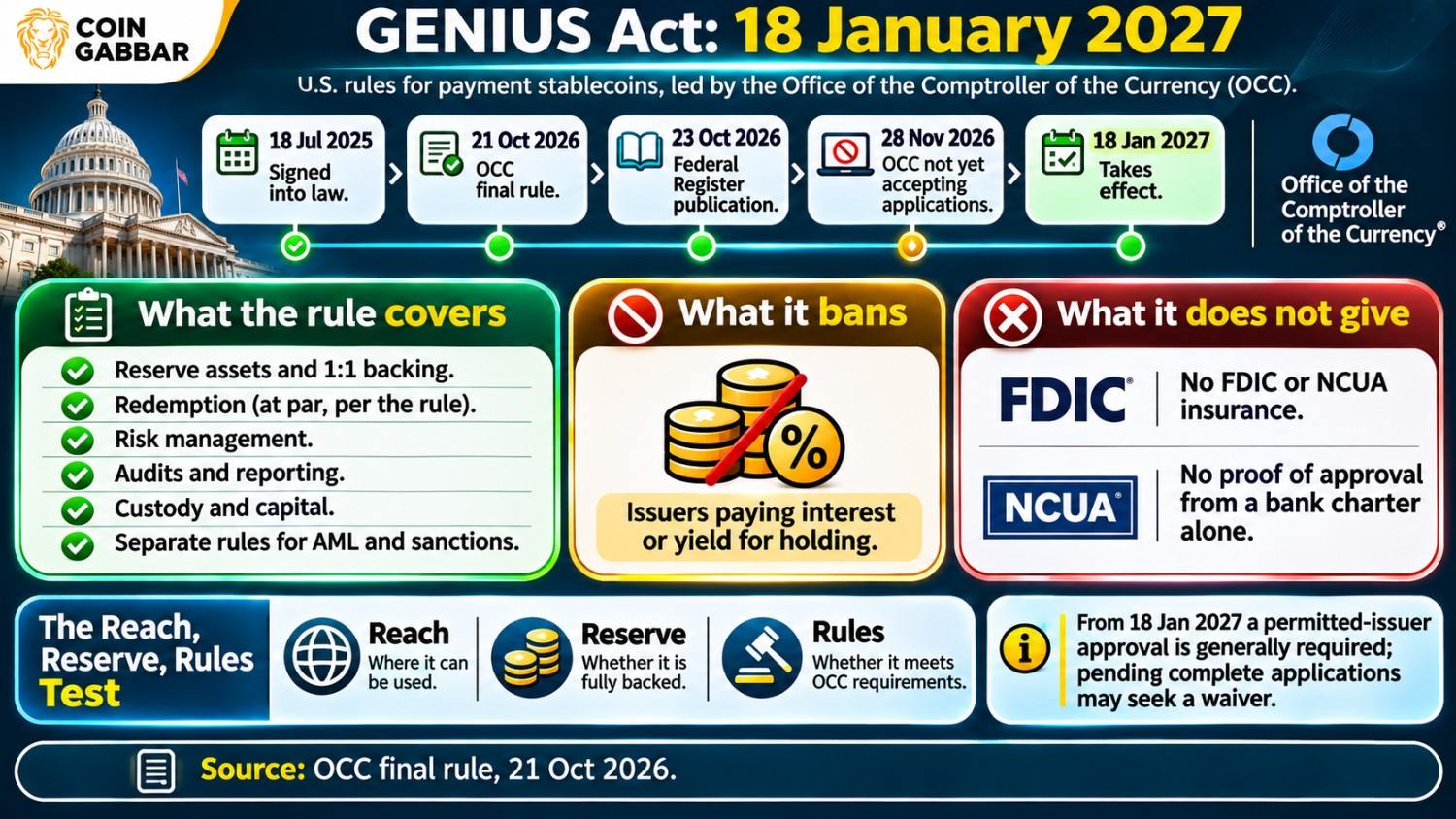
The OCC finalized itsGENIUS Act rule on 21 October 2026, and the Federal Register printed it on 23 October.
It sets reserve, redemption, risk, and reporting standards under the GENIUS Act. From 18 January 2027, a person generally needs approval as a permitted issuer to issue a payment stablecoin in the United States.
As of 28 November, the OCC was not yet taking applications, pending a federal paperwork approval. A firm with a pending complete application may ask for a waiver. Anchorage's bank charter and Circle's trust-bank approval do not by themselves prove that either coin meets every new rule.
For ZelleUSD vs USDC, the law also bars issuers from paying interest or yield just for holding a coin. Holders get no FDIC insurance from owning one. A bank-owned brand does not turn ZLUSD into an insured deposit.
Expert Opinion: ZelleUSD vs USDC, Which Fits 2027?
Supporters of ZelleUSD argue that bank trust and a familiar app could bring stablecoins to people who avoid crypto exchanges. Critics reply that the supply is tiny and the fee, access, and freeze terms are still unpublished. Backers of Circle's coin point to its size, while critics note that its openness depends on outside wallets and exchanges.
CoinGabbar research uses a three-part Reach, Reserve, and Rules test. Reach asks where the coin can actually be used. Reserve asks what backs it and who checks it. Rules ask who can redeem, freeze, or block it. Today Circle's coin wins on reach, both pass the reserve question on published reports, and rules remain open for ZLUSD.
Before Choosing a Dollar Stablecoin
Check the issuer name and verify the token address on the official page.
Read the latest reserve report and note the date.
Price the full transfer, including conversion and cash-out.
Confirm who may redeem directly and who may freeze balances.
Disclaimer: This article is for general information and is not financial, legal, or tax advice. Holders have no deposit insurance and face lost pegs, freezes, and new stablecoin rules. Information is subject to change after this date.