How Does Zenora Network Staking Work for Validators and Delegators? Staking is usually the first thing people ask about when a new chain appears. Zenora has a detailed staking design on paper
How Does Zenora Network Staking Work for Validators and Delegators?
Staking is usually the first thing people ask about when a new chain appears. Zenora has a detailed staking design on paper, but no live chain yet. This guide to Zenora Network staking separates what is planned from what exists today, using the official whitepaper and the official staking page.
Key Takeaways
Staking is planned, not live. The chain hasn’t launched, so there is nothing to stake yet.
The 2.0–3.5% reward range on the staking page is illustrative, not a promise.
Delegators keep custody of their tokens, but they share a validator’s slashing risk.
About Zenora Network
Zenora is an EVM compatible Layer-1 built with Polygon CDK. Its builders say the network is made stage by stage, in the open, from the first line of code to a live mainnet.
The roadmap has five stages. The first thing shipped was a community app, before any chain existed. That app includes Zenora Miner, a free web miner. It is a community and contribution tool, not proof-of-work hashing, and it plays no part in block production. Real blocks will come from validators, which is where staking comes in.
The native token, ZNR, has a fixed supply of 1,000,000,000 ZNR, with no new minting after genesis. Community, ecosystem and staking allocations make up 58% of it. The official site is clear on one point: ZNR is not yet listed or tradable.
Source: official website.
What Is Zenora Network Staking?
Staking means bonding ZNR to help secure the network and earn rewards for it. One token covers every job in the design, so there is no separate staking token and no separate governance token.
The model is self-custodied. Staking hands voting weight to a validator, but it never transfers ownership of the tokens. The holder keeps control throughout.
The official staking page labels itself “planned” and states plainly that nothing can be staked until the chain launches.
How Does Zenora Network Staking Work?
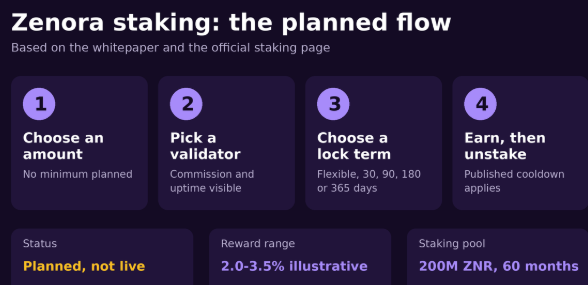
The staking page describes four steps:
Choose an amount. No minimum is planned, so small holders can start.
Pick a validator. Commission, uptime and track record are visible before committing.
Choose a lock term. Options are flexible, 30, 90, 180 or 365 days.
Earn, then unstake. Rewards build up while staked, and unstaking follows a published cooldown before funds are liquid again.
Zenora Validators
A validator runs the node software and bonds a minimum stake of ZNR. That minimum is one of the genesis parameters, and it has not been finalized. The whitepaper aims to set it high enough to resist capture, yet low enough that more than a small, wealthy group can take part.
Influence scales with stake, so a validator’s weight reflects what it has put at risk. No separate permission system sits on top.
Zenora nodes are a different thing, and the two are easy to confuse. The Zenora Node Program is a fixed set of 10,000 nodes. They are earned or gifted, never sold, and they are not validators. A node is meant to give a better path into validating or delegating once the network is live.
Role
What it does
Status
Validator
Runs node software, bonds stake, validates blocks
Planned
Delegator
Assigns ZNR to a validator and shares rewards and risk
Planned
Node holder
Holds a pre-mainnet status and priority path
Allocation program
Zenora Delegation
Holders who don’t want to run infrastructure can delegate instead. Delegated stake adds to the validator’s weight, so it counts toward the network’s security. Validators set their own commission on the rewards they earn from delegators.
The staking page shows three sample validators. They are illustrative and not real:
Sample validator
Commission
Uptime
Alpha
5%
99.9%
Beta
3%
99.7%
Gamma
7%
99.95%
Look at Beta. It has the lowest commission and the lowest uptime. Gamma charges the most and has the best uptime. The cheapest validator is not automatically the best one, which is why the design wants delegators to choose by track record and never blind.
Zenora Slashing
Slashing is the penalty for validator failure, and the design treats malice and mistakes differently.
Fault
Nature
Consequence
Double-signing or equivocation
Provable misbehavior
Severe slashing, shared by delegators proportionally
Extended downtime
Operational failure
A smaller penalty scaled to missed participation
Treating both the same would either scare off honest operators or let real malice off lightly. Delegators share the downside, so delegation is an act of trust, not a risk-free yield product.
ZNR Staking Rewards
Rewards come from a fixed pool, not new minting. The staking allocation is 20% of supply, or 200,000,000 ZNR, released over 60 months. Total supply never exceeds 1,000,000,000.
Rewards follow stake weight and are adjusted for participation. A validator that misses its share of proposing and voting earns less than one with the same stake that shows up every time.
When the pool runs out, it is not refilled. Transaction fees then become the long-term source of validator pay. Whether fees can carry that load depends on real network usage, which no document can predict. The whitepaper states this tension openly instead of hiding it.
Zenora Staking APY
The staking page shows an illustrative reward range of 2.0–3.5%. Longer lock terms are designed to carry a wider and higher range, never a single guaranteed number. The page says every figure is a planning target based on the design, not a live or guaranteed return.
The whitepaper does not publish an APY at all. Real rates will depend on real network conditions once staking is live.
Staking and Governance
Staking also decides who gets a voice. The long-term plan is stake-weighted voting on upgrades, network parameters and treasury spending, so a large passive balance can’t simply take control. Today there is no live governance body, and major decisions stay with the founding team. A limited version is meant to start around the public testnet.
When Could Staking Go Live?
Staking cannot start before the chain does. The build runs through five stages: the community app, the core protocol, a public testnet, mainnet prep and mainnet. The consensus setup is due before the public testnet, and genesis parameters are due to be confirmed ahead of mainnet prep. The ZNR roadmap shows status instead of dates, so no stage has a target date.
What to Watch Before Staking Opens
The minimum validator bond and other genesis parameters are not final.
No audit, validator set or live consensus exists yet.
Fee-funded rewards after the 60-month pool are untested.
ZNR is not listed or tradable.
Final Thoughts
The design is clear and honest about its limits: fixed supply, a capped reward pool, shared slashing risk and self-custody. Every number should still be read as a plan. Readers should check the official staking page and the whitepaper for updates before drawing conclusions.
Disclaimer: This article is for information only and is not financial advice. Crypto is volatile, so readers should do their own research before they buy, stake or hold any token.
