The best crypto funding rate trackers in 2026 are Coinglass, CoinAnk, CryptoQuant, Laevitas, Velo, Hyblock, Binance Futures data, Bybit derivatives pages, CME crypto markets, TradingView cust
The best crypto funding rate trackers in 2026 are Coinglass, CoinAnk, CryptoQuant, Laevitas, Velo, Hyblock, Binance Futures data, Bybit derivatives pages, CME crypto markets, TradingView custom scripts, and Glassnode. Coinglass leads on breadth and ease of cross-exchange comparison. CoinAnk is the sharpest derivatives-native alternative. CryptoQuant adds narrative framing. Laevitas stands out when options volatility surfaces matter alongside funding.
ToolOutstanding pointScoreBest forCoinglassBroadest cross-exchange funding comparison in one screen5/5Daily monitoring, fast cross-exchange readsCoinAnkTightest futures-native layout with OI and long-short context4.5/5Derivatives-first tradersCryptoQuantFunding embedded in broader market interpretation4/5Narrative analysts and macro context readersLaevitasFunding alongside options vol surfaces4/5Multi-product derivatives desksVeloProfessional derivatives terminal depth3.5/5Institutional desksHyblockFunding as part of crowd positioning workflow3.5/5Leveraged position flow analystsBinance FuturesVenue-level first-party data confirmation3/5BTC and ETH venue-specific checksBybit DerivativesAltcoin-rich exchange-native funding data3/5Altcoin and perpetual tradersCME crypto marketsRegulated futures context vs offshore perp sentiment3/5Institutional cross-market comparisonTradingView scriptsFunding overlaid directly on price chart3/5Chart-native tradersGlassnodeOn-chain and derivatives signals combined3/5Macro-level derivatives and on-chain researchers
The 11 best crypto funding rate trackers in 2026
1. Coinglass
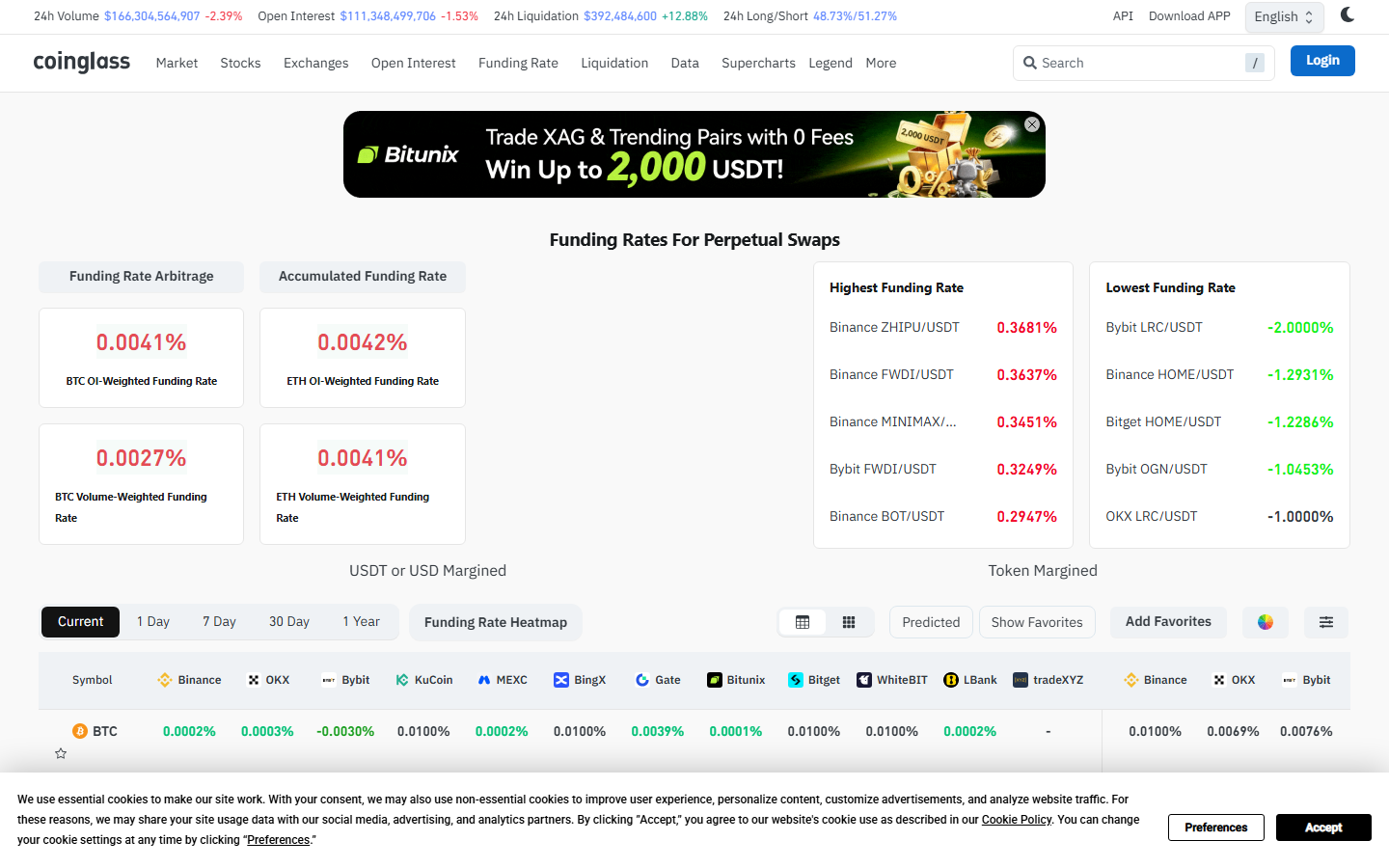
Coinglass funding rate page, July 2026: cross-exchange funding rate comparison and live data layout reviewed directly.
Coinglass is the easiest and most complete starting point for funding rate monitoring. The cross-exchange comparison screen aggregates live funding from Binance, Bybit, OKX, Deribit, and other major venues into one view, with color coding that makes rate dispersion immediately visible. For most MarketBit readers, this is the first screen to open when checking whether a funding extreme is meaningful.
In a crypto futures trading thread on Reddit, one trader described Coinglass as "great for funding heatmaps and live rate tracking" and listed it first among the tools they check before entering a trade. A separate CryptoCurrency thread on watching funding rates bookmarked the Coinglass funding page directly and offered specific thresholds: anything above 0.01% is overheated, above 0.03% means "it's only a matter of time" before a liquidation sweep.
- Best for: daily funding monitoring and fast cross-exchange comparison.
- Main tradeoff: the broad layout includes more market context than a trader who only wants funding data needs to parse. Whether that density helps or hurts depends on how many derivatives signals the trader actually checks each session.
2. CoinAnk
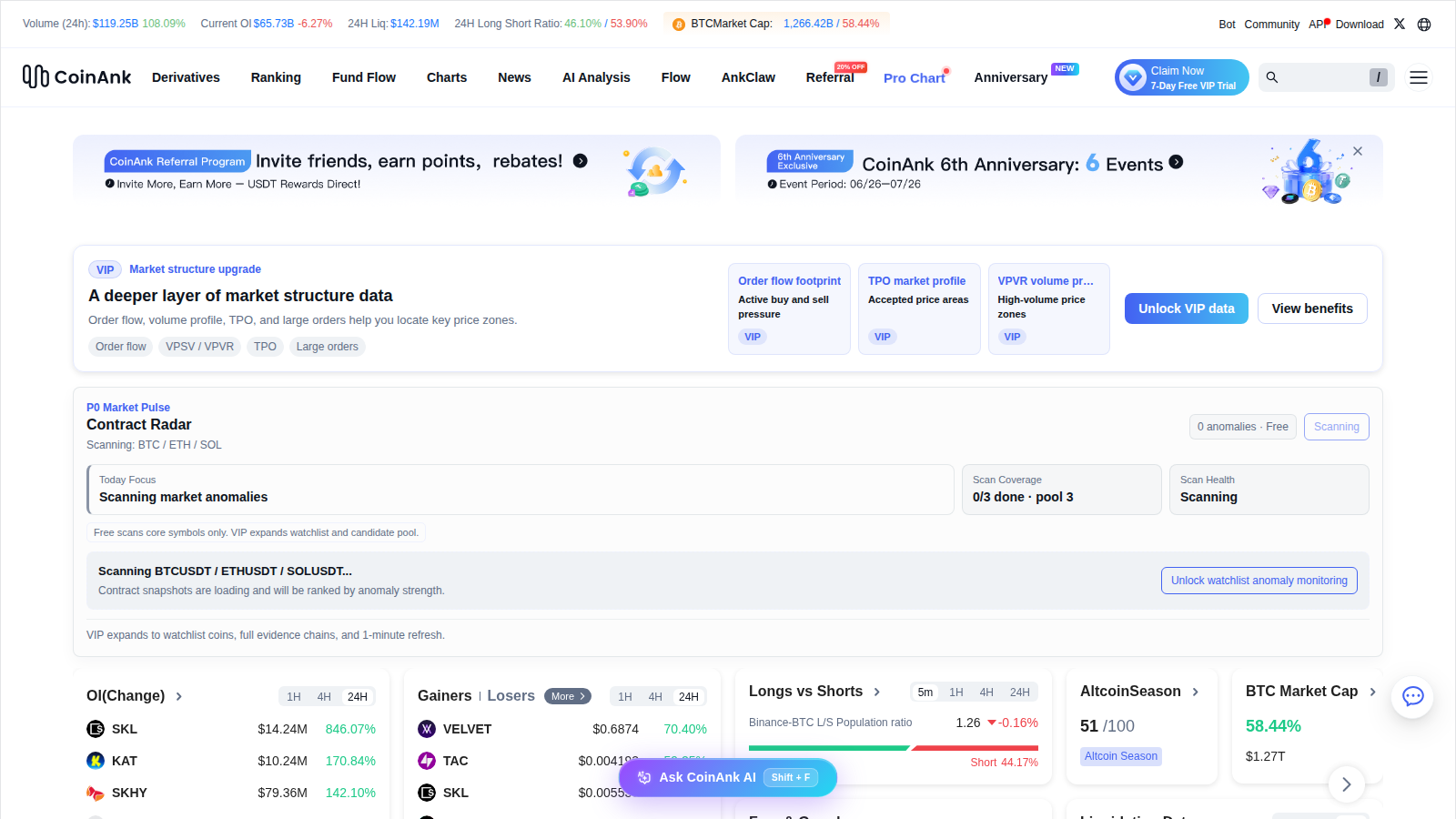
CoinAnk homepage, July 2026: derivatives-native layout with OI, long-short, and funding signals reviewed directly.
CoinAnk presents funding rate data inside a derivatives-native layout that integrates OI change and long-short context on the same screen. The product feels built for traders who think about funding as part of a positioning picture, not as an isolated number.
CoinAnk's derivatives screenshots circulate in Bitcoin and crypto trading threads when traders analyze funding and liquidation imbalances together, though Coinglass still gets named more often for pure funding rate lookups.
- Best for: traders who want funding as one layer inside a derivatives-first workflow.
- Main tradeoff: less intuitive for users who are new to reading multiple derivatives signals simultaneously. Whether the tighter layout accelerates or overwhelms depends on how many metrics the trader already tracks.
3. CryptoQuant
CryptoQuant homepage, July 2026: on-chain and derivatives data with market interpretation framing reviewed directly.
CryptoQuant provides funding rate data embedded within a broader on-chain and market interpretation layer. The platform adds narrative framing around its metrics, which makes it more useful for analysts who want to understand why funding is moving, not just that it moved.
CryptoQuant appears in crypto fund discussions on Reddit as part of the institutional analytics stack, though traders focused purely on funding rate speed tend to default to Coinglass or exchange-native dashboards first.
- Best for: market analysts and narrative-driven traders who pair funding with on-chain macro signals.
- Main tradeoff: less visual speed on pure funding monitoring than Coinglass or CoinAnk. Whether the narrative framing adds clarity or delays the read depends on whether the trader is researching or executing.
4. Laevitas
Laevitas homepage, July 2026: derivatives analytics including options vol and funding context reviewed directly.
Laevitas is the strongest choice when funding rate tracking needs to sit alongside options implied volatility, term structure, and structured product analytics. The platform serves multi-product derivatives desks that monitor perpetuals and options in the same workflow.
Laevitas gets recommended in crypto analysis tool threads on Reddit for "market advanced analytics," and its options data has been referenced in BTC max pain analysis posts where traders track how options expiry affects price behavior.
- Best for: desks trading both perpetuals and options who want funding rate context alongside vol surface data.
- Main tradeoff: higher complexity and access friction than pure funding dashboards. Whether the options context justifies that friction depends on how much of the trader's book involves structured products.
5. Velo
Velo provides a professional-tier derivatives terminal that includes funding rate data within a richer market context. It serves institutional desks that need funding embedded in a broader order flow and cross-market analytics environment.
Velo appeared in a Reddit thread on crypto tools that actually improved workflow, where users distinguished it from lighter dashboards by its terminal-grade depth across derivatives and options data.
- Best for: institutional desks with professional derivatives workflow needs.
- Main tradeoff: higher access requirements than most tools on this list. Whether the terminal depth justifies the onboarding cost depends on the trader's daily volume and workflow complexity.
6. Hyblock
Hyblock integrates funding rate context alongside its crowd positioning and liquidation cluster tools. For traders using Hyblock primarily for liquidation zone analysis, checking funding on the same platform maintains workflow consistency.
A vetted trading tools list on Reddit categorizes Hyblock as a "specialized crypto mapping and inside edge data provider" for intermediate to advanced traders, which includes its funding rate integration alongside liquidation data.
- Best for: traders who are already using Hyblock for liquidation monitoring and want funding in the same environment.
- Main tradeoff: narrower than Coinglass for pure cross-exchange funding comparison breadth. Whether the positioning context compensates for that narrowness depends on how central liquidation analysis is to the trader's workflow.
7. Binance Futures data
Binance publishes its own funding rate data directly on its futures product pages. For trades that are executed on Binance, the venue-level funding data is the most accurate first-party source. It is a confirmation check, not a primary monitoring tool.
In a funding rate research thread on Reddit, a quant researcher described building a structured framework around Binance funding mechanics, testing "how price reacts before and after funding timestamps." That kind of venue-specific analysis is what first-party Binance data enables.
- Best for: confirming Binance-specific funding readings alongside aggregated tracker data.
- Main tradeoff: single-venue only, with no cross-exchange comparison. Whether first-party venue data adds enough confirmation value depends on how much of the trader's volume runs through Binance.
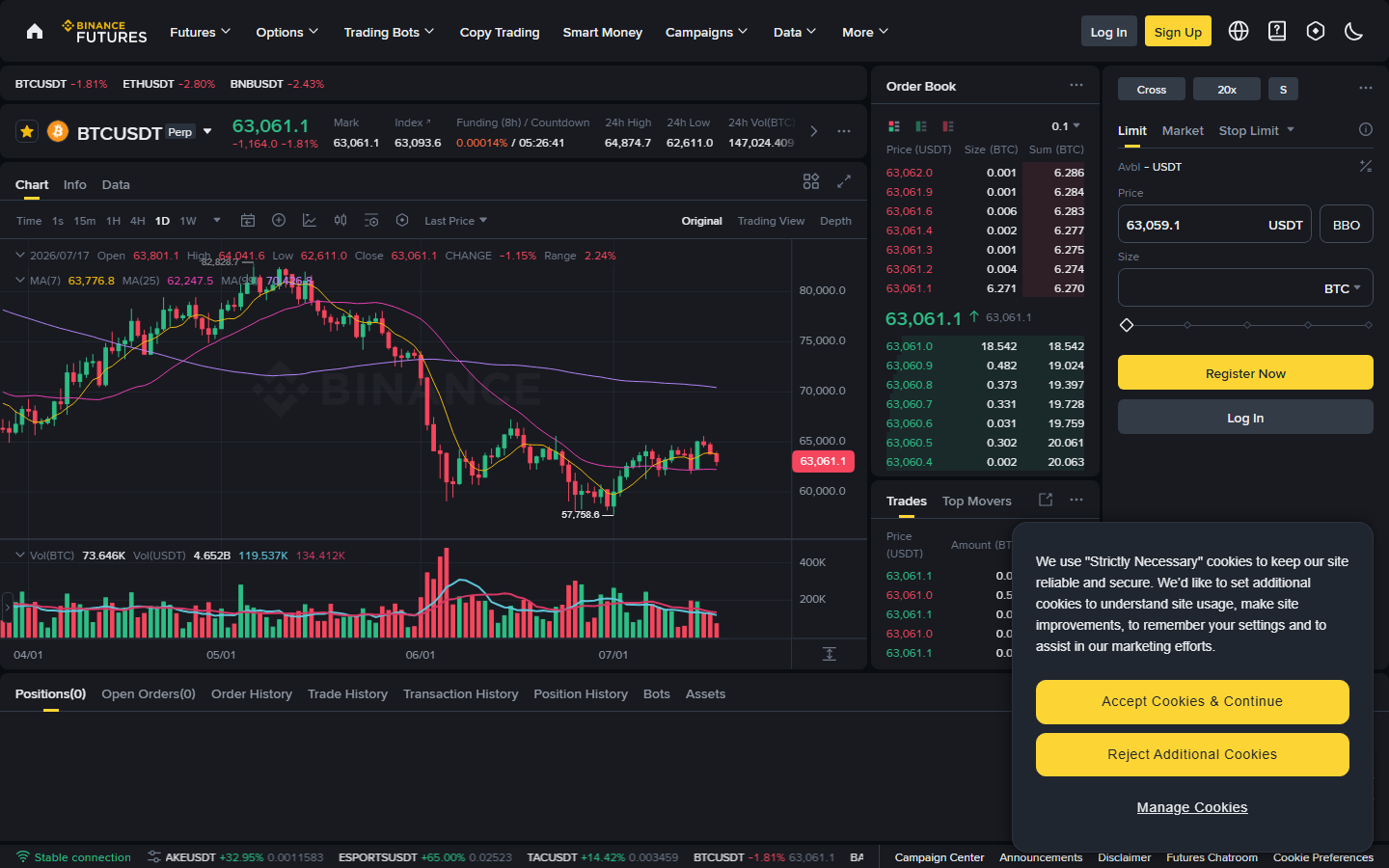
Binance Futures, July 2026: venue-level funding rate data reviewed as a first-party confirmation source.
8. Bybit Derivatives
Bybit's derivatives product pages publish funding rates for its perpetual and inverse contract markets. Bybit's altcoin coverage is broader than Binance's for some trading pairs, which makes it useful for traders monitoring alt-market funding.
Bybit's funding mechanics are a recurring topic in its own community on Reddit, where new traders ask how the 8-hour cycle works and experienced users explain the long-short balance mechanism. One thread documented a user paying $750 in funding over four days on a short position during a period of sustained negative rates, illustrating why monitoring funding before and during a trade matters.
- Best for: altcoin-focused traders who want venue-level funding confirmation on Bybit-listed pairs.
- Main tradeoff: single-venue only, requiring cross-referencing with aggregators for the full picture. Whether Bybit's altcoin depth justifies that extra step depends on the trader's pair coverage.
9. CME crypto markets
CME publishes settlement data and open interest for its Bitcoin and Ethereum futures contracts. For traders who want to understand how regulated futures sentiment compares to offshore perpetual funding, CME's data adds an institutional calibration point.
- Best for: understanding the gap between institutional regulated futures positioning and retail-heavy perpetual funding.
- Main tradeoff: CME futures are not perpetuals, so the funding rate concept does not translate directly. Whether the institutional calibration this adds is worth the interpretation overhead depends on how much weight the trader gives to regulated-market signals.
10. TradingView custom funding scripts
TradingView's community library includes scripts that overlay funding rate data onto price charts. For chart-native traders who want to see funding extremes in the same view as price action without switching windows, TradingView offers the most flexible integration.
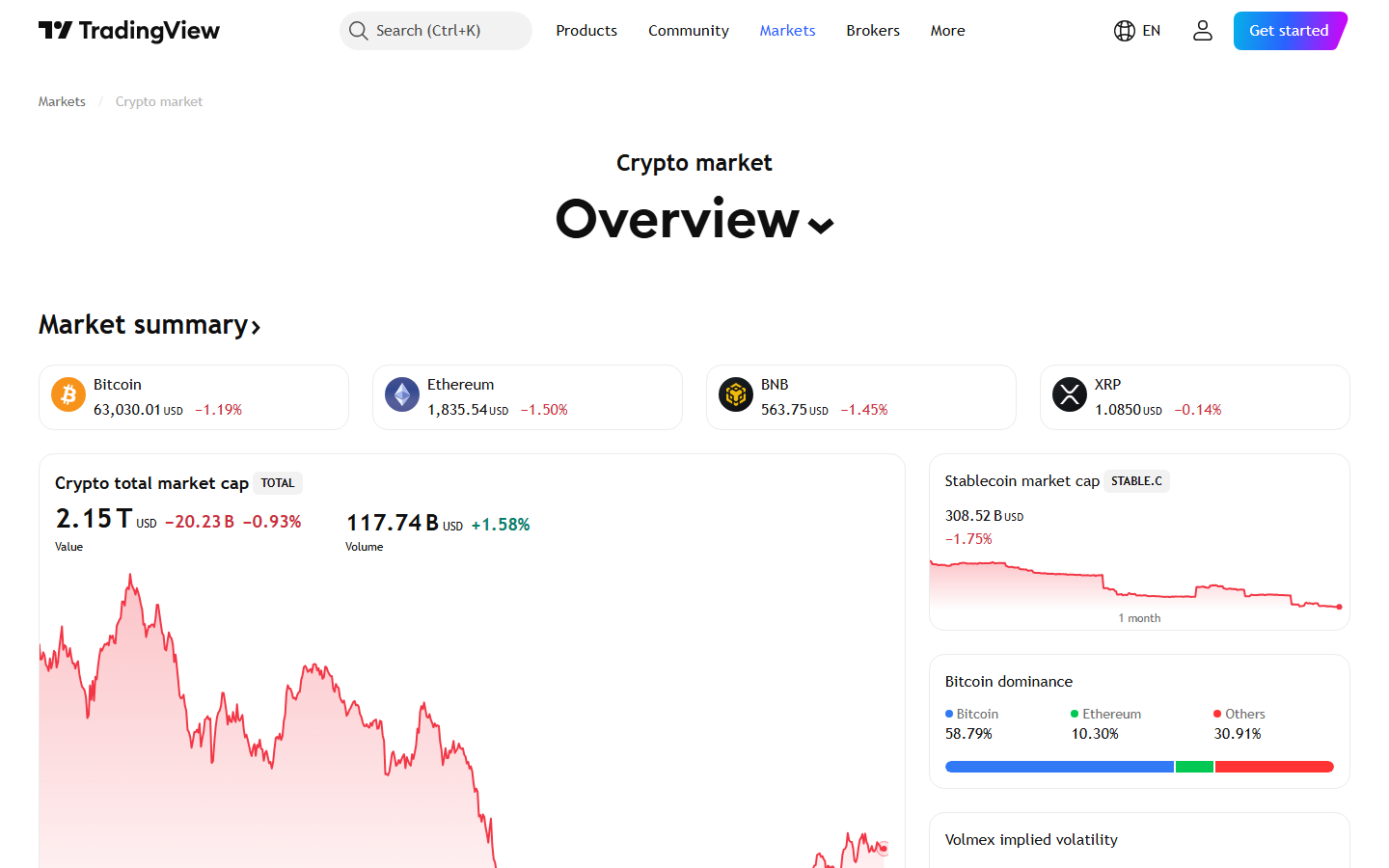
TradingView, July 2026: chart-native environment for custom funding rate overlay scripts reviewed directly.
A TradingView feature request thread asking for native funding rate access in PineScript received attention from traders frustrated that this data still requires external sources or community scripts rather than a first-party feed.
- Best for: technical analysts who want funding overlaid on price rather than in a separate data terminal.
- Main tradeoff: quality depends on the specific script; requires finding and validating a reliable community script rather than using a maintained first-party feed.
11. Glassnode
Glassnode includes perpetual funding rate data within its derivatives analytics module, alongside on-chain metrics. For researchers who want to connect funding extremes to longer-term market cycles, Glassnode provides the deepest historical context on this list.
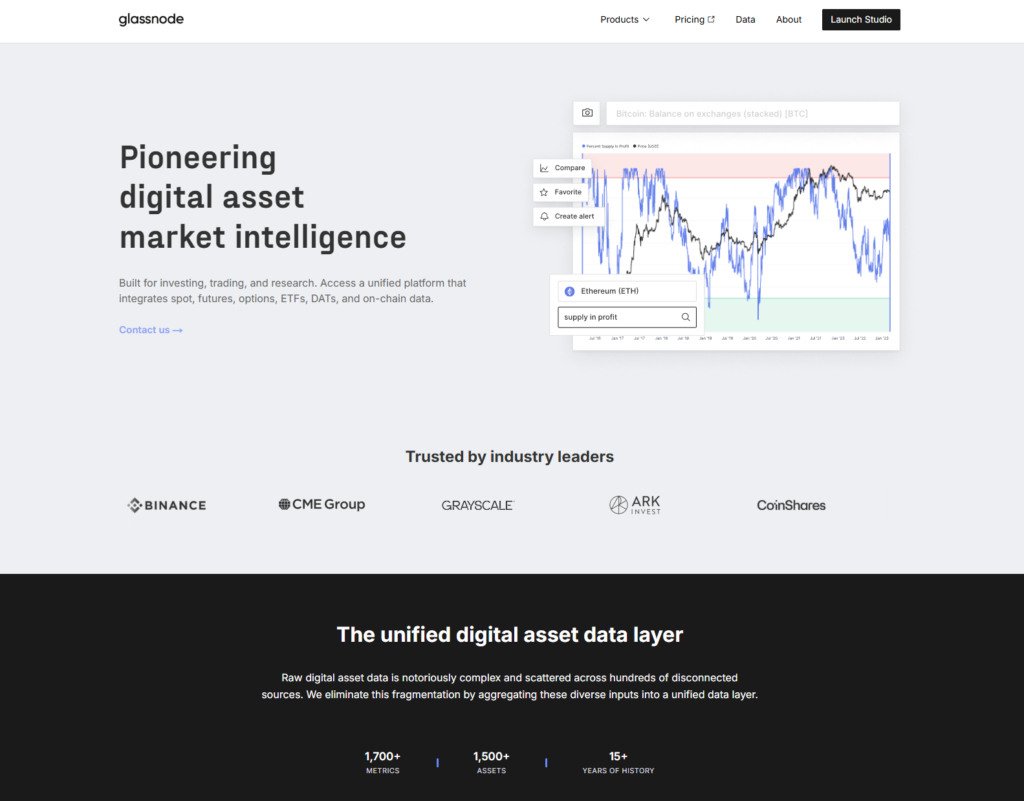
Glassnode homepage, July 2026: on-chain and derivatives analytics platform reviewed directly.
When a trader in an algo trading forum on Reddit asked for 10+ years of BTC funding rate history, Glassnode was one of the few paid services recommended for that depth. In a widely-shared crypto tools compilation, Glassnode was listed for on-chain analysis while Coinglass was listed "mainly to see funding rates," reflecting how the community segments these tools by purpose.
- Best for: on-chain researchers and macro analysts who want funding data in a long-cycle context.
- Main tradeoff: more suited to research and longer-term analysis than tactical daily monitoring. Whether the historical depth compensates for the slower workflow depends on the trader's time horizon.
Best funding tracker by use case
- Best for most traders: Coinglass
- Best derivatives-native alternative: CoinAnk
- Best for narrative and on-chain pairing: CryptoQuant
- Best for multi-product desks: Laevitas
- Best for institutional calibration: CME crypto data
- Best for chart-native workflow: TradingView scripts
- Best for deep historical research: Glassnode
Ranking scorecard
Scored out of 10 per category. Total out of 60.
ToolExchange breadthHistory depthSignal contextFree accessWorkflow fitCross-exchange comparison
TotalCoinglass10889910
54CoinAnk779887
46CryptoQuant699575
41Laevitas788466
39Velo777366
36Hyblock568474
34Glassnode5107354
34Binance Futures374862
30Bybit Derivatives364862
29TradingView scripts453783
30CME crypto markets275643
27Scoring notes. Exchange breadth measures how many venues feed into the funding view. History depth scores how far back funding data is accessible. Signal context measures whether OI, liquidation, and positioning data sit alongside funding in the same view. Free access reflects how much is usable without a subscription. Workflow fit scores how naturally the tool integrates into a daily derivatives check. Cross-exchange comparison measures how directly a trader can compare funding across venues in one screen. Coinglass leads because it scores highest on the two criteria that matter most for funding tracking: cross-exchange comparison and exchange breadth.
Why funding rates matter
Funding rates show how perpetual futures markets are balancing long and short demand at any given moment. When funding is heavily positive, longs are paying to stay long. When it turns deeply negative, shorts are paying to stay short. Neither sign is a trade signal by itself. The useful question is whether the extreme is broad across exchanges or isolated on one venue, and whether open interest is rising with it or already rolling over.
A funding spike on one exchange with neutral funding everywhere else is noise. A synchronized extreme across Binance, Bybit, and OKX with rising OI and a crowded liquidation zone is a setup worth analyzing
How to read positive, negative, and extreme funding
Positive funding means long demand is outpacing short demand. Negative funding means short demand is outpacing long demand. The sign alone does not determine the trade. The actionable read comes from three observations:
Is funding rising with open interest? Rising OI confirms participation is growing, which makes the extreme more credible.
Is funding extreme while price stalls? Funding that stays elevated without price follow-through is a crowding signal that has stopped expressing itself in price, which often precedes mean reversion.
Is funding diverging across exchanges? Isolated extremes on one venue are noise. Synchronized extremes across multiple venues are structural.
When our team reviews a funding extreme, we check liquidation zone density immediately after. A crowded funding environment with a dense liquidation cluster below the current price is the highest-risk combination for a squeeze setup.
In a widely-referenced crypto tools thread on Reddit, users specifically called for "pure statistics" sources over narrative-heavy tools. That preference maps directly onto how a good funding tracker should be evaluated.
The tools that provide raw, cross-exchange data with clear sourcing are the ones worth trusting for real decision-making. Tools that layer directional narratives on top of funding data without making the data itself transparent are harder to use analytically.
What to watch
Funding rate divergence between BTC perps and BTC CME. When offshore perpetual funding runs heavily positive while CME open interest is flat or declining, institutional participation is not matching the retail leverage narrative. That divergence is one of the clearest signals that a crowded perpetual position has no institutional support underneath it.
Negative funding plus rising OI. This combination means new short positions are being added at the same time as funding has turned negative, which is a signal that the short trade is becoming crowded rather than protective. Watch for this when liquidation maps show dense short liquidation clusters above current price.
Funding dispersion across altcoins. When altcoin funding rates run substantially hotter than BTC funding, altcoin leverage is outpacing the index. That historically precedes sharper altcoin corrections when the leverage unwinds.
For this article, we reviewed the live public product pages of Coinglass, CoinAnk, CryptoQuant, and Laevitas directly in July 2026. Screenshots were captured from each to verify what information the product surfaces on first load and how that information is framed for a derivatives trader.
What stood out immediately in Coinglass was the density of the cross-exchange comparison. The funding rate page aggregated data across a broad exchange set, with color coding that made it fast to spot which venues were running hot or cold relative to one another. That is the most critical feature for a funding tracker: not just showing one number, but letting a trader instantly see whether an extreme is isolated or synchronized.
CoinAnk's layout was more aggressive in how it brought OI change and long-short data into the same view as funding. The effect is a tighter signal cluster that suits a trader who already knows what they are looking for.
CryptoQuant added interpretive framing around its data, which makes it more useful for analysts who want to connect a funding extreme to a broader market narrative. Laevitas immediately signaled its options market orientation, making it the right choice for desks that trade derivatives across both perpetuals and structured products.
Why you can trust this guide
This guide is based on live public product pages for Coinglass, CoinAnk, CryptoQuant, Laevitas, TradingView, and Glassnode reviewed directly in July 2026. Screenshots were captured from live product surfaces.
Claims about Velo, Hyblock, Binance, Bybit, and CME are based on publicly available product descriptions and known market positioning. Full logged-in workflow tests for those tools were not completed as part of this review. Exchange coverage counts and premium tier features should be verified against current platform documentation.
What this review verified and what it did not
ClaimStatusCoinglass funding rate page reviewed and screenshot capturedObservedCoinAnk homepage reviewed and screenshot capturedObservedCryptoQuant homepage reviewed and screenshot capturedObservedLaevitas homepage reviewed and screenshot capturedObservedBinance Futures platform reviewed and screenshot capturedObservedTradingView crypto page reviewed and screenshot capturedObservedGlassnode homepage reviewed and screenshot capturedObservedVelo, Hyblock logged-in workflow testedNot verifiedBybit and CME live funding data comparedNot verifiedExchange coverage counts verified against current docsNot verifiedHistorical funding depth on all tools verifiedNot verifiedPost-July 17, 2026 product updates includedNot verified
FAQ
What is the best crypto funding rate tracker for free use?
Coinglass offers the broadest free-tier cross-exchange funding comparison for most users. CoinAnk is the best free alternative for a more derivatives-native layout.
Does high positive funding mean price must fall?
No. High positive funding means the long side is crowded or expensive, not that reversal is guaranteed. It becomes more significant when combined with elevated OI and a dense liquidation cluster below current price.
What should funding rates be paired with?
Open interest, liquidation zone density, and nearby market structure are the most important complements.
Sources
Read original article on marketbit.net