The United States and Russia now control more than half of all Bitcoin mining power on Earth. According to January 2026 estimates, the two countries together account for 53.9% of global hashr
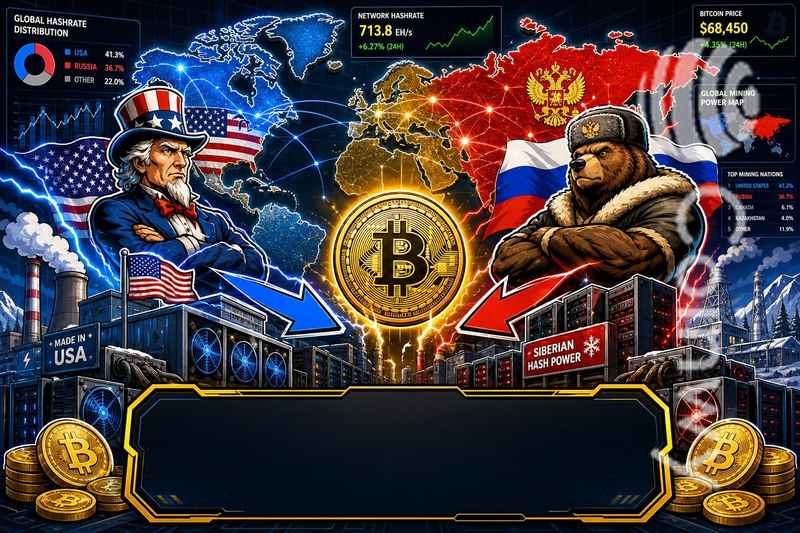
The United States and Russia now control more than half of all Bitcoin mining power on Earth. According to January 2026 estimates, the two countries together account for 53.9% of global hashrate, cementing a concentration of computing power that is reshaping how governments, investors, and miners think about Bitcoin's geopolitical future.
Why the 2026 Bitcoin Mining Map Now Revolves Around the US and Russia
The numbers tell a stark story. Hashrate Index estimates that the United States held 37.5% of global Bitcoin hashrate in January 2026, equivalent to roughly 400 EH/s. Russia followed at 16.4%, or about 175 EH/s, while China placed third at 11.7% with approximately 125 EH/s.
U.S. Estimated Hashrate Share 37.5% January 2026 estimate, equivalent to about 400 EH/s.
The term "duopoly" here is interpretive framing, not an official classification. But the underlying math is hard to dispute: the top three countries hold 65.6% of estimated global hashrate, and two of them account for the vast majority of that share.
This concentration followed years of redistribution after China's 2021 mining ban scattered hashpower across North America, Central Asia, and the Middle East. What was briefly a multipolar landscape has consolidated again, this time around Washington and Moscow rather than Beijing.
Global Bitcoin hashrate itself crossed the 1 zettahash per second threshold as mining industrialized through 2025. Other countries still host meaningful operations, but none individually sets the pace the way the US and Russia now do.
KEY TAKEAWAYS
- The US and Russia together hold an estimated 53.9% of global Bitcoin hashrate as of January 2026.
- The top three mining countries (adding China at 11.7%) account for 65.6% of all hashpower.
- Post-2021 redistribution has re-concentrated, shifting the center of gravity from Asia to a US-Russia axis.
The Political and Energy Advantages Fueling the Two Mining Giants
The American model rests on scale capital, cheap natural gas in states like Texas and Pennsylvania, and an increasingly favorable regulatory posture. The White House crypto page states that the federal government should operationalize the promise to make America the "crypto capital of the world," a signal that has drawn institutional mining investment and data-center buildouts.
That policy clarity matters. Public mining companies listed on US exchanges can raise capital at scale, lock in long-term power purchase agreements, and deploy next-generation ASIC hardware faster than competitors in jurisdictions with uncertain rules. Recent moves by US regulators to formalize digital asset frameworks have reinforced the perception that American miners operate in a relatively predictable environment.
Russia's model is structurally different. The country legalized mining in 2024 and, according to reporting by Ukrainska Pravda citing Reuters, is already using domestically mined bitcoin for international payments under an experimental regime. Russian Finance Minister Anton Siluanov confirmed this linkage, tying mining capacity directly to sanctions-era trade policy.
Where the US attracts miners through market incentives, Russia channels mining through state interest. Abundant hydroelectric and natural gas capacity provides cheap power, while the government treats hashrate as a tool of economic sovereignty rather than a purely private enterprise.
Both models demonstrate the same underlying principle: mining gravitates toward jurisdictions with surplus energy and political willingness to host it. Regulation can attract miners when it provides clarity, or constrain them when compliance costs outweigh energy savings.
What the US-Russia Mining Rivalry Means for Bitcoin's Next Geopolitical Cycle
Concentration of hashpower in two geopolitically opposed states raises questions about network resilience. Bitcoin was designed to resist single points of control, yet more than half of all mining now sits within two national regulatory jurisdictions, each with the theoretical capacity to compel or restrict miners.
Bitcoin was trading at $63,512 at the time of this analysis, with the Fear and Greed Index reading 23, or Extreme Fear. That market backdrop adds pressure: miners operate on thin margins when prices stagnate, and concentrated mining in high-cost jurisdictions becomes vulnerable if revenue per terahash declines further.
Bitcoin Spot Price $63,512 Readable market reference page used in place of the raw API endpoint.
The concentration debate is not settled. One view holds that geographic consolidation is simply industrial maturity: mining follows cheap power and legal certainty, the same way aluminum smelting does. The counterargument is that a network claiming to be censorship-resistant should not have its security budget concentrated in countries with the political leverage to weaponize it.
For investors watching Bitcoin's upcoming options expirations and macro catalysts, the mining map adds a layer of sovereign risk that price models rarely capture. If the US tightens environmental rules or Russia escalates the use of mined bitcoin for cross-border payment channels, hashrate could migrate again, as it did after China's ban.
Other nations are watching. Countries with stranded energy resources, from Ethiopia to Paraguay, could position themselves as alternative mining hubs if the duopoly's political costs rise. The question is whether they can build infrastructure fast enough to matter before the next halving cycle compresses margins further.
The 2026 mining map is not permanent. But it reflects a reality that Bitcoin's security layer is now entangled with great-power competition, and any shift in US or Russian policy toward miners will ripple across the network's global distribution.
Disclaimer: This article is for informational purposes only and does not constitute financial or investment advice. Cryptocurrency and digital asset markets carry significant risk. Always do your own research before making decisions.
Read original article on coinwy.comRead also :