If you had $10,000 today but could not buy Bitcoin, XRP, or Ethereum, which cryptocurrencies would make your list? We asked ChatGPT, Claude, and Grok AI to answer that question. Each AI faced
If you had $10,000 today but could not buy Bitcoin, XRP, or Ethereum, which cryptocurrencies would make your list?
We asked ChatGPT, Claude, and Grok AI to answer that question. Each AI faced the same restriction, but their responses revealed different ideas about risk, diversification, and the strongest opportunities outside the 3 excluded market leaders.
Solana appeared in every answer and received the largest proposed allocation from 2 of the AIs. Chainlink and Bittensor also appeared repeatedly. However, the differences became clearer once each AI moved beyond those shared choices.
ChatGPT created a precise portfolio with a sizable USDC reserve. Claude preferred a flexible framework built around established tokens. Grok AI accepted more risk through TAO, HYPE, Dogecoin, and Render.
Here is how each AI would spend the $10,000 and why every selected token earned its place.
ChatGPT Would Put 40% Into Solana and Keep $2,000 Available
ChatGPT produced the most detailed allocation. Its portfolio focused on cryptocurrencies with genuine users, established infrastructure, and measurable network activity.
AssetAllocationAmountSolana40%$4,000Chainlink20%$2,000Aave10%$1,000Bittensor10%$1,000USDC Reserve20%$2,000
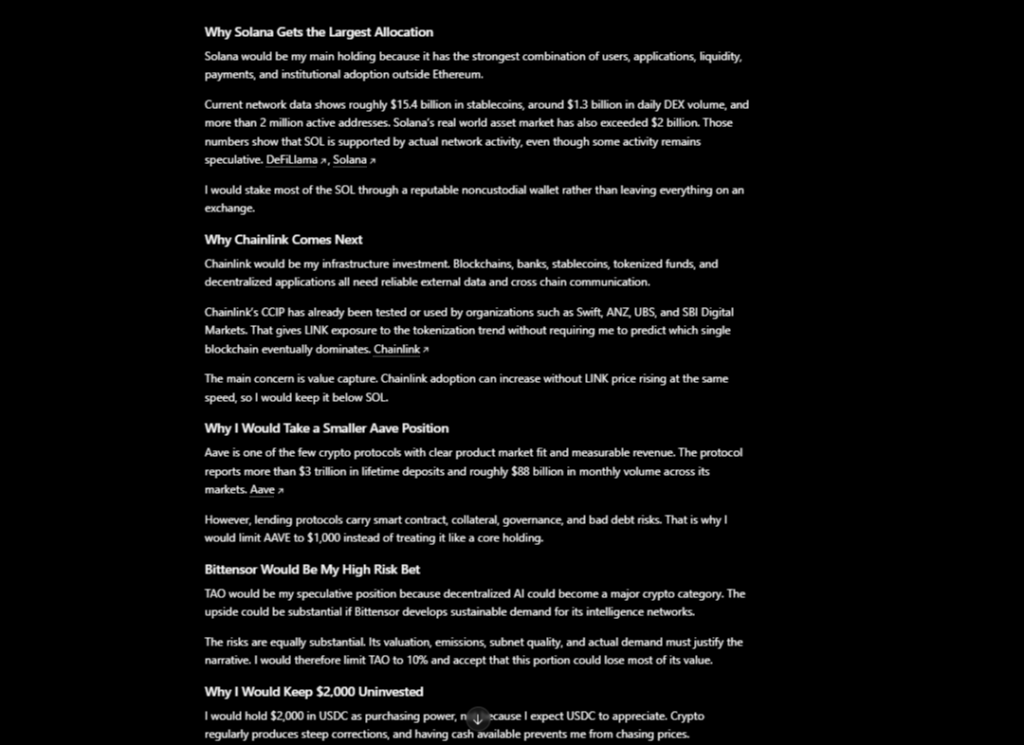
Solana received the largest share because ChatGPT viewed it as the strongest major blockchain outside Ethereum. Solana supports decentralized finance, payments, tokenized assets, consumer applications, and an active developer ecosystem.
The supplied network figures help explain that decision. Solana reportedly holds about $15.4 billion in stablecoins, processes roughly $1.3 billion in daily decentralized exchange volume, and serves more than 2 million active addresses. Its real world asset market has also passed $2 billion.
ChatGPT’s Response
Those figures give the SOL price a foundation beyond future promises. Some Solana activity remains speculative, but the network already handles substantial capital and user demand.
ChatGPT would also stake most of its SOL through a reputable noncustodial wallet. That choice could generate staking rewards without leaving the entire position under an exchange’s control.
Chainlink Gives ChatGPT Exposure to Essential Blockchain Infrastructure
Chainlink received $2,000 because its services connect blockchains with external information and other networks. Decentralized applications need reliable price feeds, banks need secure connections, and tokenized assets often require data from outside their original blockchain.
Chainlink’s Cross Chain Interoperability Protocol has been tested or used by organizations such as Swift, ANZ, UBS, and SBI Digital Markets. That reach gives LINK exposure to blockchain adoption across several networks instead of tying its future to one chain.
ChatGPT still identified value capture as a concern. Chainlink usage can grow without the LINK price matching that growth. That uncertainty explains why LINK received half the amount allocated to Solana.
Aave and Bittensor completed the invested portion. Aave received $1,000 because its crypto lending product already has measurable demand. The protocol reports more than $3 trillion in lifetime deposits and about $88 billion in monthly volume across its markets.
Smart contract failures, weak collateral, governance disputes, and bad debt remain possible. ChatGPT limited the AAVE position because those risks could damage even an established lending protocol.
Bittensor received the final $1,000 investment. The decentralized AI project could benefit if demand for open intelligence networks expands. However, the TAO price still depends on subnet quality, token emissions, valuation, and genuine demand for its services.
ChatGPT treated TAO as its speculative position because those questions remain unresolved.
ChatGPT Would Use USDC to Prepare for Better Entry Prices
ChatGPT reserved $2,000 in USDC instead of investing the full amount immediately. The stablecoin would act as available purchasing power during a market correction.
That reserve would not be expected to appreciate like SOL, LINK, AAVE, or TAO. USDC also carries issuer, banking, regulatory, and depegging risks. ChatGPT therefore rejected the idea of placing the reserve inside an unfamiliar yield platform for a small additional return.
The remaining $8,000 would enter the market through 4 separate purchases:
- The first $2,000 would enter immediately.
- Another $2,000 would enter after 2 weeks.
- The third $2,000 would enter 2 weeks later.
- The final $2,000 would enter after a correction or another month.
ChatGPT would avoid leverage, futures, meme coins, microcaps, and tokens supported mainly by predictions of extraordinary returns. SOL would be its preferred single token. SOL and LINK would become its choices if only 2 tokens were permitted.
Claude Would Build Around Solana, Chainlink, and BNB
Claude did not provide exact percentages for every token. Instead, it divided the crypto portfolio into established assets, exchange utility, and smaller thematic positions.
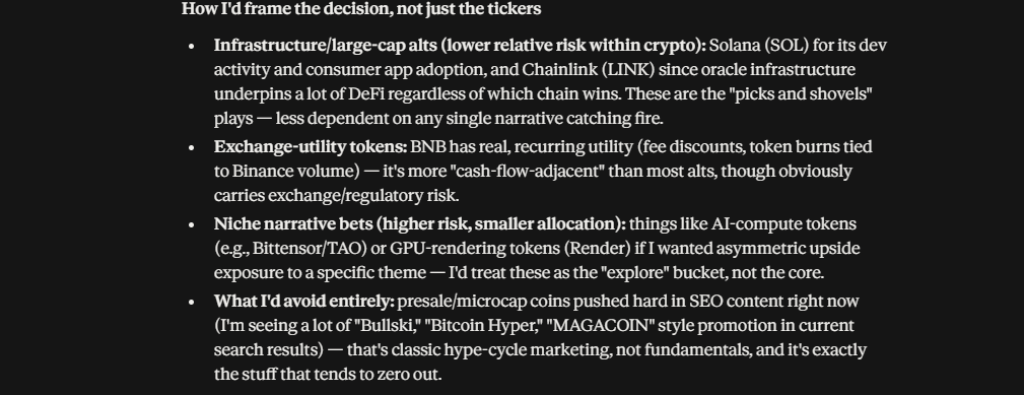
Solana and Chainlink formed the foundation. Claude chose Solana because of its developer activity, consumer applications, and large ecosystem. Chainlink earned a place because oracle infrastructure remains necessary across decentralized finance, tokenized assets, and blockchain applications.
Claude’s Response
Claude described SOL and LINK as infrastructure plays. Their investment cases do not require one narrow crypto trend to remain popular.
BNB was Claude’s main exchange utility choice. BNB supports trading fee discounts and token burns connected to activity across the Binance ecosystem. Those recurring uses make BNB different from tokens that depend almost entirely on market narratives.
Exchange concentration creates a major weakness. Regulatory action, operational trouble, or declining Binance activity could place pressure on the BNB price. Claude therefore treated BNB as useful but not risk free.
Bittensor and Render formed Claude’s smaller thematic category. TAO offers exposure to decentralized AI networks, and Render connects unused graphics processing capacity with projects that need computing resources.
Claude would keep these positions smaller because their prices may depend heavily on AI enthusiasm. Actual usage and sustainable token demand still need to support their valuations.
Claude also rejected heavily promoted microcaps and obscure crypto projects. Its response specifically mentioned names such as Bullski, Bitcoin Hyper, and MAGACOIN as examples of the type of promotional assets it would avoid.
Grok AI Would Take More Risk Through TAO, HYPE, and DOGE
Grok AI proposed the most adventurous portfolio. Solana still received the largest allocation, but Grok devoted more capital to decentralized AI and newer crypto platforms.
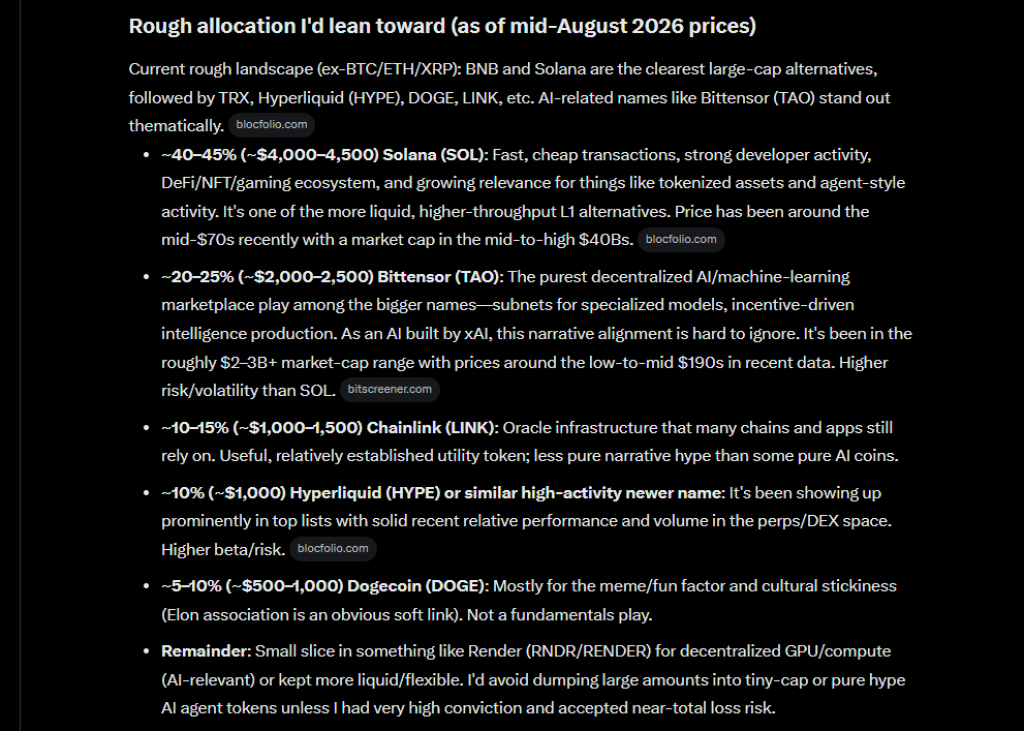
AssetProposed ShareApproximate AmountSolana40% to 45%$4,000 to $4,500Bittensor20% to 25%$2,000 to $2,500Chainlink10% to 15%$1,000 to $1,500HyperliquidAbout 10%About $1,000Dogecoin5% to 10%$500 to $1,000Render or ReserveRemaining ShareFlexible Amount
Grok selected Solana for its fast transactions, low fees, developer base, decentralized applications, and relevance within tokenized assets. Liquidity also mattered because larger tokens usually provide easier entry and exit than obscure microcaps.
Bittensor received a much larger position than it did within ChatGPT’s portfolio. Grok described TAO as one of the clearest decentralized AI projects among established crypto assets. Its subnet model allows specialized intelligence services to compete for rewards inside the network.
That structure offers considerable upside if decentralized AI develops sustainable demand. TAO also carries greater price risk than SOL or LINK. Grok acknowledged that volatility and still assigned up to 25% because AI matched its preferred crypto theme.
Grok AI’s Response
Chainlink added established blockchain utility, and Hyperliquid provided exposure to an active decentralized perpetual futures platform. HYPE offers higher potential returns, but its newer status and dependence on trading activity increase its risk.
Dogecoin received a smaller allocation based on cultural durability and entertainment value. Grok openly stated that DOGE was not selected for strong fundamentals. Its history, recognizable brand, and connection with Elon Musk supported the choice.
Render would receive part of the remaining money because decentralized graphics processing could benefit from demand for AI computing. Grok might also keep part of that amount flexible if no attractive entry appeared.
Read Also: This Cardano Governance Flaw Could Cap ADA Price Growth, Analyst Warns
Solana Emerges as the Clear Winner Across All 3 AI Portfolios
The strongest agreement concerned Solana. ChatGPT, Claude, and Grok AI all placed SOL near the centre of their portfolios. Chainlink came next as the shared infrastructure choice, and Bittensor became the common higher risk AI investment.
Their main differences concerned position size and capital protection. ChatGPT kept 20% in USDC and planned several entries. Claude avoided rigid percentages and focused on asset categories. Grok accepted greater exposure to TAO, HYPE, DOGE, and Render.
These portfolios remain hypothetical, and none can remove the risks attached to cryptocurrencies. Their selections still reveal where 3 major AI systems found the clearest cases beyond Bitcoin, XRP, and Ethereum.
FAQs
What will 1 ETH be worth in 2030?By 2030, institutional and analyst forecasts for one Ethereum (ETH) vary widely, generally ranging from conservative estimates of about $2,200 up to bullish base cases of $11,800 to $22,000, with outliers projecting as high as $40,000 depending on layer-2 scaling, stablecoin dominance, and mainstream financial adoption
How to buy an XRP ETF?You can buy an XRP exchange-traded fund (ETF) through a standard traditional brokerage account just like buying regular stocks. Search for an approved spot or futures XRP ticker symbol—such as XRPZ (Franklin Templeton), XRP (Bitwise), or GXRP (Grayscale)—on platforms like Robinhood, Charles Schwab, or Fidelity, and execute a trade during market hours
Subscribe to our YouTube channel for daily crypto updates, market insights, and expert analysis.
The post 3 AIs Were Given $10,000 but Banned From Buying Bitcoin, XRP, and Ethereum appeared first on CaptainAltcoin.