Last week, something unusual happened on Wall Street. Executives from Vanguard, BlackRock (BLK), and State Street (STT), the “big three” companies that together manage around $35 trillion, to
Last week, something unusual happened on Wall Street.
Executives from Vanguard, BlackRock (BLK), and State Street (STT), the “big three” companies that together manage around $35 trillion, took the stage together for Bloomberg’s Trillions podcast in New York.
The podcast hosts, Eric Balchunas and Joel Weber, said that the firms account for around 70% of the U.S. exchange-traded fund (ETF) market, down from around 80% a decade ago. Their decisions impact the money investors have available, the fees they pay, and how they buy everything from stocks to private-market investments.
But one part of the conversation was especially relevant for crypto investors: tokenization and whether placing traditional investment products on a blockchain could bring a new generation of investors into Wall Street’s financial system.
ETF flows show where investors are putting their money
The scale of these asset managers matters because investors are already using their products to gain exposure to crypto.
But recent ETF flows suggest that demand for one of Wall Street's biggest crypto investment products has weakened.
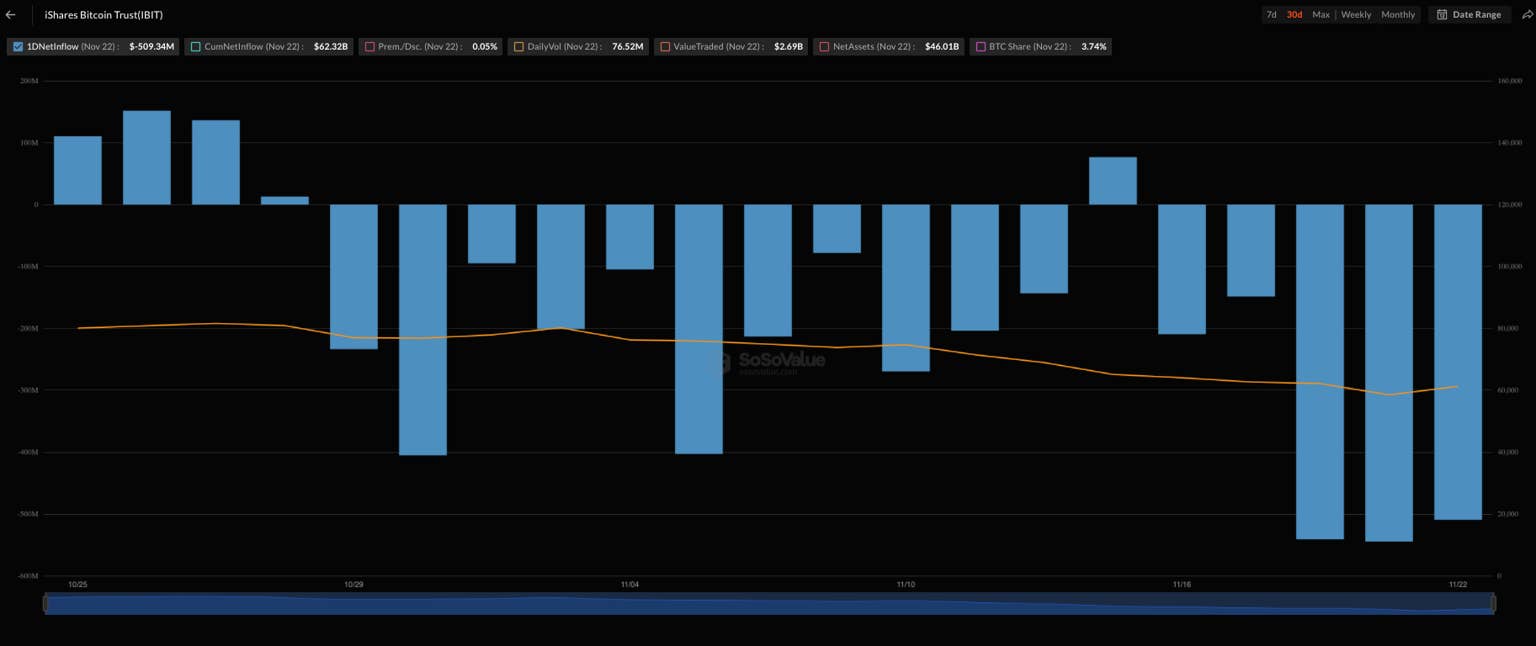
U.S. spot Bitcoin ETFs recorded around $4.7 billion in net outflows in November yet, according to SoSoValue data. Investors withdrew money on 14 of the month's 16 trading days.
The funds recorded another $569.7 million in net outflows on Nov. 23, marking their fifth consecutive day of withdrawals. BlackRock's iShares Bitcoin Trust (IBIT) accounted for approximately $509.3 million of that day's outflows.
The figures are worth putting into perspective. IBIT has attracted around $62.3 billion in cumulative net inflows since its launch, according to the same data. But its recent outflows show that investors can pull back from a product even after it has attracted billions of dollars.
IBIT logs record inflow. Source:
SoSoValue
Trending on TheStreet Roundtable:
Wall Street aims to tap crypto wallet investors
Elise Terry from BlackRock said she used to wonder what tokenization would actually solve for ETF investors. The answer came from an unlikely place: Terry's hairdresser. She had owned Bitcoin (BTC) since 2015 and preferred to store her investments in a digital wallet rather than in large banks or custodians.
That conversation highlighted a potential audience for Wall Street. There are investors who are willing to hold assets in crypto wallets, but who have little interest in accessing conventional financial products through traditional banking channels.
Tokenizing ETFs could provide those investors with another way to access the products, Terry said. She viewed it as another distribution channel, not an “ETF killer”.
Anna Paglia of State Street made a similar point, but added the need for tokenization to have a practical use case.
The point of the discussion was not to replace Bitcoin or turn ETFs into cryptocurrency. It was about using blockchain-based infrastructure to deliver traditional financial products through a different channel.
Related: Before the bell: Bitcoin can’t catch a break
AI could change how investors get advice
Artificial intelligence was another major topic of discussion. The executives were largely in agreement about how AI has become an integral part of investment.
According to Vanguard's Janel Jackson, AI tools are already helping investment teams save time on research and spreadsheets.
"AI can really help us design, test, and think about the underlying construction of our new innovation. It's not wild or hot sauce, but like our new innovation. And I think that frees up time for the teams to actually spend with our clients and understand what they're asking for, what they need, and what solutions we're actually trying to solve," said Terry.
Paglia was of the opinion that the technology assisted State Street in analyzing fund flows and developing more targeted research and investor education
Even as the executives listed out the benefits, they were also quick to caution about the risks of financial advice being disseminated on social media and by AI tools.
The panel discussed the increasing influence of financial influencers, especially among younger investors. Terry said investment firms have a responsibility to help creators access reliable expertise, since influencers are not licensed financial professionals.
One example of the dangers, she said, was investors buying leveraged products without understanding the downside.
The discussion was a reminder for investors that Wall Street's next phase of growth may not just be about lower fees.
Tokenization could give traditional funds access to crypto-native investors, private market products could create new types of exposure, and AI could change the way people research and manage their money.
However, increased access does not mean reduced risk. Investors still need to know what they're buying, how it trades, and what it might cost them.
Related: Aptos exec: Wall Street still needs treasury stocks