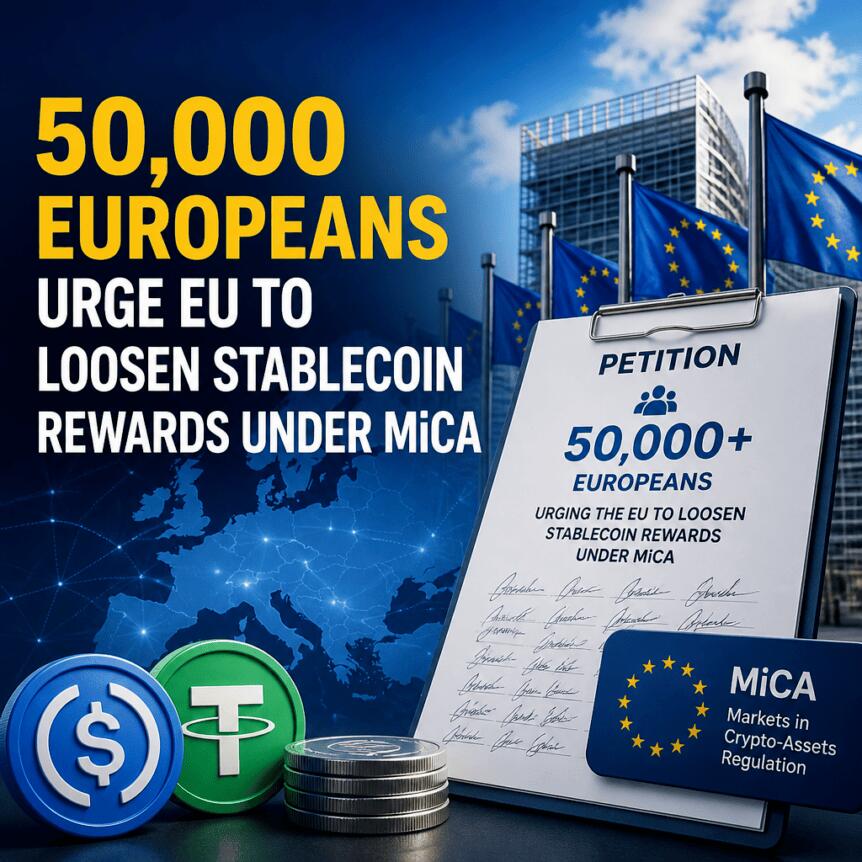
More than 50,000 people have urged the European Commission to loosen restrictions on stablecoin rewards as part of its review of the Markets in Crypto-Assets (MiCA) rules. The request, organi
More than 50,000 people have urged the European Commission to loosen restrictions on stablecoin rewards as part of its review of the Markets in Crypto-Assets (MiCA) rules. The request, organized by Stand With Crypto EU, asks the EU to let regulated stablecoin providers offer incentives to holders—such as cashback, loyalty programs, and fee reductions—rather than banning the practice outright.
The Commission’s MiCA consultation concluded on Wednesday. Stand With Crypto EU said the effort produced over 50,000 campaign emails to the Commission and that more than 126,000 people have also signed a separate petition calling for a more permissive approach to stablecoins. The group’s central argument is that the current MiCA framework prevents stablecoins from competing fairly with bank deposits and other e-money products that can provide customer benefits.
Key takeaways
- Stand With Crypto EU says over 50,000 supporters wrote to the European Commission during the MiCA consultation about allowing regulated stablecoins to offer customer incentives.
- MiCA currently prohibits issuers and crypto service providers from paying interest on stablecoins, a restriction Stand With Crypto EU argues reduces the products’ competitiveness.
- The campaign compares its outreach to prior MiCA-related consultations, arguing it substantially outpaced earlier response levels.
- The push aligns with ongoing calls from European central banks to revisit specific stablecoin rules, though their focus is primarily on yield-linked arrangements and reserve liquidity.
Why stablecoin “rewards” are at the center of MiCA talks
MiCA’s stablecoin provisions, as applied to issuers and crypto service providers, prohibit paying interest on stablecoins. Stand With Crypto EU argues that the rule puts stablecoins at a disadvantage relative to traditional financial products where consumers can receive benefits. While the campaign does not frame the issue as simply “more profit,” it is clear that it views consumer incentives as part of the competitiveness equation for euro-denominated stablecoins.
In comments to Cointelegraph, Stand With Crypto EU general manager Harry Pearce Gould said the group wants the Commission to use the MiCA review to allow regulated stablecoin providers to offer rewards to holders.
“We are calling on the Commission to use the MiCA review to allow regulated stablecoins to offer rewards to holders,” Pearce Gould told Cointelegraph.
He added that the incentive model could help euro stablecoins build adoption and compete more effectively with dollar stablecoins. The rationale goes beyond marketing: the group contends that stronger euro stablecoins are tied to Europe’s payments standing and “payment sovereignty,” framing the debate as one of strategic relevance to the euro area.
A “compete with the US” framing for stablecoins
Gould also urged policymakers to consider regulatory competition, pointing to the United States as an example of a different approach to stablecoins. In his view, Europe does not have to replicate the US model directly, but it does need to ensure its framework does not leave euro stablecoins unable to scale.
“The US has made a clear choice to back stablecoins as the settlement layer for tokenisation. Europe doesn’t need to copy that, but it does need to compete with it,” he said.
The campaign’s logic is that regulatory constraints on customer incentives can translate into weaker product demand, which then limits the euro’s ability to anchor tokenized financial activity. That is a significant shift from earlier debates that largely focused on compliance, transparency, and reserve management; here, the focus includes consumer-facing features as a factor in broader market development.
What central banks are asking the Commission to change
Stand With Crypto EU’s campaign arrives while European central banks are pressing for adjustments to MiCA’s stablecoin treatment. The European System of Central Banks (ESCB) submitted a response to the Commission’s MiCA review on Sept. 22, arguing that the current prohibition on stablecoin interest should be broadened to cover lending, borrowing, and staking arrangements that generate yield.
In other words, the ESCB’s position is not limited to direct interest payments. It suggests the rules should capture a wider category of “yield-like” behavior tied to stablecoins. That stance also reflects a broader concern about how stablecoin-linked incentives might affect risk and liquidity dynamics in practice.
The ESCB also proposed a change to how reserve holdings are structured. Instead of requiring stablecoin issuers to hold a minimum portion of reserves in bank deposits, it called for liquidity thresholds. The central banks’ concern is that existing requirements could strain lenders if a stablecoin run forces an issuer to withdraw deposits quickly.
The ECB has previously raised a related warning about liquidity mismatches, pointing to the timing difference between stablecoin settlement, which runs around the clock, and the settlement schedules of reserve assets that may still depend on traditional financial infrastructure.
Separately, ECB President Christine Lagarde has warned that a shift of deposits from banks into stablecoins could weaken bank lending and impair monetary policy transmission. In the same vein, Lagarde argued that Europe should prioritize tokenized financial infrastructure anchored by central bank money.
Why investor and user expectations are colliding with stability concerns
The juxtaposition is notable: Stand With Crypto EU is advocating for stablecoin reward programs that would make euro stablecoins more attractive to users, while the ESCB and ECB have emphasized the potential stability and liquidity implications of how stablecoins are structured—especially when incentives can resemble yield. For market participants, this tension suggests that the MiCA review may not settle solely on whether customer rewards should be allowed, but also on what form those rewards take and how regulators categorize them.
Stand With Crypto EU also said its consultation outreach dramatically exceeded earlier participation levels. The group claims its campaign generated more than six times the 8,221 responses submitted to the European Central Bank’s digital euro consultation, and far more than the 198 responses received during the Commission’s 2020 consultation on crypto rules. The implication for policymakers is straightforward: the stablecoin incentive question appears to be drawing significant public interest, not just industry submissions.
However, even with public support, the central bank concerns point to a different kind of priority—ensuring that stablecoin incentives do not unintentionally increase the risk of rapid liquidity stress or create structures that regulators treat as economically equivalent to interest-bearing products.
Readers should watch how the Commission frames the boundary between “rewards” and interest or yield-like arrangements, and whether it adopts the ESCB’s suggested expansion beyond direct interest prohibitions. With European central banks already signaling liquidity and stability concerns, the next step will likely determine whether euro stablecoins can compete on user incentives without triggering renewed regulatory objections.
This article was originally published as 50,000 Europeans urge EU to loosen stablecoin rewards under MiCA on Crypto Breaking News – your trusted source for crypto news, Bitcoin news, and blockchain updates.