7 Crypto Projects Shutdown: What Happened and What Comes Next The list of crypto projects shutdown in 2026 keeps growing, and this latest batch includes names that once defined entire categor
7 Crypto Projects Shutdown: What Happened and What Comes Next
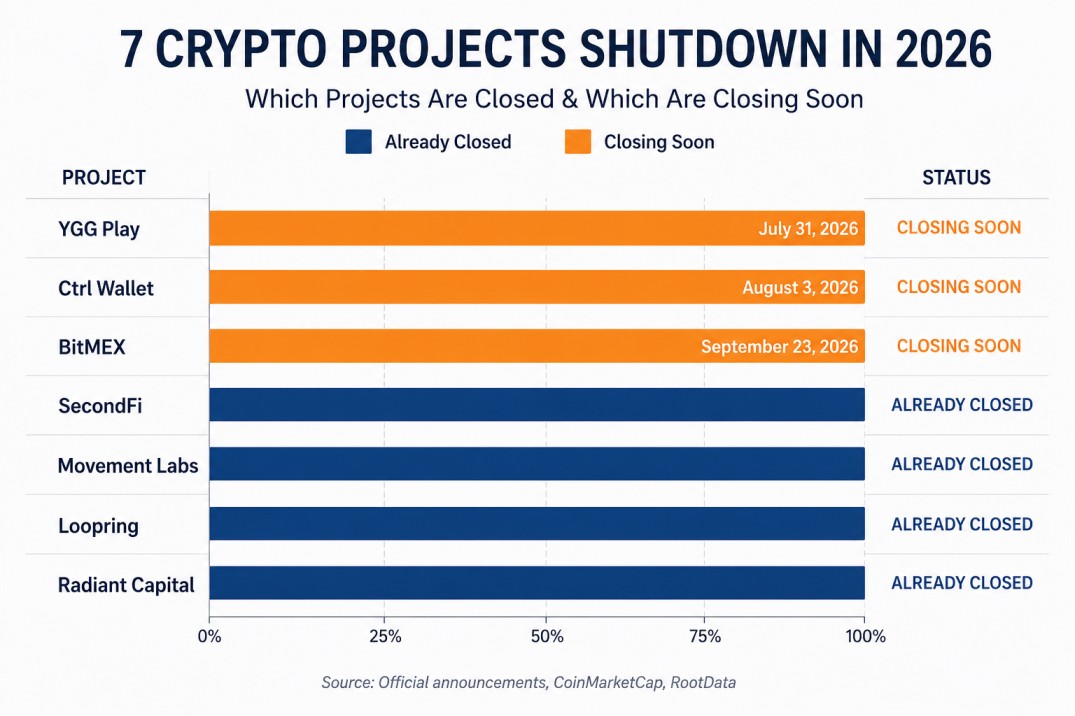
The list of crypto projects shutdown in 2026 keeps growing, and this latest batch includes names that once defined entire categories. Seven projects, spanning gaming, wallets, derivatives, and DeFi lending, are either closed or closing within weeks of each other. According to RootData, more than 79 crypto projects have shut down, gone bankrupt, or gone dark in 2026 alone, and this group shows the pattern cuts across the whole industry, not just weak corners of it.
Two of the names here, BitMEX and Loopring, are not failed experiments. BitMEX invented the 100x leverage perpetual swap, the contract type that still powers most crypto trading today. Loopring shipped Ethereum's first zk-rollup decentralized exchange. Being first built a legacy for both, but it did not guarantee survival once trading volume concentrated on a handful of dominant platforms. Two other closures, SecondFi and Radiant Capital, were forced by hacks rather than market pressure, and in a prolonged bear market, there was no path back from either exploit.
The Shutdown List at a Glance
Project
Status
Category
Reason
YGG Play
Closing July 31, 2026
Web3 game publisher
Unsustainable economics after Oct 2025 crash
Ctrl Wallet
Closing August 3, 2026
Self-custody wallet
Security exploit, no fix found
BitMEX
Closing September 23, 2026
Derivatives exchange
Strategic business review
SecondFi
Already closed
Cardano wallet
$2.4M exploit, no recovery
Movement Labs
Already closed (bankruptcy)
Layer 1 blockchain
Token scandal, weak revenue
Loopring
Already closed
zk-rollup DEX
Low adoption, newer rivals
Radiant Capital
Already closed (DAO wind-down)
DeFi lending
$50M exploit, no recovery
YGG Play
YGG Play was the Web3 game publishing arm of Yield Guild Games, home to titles like LOL Land and Waifu Sweeper since its 2025 launch. The unit generated more than $9 million in lifetime revenue, which sounds healthy until you look at when that revenue peaked: October 2025, right before a major market liquidation event hit retail confidence hard.
Yield Guild Games itself is still active. Its YGG token trades around $0.019 with a market cap near $15.0M, up about 3.5 percent over the past 24 hours, according to CoinMarketCap data. The parent company is not shutting down; it is closing this one division, laying off 35 employees, and redirecting its $20.6 million treasury toward selling gaming behavioral data to AI companies instead of publishing games.
What users should do: Anyone with points or staked YGG tied to YGG Play needs to unstake and claim rewards before July 31. Two games on the platform, GIGACHADBAT and Ragnarok Breaker, will keep running under their original developers, so those specific titles are not disappearing even though the publishing arm is.
Ctrl Wallet
Ctrl Wallet was a self-custody wallet supporting more than 2,500 blockchains, and it is shutting down completely on August 3, 2026. The trigger was a security exploit discovered on June 23 that hit a subset of Cardano-linked hot wallets on the platform, part of a broader wave of vulnerabilities that also struck SecondFi and Emurgo integrations around the same time.
Ctrl Wallet has no native token, so there is no market cap or price data tied to the closure itself. The team chose to decommission the app rather than patch and rebuild, and new downloads have already been pulled from app stores.
What users should do: Full wallet functions, including sending, receiving, and swapping, work only until August 2. From August 3 onward, the only remaining feature is exporting your recovery phrase, so anyone with funds still in the wallet needs to move them or back up their seed phrase before that date.
BitMEX
BitMEX is the oldest name among this week's crypto projects shutdown and arguably the most consequential. Launched in 2014, it invented the 100x leverage perpetual swap, a product now offered by nearly every major exchange in the industry. HDR Global Trading, the company behind BitMEX, announced on July 23, 2026, that the exchange will close for good on September 23, 2026, at 04:00 UTC, following what it called a strategic review of the business and the broader industry. The company did not cite financial trouble or regulatory action as the cause.
BitMEX has stopped accepting new account registrations immediately. Starting August 26, the platform will block new positions and only allow traders to reduce existing ones before force-closing anything still open by the September 23 deadline. Notably, BitMEX says it has never lost customer funds to a hack in over 11 years of operation, a track record few exchanges its age can claim.
What users should do: Close open positions and withdraw funds well before September 23. Accounts left with balances after closure will face a monthly custody fee, and the company has warned that fee could rise over time.
SecondFi
SecondFi, the rebranded successor to Cardano's long-running Yoroi wallet, has already shut down. Developer Emurgo confirmed the platform will not resume normal operations even after security audits are complete. The cause was a nonce derivation flaw in the wallet's own transaction-signing code, not a breach of the Cardano network itself, which let attackers drain roughly 16 million ADA, worth about $2.4 million, from 374 wallets in late June 2026. A separate white hat hacker moved another 129 million ADA into safekeeping during the emergency response.
SecondFi itself has no separate token; the affected asset was ADA, Cardano's native coin, which trades independently of this incident. Emurgo's role has narrowed to a dedicated recovery team focused solely on returning stolen funds to affected users.
What users should do: If your wallet was among the 374 affected addresses, watch official Emurgo channels for the wallet status checker and export tool, expected in August, and avoid any third-party site offering a "migration token," since Emurgo has confirmed no such token exists.
Movement Labs
Movement Labs, the company behind the Movement blockchain built on Meta's discontinued Move programming language, filed for Chapter 11 bankruptcy in Delaware on July 15, 2026. The filing followed a controversy that began in December 2024, when a market-making agreement let roughly 66 million MOVE tokens hit the open market right after the token's Binance listing, crashing the price and triggering exchange bans.
The company raised more than $141 million from investors but never generated enough on-chain revenue to sustain itself independently; daily network fees had fallen as low as $1 in the 24 hours before the filing. The MOVE token itself trades around $0.0106 today, with a market cap near $44.2 million, per CoinMarketCap, down roughly 99 percent from its all-time high.
What users should do: The underlying movement network technically still runs through a separate entity, Move Industries, which says it is operating normally and is not part of the bankruptcy filing. Court records show creditors have until September 14, 2026, to file claims, with a restructuring plan expected by October 13.
Loopring
Loopring shut down its decentralized exchange, AMM, and relayer with immediate effect on June 28, 2026, ending the run of what was Ethereum's first zero-knowledge rollup DEX. The team, in its own words, described itself as "engineers, not business operators" and pointed to three specific reasons: the protocol never achieved meaningful adoption, its early architecture lacked a virtual machine that newer zkEVM rivals now offer, and a wave of exchange delistings for its LRC token in 2026 added further pressure.
Loopring's total value locked collapsed from a peak of $760 million in November 2021 to about $8 million by the time of closure, a drop of more than 99 percent. As of now, LRC trades near $0.01225, though CoinMarketCap shows a sharp 24-hour swing of roughly 60 percent amid the volatility around the shutdown news, with a market cap close to $16.77 million.
What users should do: Loopring says it will calculate final balances and distribute funds directly to users' Ethereum wallets in batches, covering the gas fees itself. Balances above a small minimum threshold qualify, and the team has said a two-week review window will run before distributions begin.
Radiant Capital
Radiant Capital, once one of DeFi's larger cross-chain lending protocols, announced on June 1, 2026, that its DAO would wind down active development after 18 months of failed attempts to recover from an October 2024 exploit. Attackers linked to North Korea's Lazarus Group stole more than $50 million by compromising three of the protocol's eleven multi-signature wallet keys during a routine update, and Radiant's total value locked never recovered, falling from $386.8 million to roughly $5 million within a month of the attack.
RDNT, the protocol's token, now trades at about $0.000557 with a market cap near $794.58k, according to CoinMarketCap, a small fraction of its 2023 peak. The DAO has stopped issuing RDNT emissions and set borrowing caps to zero across all markets, though the protocol is not disappearing entirely.
What users should do: Radiant says withdrawals, loan repayments, and position management will remain available through the end of 2026. The remediation portal will stay open indefinitely, and any funds recovered from the 2024 exploit are meant to flow back to affected users through that channel.
What This Wave Says About the Market
Looking at these seven crypto projects shutdown together, a pattern shows up that goes beyond any single failure. Being early to a category, whether that's perpetual swaps, zk-rollups, or cross-chain lending, does not protect a project once the market consolidates around a smaller number of dominant venues. Separately, the two hack-driven closures here, SecondFi and Radiant Capital, reinforce a harder truth about this market cycle: a serious exploit during a bear market rarely leaves room for a comeback because there is neither the capital nor the user trust left to rebuild on.
For anyone holding assets tied to these platforms, the immediate priority is the same across all seven cases: check official announcement channels directly, move funds or export recovery phrases before stated deadlines, and treat any unofficial "migration" or "compensation" token offer as a red flag, since none of these teams have announced one. This wave of crypto projects shutdown is a reminder that deadlines here are real and rarely extended.
Disclaimer
This article is for educational and informational purposes only and should not be considered financial or investment advice. Always conduct your own research before making investment decisions.