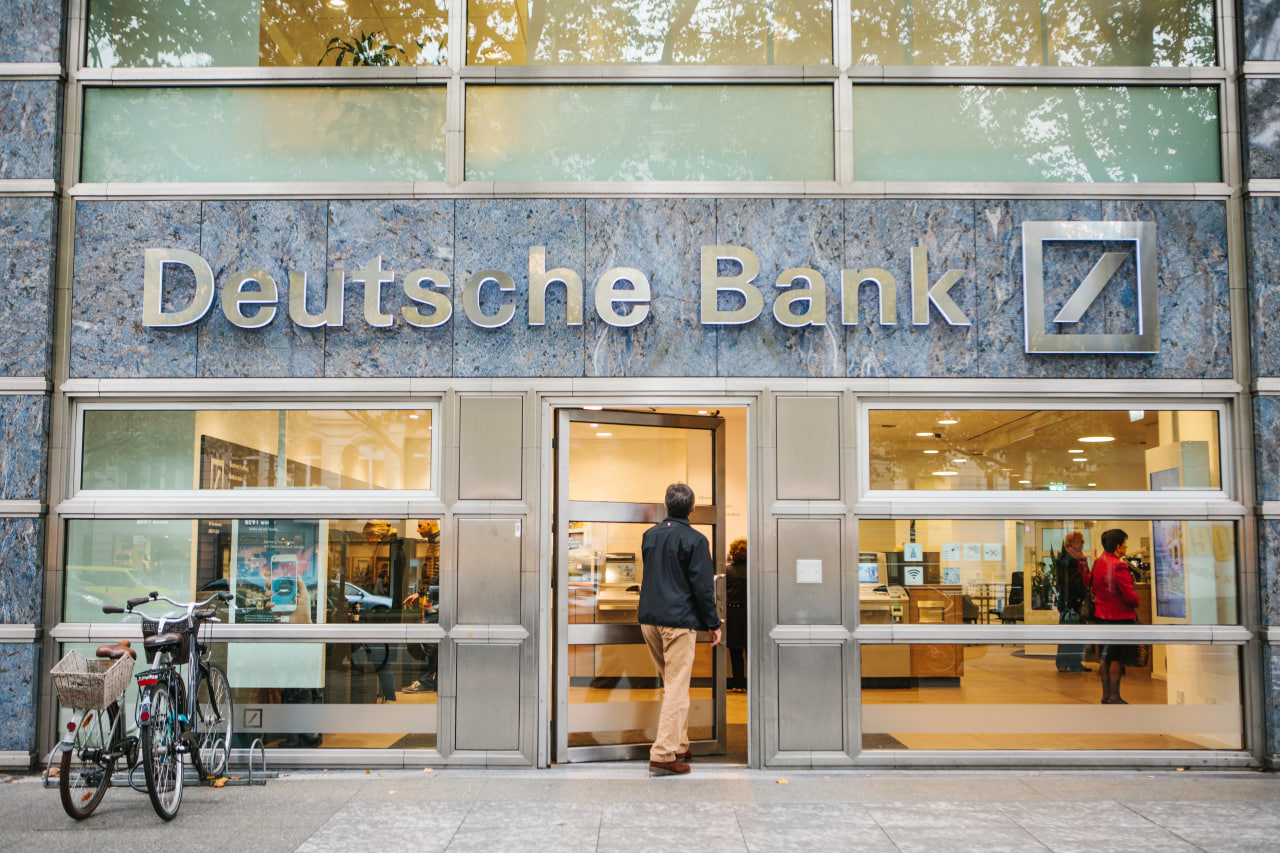
Deutsche Bank plans to launch crypto custody for institutional and corporate clients by the end of 2026. The service depends on a BaFin custody licence the bank expects in October. Around eig
- Deutsche Bank plans to launch crypto custody for institutional and corporate clients by the end of 2026.
- The service depends on a BaFin custody licence the bank expects in October.
- Around eight of Europe’s twenty largest banks already run live digital asset services.
- Under MiCA, a single national licence can be passported across the entire European Economic Area.
Deutsche Bank intends to open a digital asset custody service for institutional and corporate clients before the end of 2026, a move that would place Germany’s largest lender directly inside a market it watched from the sidelines for years. The rollout hinges on a crypto custody licence from BaFin, the country’s financial regulator, which the bank expects to receive in October. As a Global Systemically Important Bank, Deutsche Bank carries a weight in this space that smaller crypto-native custodians do not, and its entry signals how far regulated European finance has moved toward holding Bitcoin and Ether on behalf of clients.
Bitcoin, Ether and three stablecoins open the service
At launch the bank will support a deliberately narrow set of assets: Bitcoin, Ether, and three regulated stablecoins, namely Circle’s USDC, its euro counterpart EURC, and AllUnity’s EURAU. The service targets asset managers, hedge funds, brokerages, custodians and corporate treasuries. Retail clients are not part of the plan. Deutsche Bank will hold clients’ wallets and private cryptographic keys directly, which lets institutions gain exposure to digital assets without building the specialised, and expensive, security infrastructure that safe key storage demands.
ElementDetail
Launch targetBy the end of 2026
Eligible clientsInstitutional and corporate only: asset managers, hedge funds, brokerages, custodians, corporate treasuries
Assets at launchBitcoin, Ether, USDC, EURC, EURAU
Custody modelDirect management of client wallets and private keys
RegulatorBaFin (Germany), under MiCA
Expected licenceOctober 2026
Technology partnersTaurus SA, Bitpanda technology unit
Next on the roadmapTokenised financial instruments; possible stablecoin or tokenised deposits
Why a single BaFin licence unlocks the whole EEA
The timing traces back to MiCA, the European Union’s Markets in Crypto-Assets regulation, whose full enforcement gave banks the legal certainty they had been waiting for. Under that framework a custody licence granted by one national regulator can be passported across the European Economic Area, meaning Deutsche Bank’s expected BaFin approval would let it offer the same service in every EEA country without seeking separate authorisation in each. A German licence becomes a continental product. It also explains why so many large banks moved within roughly the same window rather than years apart. Before MiCA, the absence of a common rulebook left crypto custody in a legal grey area that most tier-one institutions were unwilling to touch.
Taurus and Bitpanda supply the underlying technology
Deutsche Bank did not build the custody stack alone. It signed a global agreement with Taurus SA, a Swiss digital asset infrastructure provider, in 2023, and took part in the firm’s $65 million Series B round. Taurus supplies the core enterprise custody technology that safeguards keys and processes transfers. For the client-facing product and potential trading and execution components, the bank brought in the technology unit of Bitpanda, the Austrian crypto exchange. The split keeps Deutsche Bank out of the parts of the system where a banking licence offers no advantage.
Where Deutsche Bank stands among Europe’s largest banks
Deutsche Bank is arriving after most of its large peers already built the same capability. Around eight of Europe’s twenty largest banks have gone live with some form of digital asset offering, though these range from full custody to lighter ETP exposure, and a domestic rival got there first. Commerzbank secured its German crypto custody licence ahead of Deutsche Bank, concentrating on corporate storage. Spanish banks have pushed hardest on direct retail and institutional access, while French institutions have focused on market infrastructure and their own stablecoins.
Bank (Country)Status and offering
BBVA (Spain)Live spot trading and custody for institutional and retail clients
Santander (Spain)Direct spot trading and custody through OpenBank
CaixaBank (Spain)MiCA CASP authorisation; expanding from ETPs into direct custody
Société Générale (France)Institutional custody via SG-FORGE; issuer of EURCV and USDCV stablecoins
Crédit Agricole (France)Institutional custody through the CACEIS asset servicing venture
BNP Paribas (France)Crypto ETP exposure; active in European blockchain consortia
KBC (Belgium)Live, scaled custody and trading for its client base
DZ Bank (Germany)BaFin-approved meinKrypto custody and trading for cooperative clients
Commerzbank (Germany)Local custody licence secured ahead of Deutsche Bank; corporate storage focus
Deutsche Bank (Germany)Institutional custody pending BaFin licence, targeted for late 2026
What bank-grade custody changes for institutional buyers
For an institution, holding Bitcoin through Deutsche Bank rather than a crypto-native firm changes the risk calculation. Custody sits with a regulated, systemically important bank subject to supervision, and private keys are protected through cold storage and layered defences rather than a startup’s internal controls. Gerald Podobnik, co-head of the bank’s Corporate Bank, has framed digital assets as a complement to the traditional system rather than a replacement, describing them as new rails that run alongside existing infrastructure. Paul Maley, the bank’s global head of securities services, has stressed a cautious approach built to keep crypto’s volatility from contaminating the bank’s core activities.
The roadmap points past custody
Custody is the entry point rather than the destination. Deutsche Bank has said it wants to move into tokenised financial instruments and has previously explored issuing its own stablecoin or a tokenised deposit product for payments. The broader direction is visible in Qivalis, a consortium that has grown to 37 banks across 15 countries, including ING, BNP Paribas, KBC and UniCredit, and is building a MiCA-compliant euro stablecoin for cross-border settlement. Member banks are expected to offer built-in wallets and custody to support it, with first issuance targeted for the second half of 2026, which would put a bank-issued euro stablecoin in the market around the same time Deutsche Bank’s custody service goes live.
The post 8 European Banks Already Hold Crypto. Deutsche Bank Is Next appeared first on ETHNews.