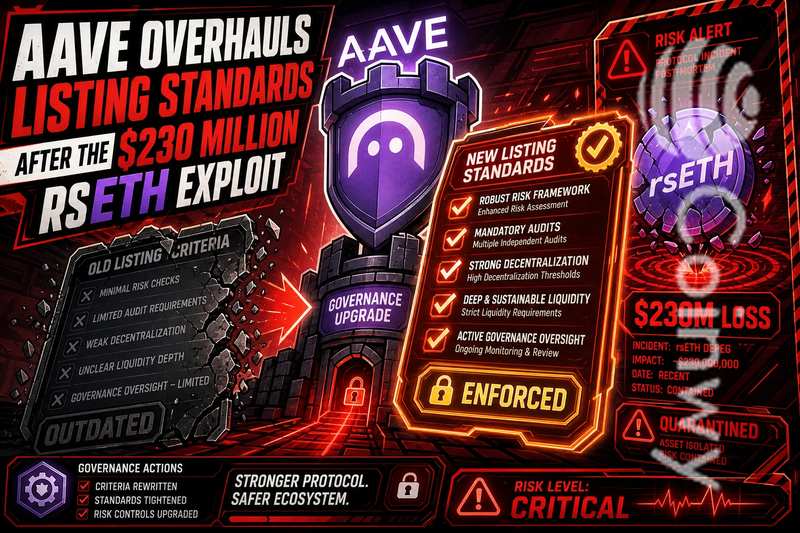
Aave is overhauling its asset listing standards following the $230 million rsETH exploit, a move that signals tighter risk controls for one of DeFi's largest lending protocols. The policy shi
Aave is overhauling its asset listing standards following the $230 million rsETH exploit, a move that signals tighter risk controls for one of DeFi's largest lending protocols.
The policy shift comes after an incident involving rsETH, a restaked ETH derivative, that resulted in significant losses across the protocol. An incident report published on the Aave governance forum details the April 20, 2026 exploit and its aftermath.
The broader attack targeted Kelp DAO's infrastructure. CoinDesk reported it as 2026's largest crypto exploit, with wrapped ether stranded across 20 chains and total losses reaching $292 million. Aave's exposure accounted for a substantial portion of the damage.
Why listing standards are Aave's primary lever for preventing future losses
For a lending protocol, listing standards determine which assets can serve as collateral and which can be borrowed. Every token onboarded introduces counterparty risk, oracle dependency, and liquidity assumptions that directly affect all depositors.
The rsETH incident exposed how liquid restaking tokens, which wrap already-staked ETH through additional protocol layers, can carry compounding smart contract risk. When one layer fails, losses cascade through any protocol that accepted the derivative as collateral.
Aave's governance response appears aimed at raising the bar for derivative asset onboarding, particularly for tokens that depend on cross-chain bridge infrastructure. LayerZero Labs published its own incident report detailing how the exploit propagated through bridged rsETH across multiple chains.
This kind of protocol-level standards review typically tightens requirements around liquidity depth, oracle reliability, and the number of independent security audits a token must pass before listing. For lenders and borrowers on Aave, stricter screening could reduce exposure to poorly vetted assets, similar to how Sui's response to its mainnet halts involved revisiting deployment procedures after repeated failures.
What tighter Aave standards could mean for DeFi token listings
Aave is among the largest DeFi lending venues by total value locked. When it raises its listing bar, projects seeking to be onboarded face higher compliance costs and longer review timelines.
The practical effect may be a two-tier market for DeFi collateral: established assets with deep liquidity will continue to be listed readily, while newer derivatives, particularly those relying on restaking or cross-chain bridges, could face extended scrutiny periods.
For governance participants, the shift reinforces that listing votes carry real financial consequences. A single under-vetted asset can expose the entire protocol to losses in the hundreds of millions, as the rsETH case demonstrated. Even routine token operations like airdrop distributions on centralized exchanges require their own vetting procedures to manage risk.
Projects building on Ethereum's restaking ecosystem, which has grown rapidly in 2025 and 2026, may need to invest more heavily in security audits and liquidity guarantees before approaching major lending protocols. Exchanges navigating similar trust and compliance questions, such as Coinbase's recent expansion into India, face their own due diligence challenges when onboarding new payment rails and trading pairs.
The immediate takeaway is narrow but significant: a major exploit has forced the most prominent DeFi lending protocol to formally tighten how it evaluates new assets. Whether other protocols follow with similar reforms will depend on whether governance communities treat this as a sector-wide wake-up call or an isolated incident.
Disclaimer: This article is for informational purposes only and does not constitute financial or investment advice. Cryptocurrency and digital asset markets carry significant risk. Always do your own research before making decisions.
Read original article on coinwy.comRead also :