A new Aave V4 proposal filed September 11, 2026 would place Aave DAO funds first in line to absorb bad debt, positioning DAO-funded deficit offsets as the initial loss layer before Umbrella u
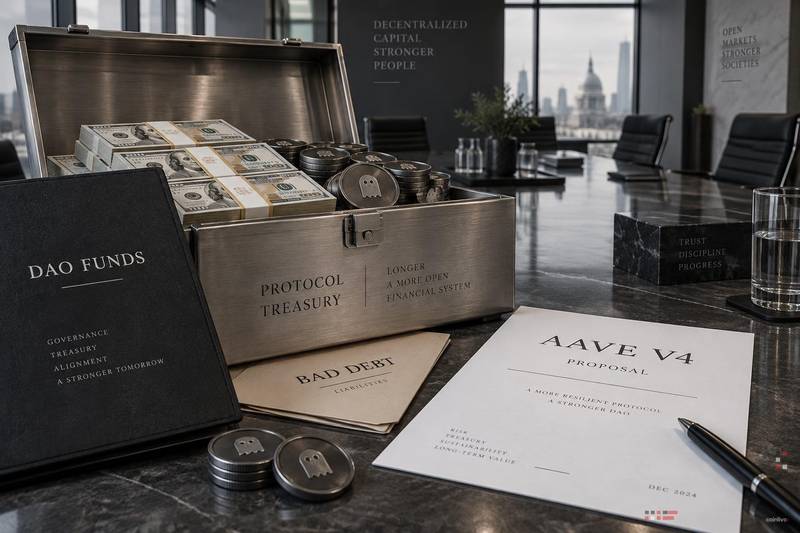
A new Aave V4 proposal filed September 11, 2026 would place Aave DAO funds first in line to absorb bad debt, positioning DAO-funded deficit offsets as the initial loss layer before Umbrella underwriter coverage kicks in for three core markets on Ethereum.
The Aave V4 proposal was published by DAO service provider TokenLogic at 14:29 UTC as an ARFC, recommending general-purpose Umbrella markets for Core WETH, Core USDC and Core USDT, according to the governance thread. It is a published proposal, not an approved or deployed change; no vote, execution transaction or funded balances have been confirmed. For related coverage, see Fed Chair Warsh Reaffirms 2% Inflation Goal Despite U.S. Debt Strain.
- Proposed priority: designated DAO funds would sit first in the loss waterfall for three Core markets.
- Conditional effect: those funds would absorb bad debt first, before Umbrella underwriters, if losses occur and the proposal takes effect.
- Still to confirm: governance status remains open; the ARFC has not been shown to have passed a vote or reached on-chain deployment.
What the Aave V4 proposal would change about bad debt
DAO funds as the proposed first source of loss absorption
Under the framework, DAO-funded deficit offsets would form the first-loss layer before underwriter coverage. TokenLogic proposes offsets of 33 ETH for Core WETH, 15,000 USDC for Core USDC and 15,000 USDT for Core USDT. In the author's words, "Deficit Offsets form the first loss layer before Umbrella coverage." For related coverage, see Senate Republicans Revise Clarity Act With Ethics Proposal.
Proposed DAO first-loss offsets
33 ETH · 15,000 USDC · 15,000 USDT
TokenLogic proposes these DAO-funded offsets for Core WETH, Core USDC and Core USDT, respectively, before Umbrella underwriter coverage absorbs losses. Each offset applies only to its own Hub and asset. Source: TokenLogic, Aave Governance, September 11, 2026; approval and activation were not verified.
The scope is narrow. Coverage and offsets apply per Hub and asset, so capital committed to one Hub asset cannot eliminate a deficit in another; Core USDC coverage would not extend to USDC held in another Hub.
What bad debt means in this proposal
Deficit recognition occurs when a liquidation seizes all collateral but leaves debt outstanding. Deficit elimination is a separate operation that burns the caller's own supplied Hub shares, while underwriting capital earns supply yield until it is used. Each proposed market would cover all Spokes borrowing the protected reserve, including credit-line draws from Spokes whose collateral sits in other Hubs.
Aave's official Umbrella guidance notes that staked assets remain at risk of slashing during cooldown while continuing to earn rewards. That is existing Umbrella context and does not prove V4 activation. The mechanism echoes lessons from earlier stress events, including the $195 million in bad debt Aave faced after a bridge exploit.
What absorbing bad debt first could mean for the DAO
How bad debt coverage could affect available DAO funds
If the proposal takes effect and bad debt materializes, designated DAO funds would be drawn down first, reducing the specific offset balances before underwriters absorb any loss. Being first in line does not establish unlimited coverage; the offsets are fixed amounts per market, not a blanket guarantee against losses.
Behind the DAO layer, TokenLogic targets underwriting liquidity of 800 ETH, 400,000 USDC and 400,000 USDT, sized for six to eight weeks of expected growth. These are proposed targets, not verified funded balances.
Proposed underwriting liquidity targets
800 ETH · 400,000 USDC · 400,000 USDT
Targets for Core WETH, Core USDC and Core USDT, respectively, sized for six to eight weeks of expected growth. These are proposed underwriting targets, not verified funded balances or DAO first-loss offsets. Source: TokenLogic, Aave Governance, September 11, 2026.
Why the remaining loss allocation order matters
To attract underwriters, the proposal sets maximum annual emissions of 20.8 ETH, 12,800 USDC and 12,800 USDT, with emission APYs at target liquidity of 2.6% for WETH and 3.2% for each stablecoin. These are proposed incentive yields layered on variable supply yield, not guaranteed total returns, and distribution would end at launch plus 12 months, with matching Collector allowances.
Stakers face real exposure. Each market proposes a 20-day cooldown and a 2-day unstake window, and staked capital remains slashable during that cooldown. The treatment of lenders, borrowers and token holders beyond these staker terms is not detailed in the fetched proposal and should not be assumed.
Which proposal details still need confirmation
Funding scope, limits, and activation conditions
TokenLogic does not recommend initial general-purpose coverage for Core USDG or Core frxUSD, citing incentive dependence and limited effective risk transfer; frxUSD also has a concentrated, issuer-linked supplier base. The plan is to monitor covered markets after activation and rerun the framework after three months.
Governance status and implementation timing
No completed vote, execution transaction or live funding balances have been verified. The three markets should not be described as activated or funded. Aave has been actively reshaping its footprint elsewhere, including moves to drop support for six low-revenue blockchains and unwind thin markets such as its USDT0 pool on Monad.
AAVE traded at $130.38, up 2.85% over 24 hours, with a market cap near $2.01 billion; the move is retrieval-time background, not a reaction to the proposal. The next milestone to watch is whether the ARFC advances to a formal vote and, if approved, whether the offsets and underwriting targets are funded on-chain.
Disclaimer: This article is for informational purposes only and does not constitute financial or investment advice. Cryptocurrency and digital asset markets carry significant risk. Always do your own research before making decisions.
Read original article on coinlive.me