Spark Savings is live on BitGo. Here's what that means for custody-native institutions. Last week, Spark Savings became available through BitGo institutional custody via Narval. While the ann
Spark Savings is live on BitGo. Here's what that means for custody-native institutions.
Last week, Spark Savings became available through BitGo institutional custody via Narval. While the announcement focused on access, the more significant development is what it changes operationally for institutional allocators. .
The BitGo integration answers a different question, one that tends to kill DeFi deals before they start.
"We'd like exposure to on-chain credit, but our compliance and custody framework doesn’t allow it."
Previously, institutions typically had to move assets out of qualified custody and into externally controlled wallets before interacting with DeFi. For many regulated institutions, that single step triggered internal governance, audit and risk concerns regardless of the underlying protocol. That objection is now off the table.
What the BitGo setup actually means operationally
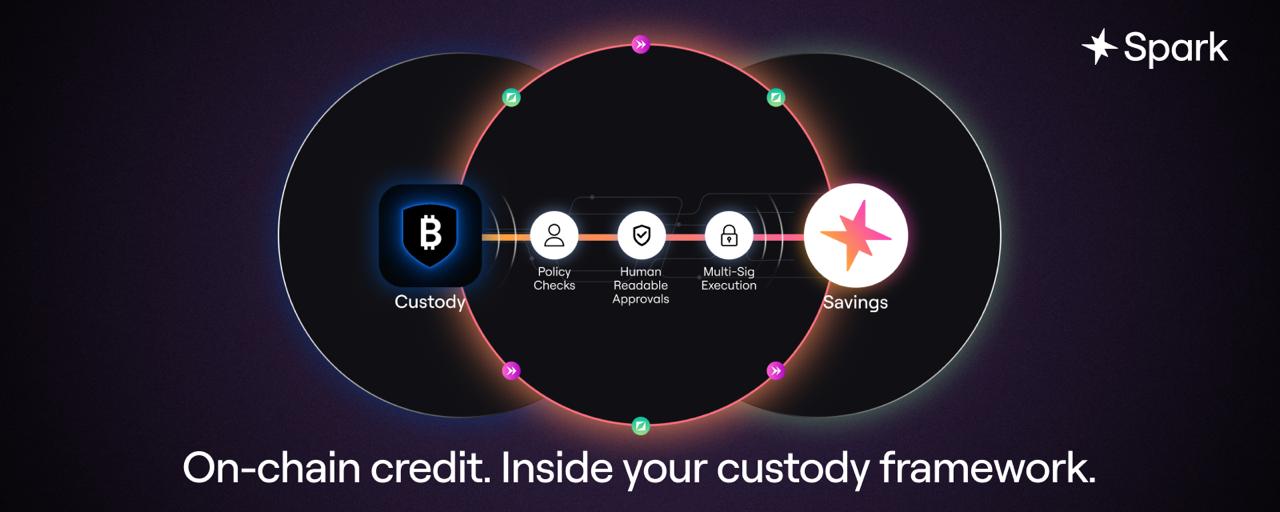
The integration isn't a bridge or wrapper that takes assets out of BitGo's custody scope. Capital remains within BitGo's multi-sig infrastructure throughout. Narval sits between the operator and the transaction, translating DeFi interactions into human-readable approval requests, validating each action against pre-approved policies and routes execution through BitGo's existing governance workflows. .
For a bank, insurance company, or pension fund, this matters more than the yield does. These institutions don't just need returns, they need every action to be auditable, policy-bound, and reconcilable within their existing compliance frameworks. Narval and BitGo deliver exactly that: the DeFi operation looks, behaves, and records like any other custodied transaction.This is also where Spark's architecture comes into its own. Spark was designed for institutional-scale capital, coordinating liquidity across multiple credit markets through predefined allocation parameters and a layered capital protection framework. Once institutions can access that infrastructure without changing how they custody or govern assets, the conversation shifts from whether they can participate in on-chain credit markets to how they allocate capital across them. .
This removes the category of objection, not just the specific friction
Most institutional DeFi integrations solve for access. They build a UI, connect a wallet, and write documentation. What they don't solve is the internal audit trigger, the moment someone in risk or legal asks "does this action take assets outside our custody perimeter?" and the honest answer is yes, or unclear.
The BitGo setup closes that loop structurally. The execution happens within BitGo's compliance scope. The policy checks happen before signing. The audit trail is legible to humans who have never seen a transaction hash.
That's not a feature. That's the thing that allows the conversation to happen at all inside institutions that operate under banking, insurance, or pension regulation.
A Blueprint for institutional On-chain Credit
What the BitGo integration makes visible is a blueprint. Any custody provider operating a similar multi-sig and policy-layer stack can, in principle, offer their institutional clients the same path as in Galaxy, Nexo, OKX, Binance Wallet, Zerion and so on. The operational and compliance architecture is established. The question is how quickly the rest of the custody landscape moves to plug into it.
For treasury and investment teams at banks, insurers, and pension funds, that's worth watching closely. The infrastructure required to access on-chain credit markets without leaving your custody perimeter is no longer theoretical.Spark Savings is live on BitGo institutional wallets. Independent risk assessments are available via Credora.