On-chain venues once meant slow trades and thin order books. Decentralized derivatives exchanges now run perps, options and downside protection features built in, all under one cross margin a
On-chain venues once meant slow trades and thin order books. Decentralized derivatives exchanges now run perps, options and downside protection features built in, all under one cross margin account, at lightning fast speeds traders expect, without ever taking custody of their funds.
TL;DR
• A decentralized exchange never holds your money. Your funds and positions sit in smart contracts you control, so the exchange cannot freeze, lend or lose them.
• Options used to be the thing on-chain venues could not do. On Aevo they take one tap: PERPS+ adds downside protection to a perp position, with no options knowledge and no strikes or expiries to pick.
• The custody argument keeps proving itself. Mt. Gox, FTX and the $1.5 billion Bybit hack all cost users money they could not get back, and centralized platforms accounted for 79% of reported crypto breaches in 2025.
• The speed trade-off has mostly gone. Modern venues match orders off-chain so trading feels instant, then settle on-chain so every balance is publicly verifiable.
• The product range now rivals a centralized desk: options, perpetual futures, pre-launch futures, structured products and an OTC desk, all sharing one pot of collateral on an Ethereum layer-2.
• On scale, perps volume is dominated by Hyperliquid. Aevo is small there, but DefiLlama ranked it second among decentralized options venues by 24-hour volume.
A decentralized exchange is a trading venue that never takes custody of your money. Your funds and open positions sit in smart contracts on a public blockchain, under keys you control, and the exchange can only do what the code allows. Nothing sits on a company balance sheet waiting to be misused.
For most of crypto’s history that guarantee came at a painful price. On-chain venues were slow, order books were thin and the spread was expensive, so serious traders held their noses and used centralized exchanges instead. That trade-off has largely dissolved, and the venues that dissolved it are now running products that look nothing like early DeFi.
Aevo is one example, a decentralized derivatives exchange running options, perpetual futures, pre-launch token futures and structured products from a single cross-margin account. Perpetual futures, or perps, are leveraged bets on price with no expiry date. Cross-margin means one pot of collateral backs every position, rather than each trade needing its own.
Why decentralization matters on an exchange
The core problem with a centralized exchange is that it holds your money. Deposit funds and the exchange controls the private keys, which means you are exposed to its solvency, its security and its discretion. The phrase traders use is blunt: “not your keys, not your coins”.
The record supports the caution. Mt. Gox suspended trading in February 2014 and its creditors are still waiting, with the repayment deadline pushed to October 2026. FTX collapsed in November 2022 with roughly $8 billion in customer funds misappropriated and withdrawals frozen. The 2025 Bybit hack drained $1.5 billion from cold wallets, which showed that institutional-grade custody is not the same as no custody. Centralized platforms accounted for 79% of reported crypto security breaches in 2025.
Insolvency is only the loudest failure mode. Centralized venues can also halt withdrawals during volatility, suffer outages precisely when traders need access, or have accounts frozen by regulators. In every case the trader has no independent recourse, because the record of what they own sits in a company database rather than on a public ledger.
A decentralized exchange changes where the assets sit, and that single change removes most of the list above. On Aevo, user funds and positions stay inside smart contracts at all times, and every settlement, funding payment and premium transfer happens through those contracts. Balances are publicly verifiable rather than reported. There is no withdrawal queue that can be quietly switched off, because there is no company account holding the money in the first place.
Access is the other structural difference, and the one that has changed most for professionals. There is no account to open and no approval to wait for. A trader connects a wallet and trades, which matters for desks in jurisdictions that centralized venues serve badly or not at all, and for anyone who has had an account closed at short notice with positions still open.
That window is narrowing rather than widening. Regulators are drafting frameworks specifically for on-chain perpetuals, institutional desks still cite compliance as their main reason for staying away, and decentralized venues including Aevo already restrict access in some jurisdictions. The durable advantage is custody and verifiability, not invisibility.
How on-chain venues got fast
The speed problem was solved by splitting the exchange in two. Order matching happens off-chain, where an order book and a risk engine run at the speed traders expect from a centralized venue. Settlement happens on-chain, where the result is written into smart contracts and becomes permanent.
Only matched trades touch the chain. On Aevo, an off-chain risk engine checks an account against its margin requirement before an order reaches the book. Once a maker and taker order match, the trade posts to smart contracts on Aevo’s layer-2. Placing and cancelling orders costs no gas at all, and the exchange covers gas on settlement, so the on-chain layer does not tax ordinary trading.
The result is order book performance without handing over your assets. Aevo reports more than 5,000 transactions per second at under 10 milliseconds of exchange latency, on a custom Ethereum layer-2 built with the OP Stack.
The honest counterweight is finality. Aevo’s rollup uses a sequencer, the server that decides the order of transactions, which bundles them into a batch and posts it to Ethereum every hour. A two-hour window then allows anyone to challenge a bad batch.
That is why withdrawals to Ethereum take around three hours to fully confirm, while withdrawals routed to Arbitrum, Optimism or Base clear in minutes. The delay is the price of Ethereum’s security guarantee, and Aevo states it plainly in its published exchange documentation rather than burying it. Trading is instant; the trust guarantee arrives a few hours later.
What a decentralized exchange can now offer
Breadth is where the model has moved furthest, and it is the clearest answer to anyone who still pictures DeFi as a single swap screen. Most decentralized venues run perpetual futures well and stop there. Aevo runs several instrument types against the same collateral pool, all live today.
- Perpetual futures. The core market, spanning major crypto assets alongside commodities and equities, with roughly 149 trading pairs listed. The ETH perpetual is the most active.
- Options. A native on-chain options order book with a range of strikes and expiries, and the segment where Aevo ranks highest against other decentralized venues.
- PERPS+. One-click protection for a perp position, with no options knowledge required. The main mode, Limit My Loss, works like insurance on the trade. You pick the most you are willing to lose, and Aevo buys an option that pays out if the market falls past that point, cancelling out further losses on the perp. Your profit stays uncapped. Two other modes pay you cash upfront in exchange for capping your profit, or fix both your best and worst case at close to zero cost.
- Pre-launch token futures. Markets on tokens that have not launched yet, capped at 2x leverage with no funding payments, which convert into standard perpetuals once a reliable index price exists.
- Structured products and strategies. Including the Aevo Basis Trade. The vault holds an asset and shorts the perp against it, so it earns funding payments from the gap between the two rather than betting on direction.
- An on-chain OTC desk. Aevo OTC targets altcoin options, where the firm estimates only around 25% of that volume currently reaches public exchanges.
Two pieces of infrastructure sit underneath. Portfolio margin judges risk across your whole account instead of trade by trade, running 15 scenarios of price and volatility moves, so a hedged book ties up less collateral. And aeUSD lets your margin earn yield while it sits there doing its job as collateral.
PERPS+ is the clearest expression of why one shared account matters. Attaching downside protection to a perp is a single action when the option and the perp clear through the same margin engine. On a venue where options live somewhere else, it means two positions on two systems with two pools of collateral, which is exactly the friction that keeps most perp traders unhedged.
The market has already moved
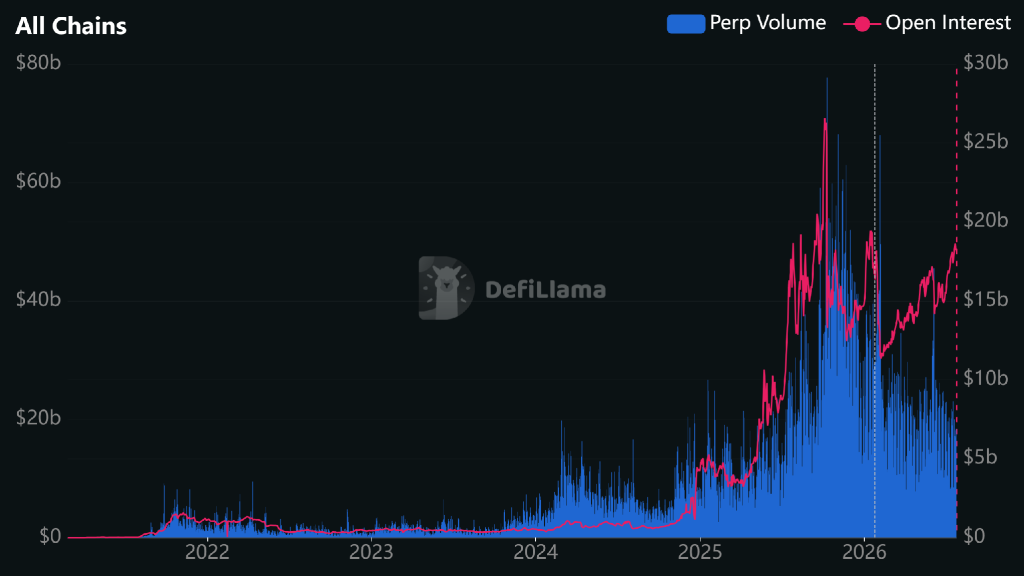
Perpetual DEXs traded around $520 billion in the last 30 days and hold roughly $18.2 billion in open interest, according to DefiLlama. Open interest is the value of positions still sitting open, so it measures money committed rather than money churned. On-chain perpetuals barely existed before late 2021.
The trajectory has not been a straight line. Daily volume climbed through 2024, accelerated sharply from early 2025, and peaked around the turn of 2026 at roughly $75 billion in a single day. Volume has cooled from that peak through 2026, while open interest fell and has since recovered to near its highs. Traders are holding positions rather than churning them, which is a different and arguably healthier market than the one that produced the peak.
Perpetual DEX volume and open interest across all chains, 2021 to July 2026. Volume has cooled from its early-2026 peak while open interest has recovered toward its highs. Source: DefiLlama.Where Aevo sits among decentralized exchanges
Two design philosophies split the field, and Aevo and Hyperliquid sit at opposite ends of it. Hyperliquid built its own layer-1 blockchain so the order book itself lives inside the chain, which means every resting order, fill and liquidation is part of the consensus record and visible to anyone. Aevo kept the order book off-chain deliberately in order to drive speed benefits for traders.
The difference is what you have to trust. A Hyperliquid trader can verify the order book itself. An Aevo trader verifies settlement, custody and balances on-chain, but takes the matching engine on trust in the way they would at a centralized venue. Hyperliquid is the more trustless design at the matching layer; Aevo inherits Ethereum’s security for settlement instead of bootstrapping its own. Both keep custody with the user, which is the difference that matters most against a centralized exchange.
AevoHyperliquidChainOP Stack layer-2, settles to EthereumPurpose-built layer-1Order bookOff-chain matching, on-chain settlementFully on-chain, matched in consensusSecurityInherits Ethereum settlement securityOwn validator setFinalitySub-secondSub-secondListingsCurated by AevoPermissionless via HYPE-staked buildersNative optionsYes, same margin accountNot yet, announced; third-party onlyOther instrumentsPre-launch futures, structured products, OTCSpot, prediction markets, builder-deployed perps
On scale the two are not close, and Aevo does not claim otherwise. Over the last 30 days Hyperliquid traded roughly $193.9 billion in perpetuals against about $80 million for Aevo, and holds around 61% of all open interest across perpetual DEXs.
Where Aevo does place is options. DefiLlama ranked it second among decentralized options venues by 24-hour notional volume at the time of writing, in a category worth about $1.5 billion of notional over 30 days across every venue listed. Notional volume is the face value of contracts traded, not the money changing hands. That is a far smaller and far less contested market than perpetuals, and it is where Aevo’s options-first history shows.
It is also worth noting what concentration means for the sector. When one venue holds roughly 61% of all open interest, a serious outage, exploit or regulatory action there would hit most on-chain derivatives positions at once. Alternatives built on different architecture carry a value that headline volume does not capture.
What to watch
The decentralized exchange model has won its central argument. Traders no longer have to choose between keeping custody and getting a usable venue, and the products available on-chain now extend well past spot swaps into options, structured products and protected leverage.
What remains unsettled is which shape wins. Aevo is betting that traders eventually want options, perps and structured products in one account more than they want every asset class listed permissionlessly, and that the margin engine tying those together is hard enough to build that it holds as a moat.
Aevo was founded by Julian Koh, Ken Chan and Luís Felipe Carvalho, with a team drawn from Coinbase, Kraken and Goldman Sachs, and backing from Paradigm, Coinbase Ventures, Dragonfly, Nascent, Ethereal Ventures, Robot Ventures, Scalar Capital and Alliance. It trades at app.aevo.xyz
The post Aevo, the decentralized exchange making perps position protection simple with options appeared first on CaptainAltcoin.