Imagine posting a video before going to bed and waking up to 500,000 views. Your follower count has jumped. The comments are still coming. Friends are sending screenshots. For a few hours, it
Imagine posting a video before going to bed and waking up to 500,000 views. Your follower count has jumped. The comments are still coming. Friends are sending screenshots. For a few hours, it feels like the moment every creator has been waiting for. Then comes the less glamorous question of how much the video actually makes you.
For many African creators, the answer can be very little. Sometimes, nothing. That is the contradiction sitting at the centre of Africa’s growing creator economy. The continent has become very good at producing attention, but turning that attention into predictable income remains harder.
Africa’s creator economy is already estimated at $3 billion and could reach $17.8 billion by 2030. Yet 6 in 10 African creators still earn less than $100 monthly. Brand sponsorships account for 28% of income among creators surveyed in the Africa Creator Economy Report 2026, while digital products and services contribute another 25%.
In other words, a large share of the real money comes from the attention creators generate.
Popular content creator Adekunle Ashimi put the problem simply: people enter content creation after hearing there is plenty of money in it, only to discover that the brand deals are not guaranteed.
“There is money, but there is work to be done, and the money is definitely not from your million views,” he said.
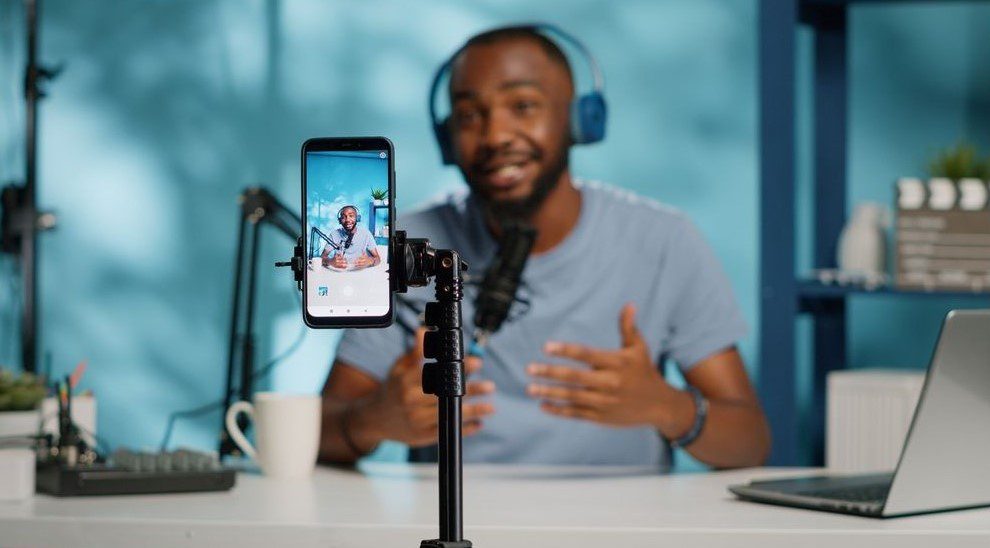 A content creator
And even when the algorithm does its part, the platforms do not always make it easy for African creators to turn that success into money.
One million views can be worth very different things
Take a Nigerian creator who posts on TikTok and suddenly gets one million views. In the United States or another eligible market, that creator may at least have a path towards TikTok’s Creator Rewards Programme, where qualified videos earn money based partly on an RPM, which is the revenue per 1,000 qualified views.
The Nigerian creator can open the same app, attract the same one million views and find no reward for that creative or viral video.
The TikTok Creator Rewards programme is currently available in the United States, the United Kingdom, Germany, France, Japan, South Korea, Brazil, Mexico and no African country. This has led some Nigerians to open UK TikTok accounts with money just to be beneficiaries of paid views.This has caused frustration among many creators, but Adekunle’s particularly stood out.
“We create content, we bring trends, we bring entertainment, but TikTok has refused to monetise us in Nigeria,” he complained, questioning why African creators continue driving engagement without receiving the same direct monetisation opportunities.
The problem becomes clearer when the creator is also a business owner.
Suppose that a viral TikTok video is not just entertainment; say it features a skincare product, clothing brand or food business. In countries with TikTok Shop, viewers can discover the product in a video, click and complete the purchase without leaving the app. A Nigerian business owner does not have that luxury.
TikTok’s own June 2026 commerce documentation lists the markets where TikTok Shop is available, and Nigeria is absent. That simply means the business owner can create demand on TikTok but still has to move the customer to either a website, WhatsApp, Instagram DM or another checkout system before that attention becomes a sale.
Facebook does not completely solve the commerce problem either.
Nigerians can use Marketplace through personal accounts, but it is not designed as a straightforward storefront for businesses. Meta says Marketplace is intended for consumers and warns that businesses listing there may be blocked or have their listings removed. Pages posting in buy-and-sell groups also do not get the option to create Marketplace listings.
So, even when creators decide that platform payments are not enough and try to sell something themselves, some of the commerce tools available elsewhere remain limited.
YouTube at least offers Nigerian creators a clearer route to ad revenue. But here is another problem. If two creators upload videos and both get one million views. One is watched mainly in Nigeria. The other is watched mainly in the United States. The view counter says they performed equally, but the money does not.
YouTube advertising is effectively an auction. Advertisers pay more to reach audiences they consider more commercially valuable, and those differences eventually show up in creators’ earnings.

LenosTube’s 2026 estimates put YouTube RPM in Nigeria at about $0.92 per 1,000 views, compared with $10.81 in the United States. Its estimated CPM is $2.89 for Nigeria and $32.75 for the US. Apply those estimated RPMs to one million views, and the difference becomes easier to understand.
A Nigerian-heavy audience could produce roughly $920. At the US estimate, the same one million views could be worth around $10,810.
It is not that YouTube has a rule saying an African creator should be paid less. The audience itself is being priced differently because advertisers spend far more aggressively in markets such as the US… African creators have complained about this gap for years, particularly those whose audiences are largely local.
Facebook follows a similar pattern.
Meta does not publish a fixed Nigerian RPM because payouts vary by audience, format and advertising demand. One independent 2026 estimate puts Nigerian Facebook long-form RPM at around $0.30 to $1.20, compared with $6 to $20 in the US.
For Reels, it estimates roughly $0.01 to $0.05 for Nigeria, compared with $0.20 to $1.50 in the US. Again, the viral number everybody sees can hide a very different financial result.
The problem is not just the platforms
It will interest you to know that platforms are only half the story. Creators can also become so focused on making content travel that they forget to make it sell.
Brand strategist and founder of Remote WorkHER, Adeife Adeoye, described the difference as “attraction content” and “sales content.” Attraction content is built for likes, comments, followers and views. Sales content is built to move someone closer to spending money.

She gave the example of a food business that uses dramatic story-time videos while preparing meals.
Perhaps the opening line is about a cheating husband. People stay because they want to know whether the wife caught him. The clip reached 300,000 views. But nobody came for the food.
“You realise that content will have 300,000 views, no sales,” she said. Now change the video. “Here is what ₦5,000 can get you at my restaurant.”
It is less dramatic. It may never go viral. But the person watching is now thinking about the food, the price and whether to order.
Adeife recalled a month when her business attracted almost 700 users despite its videos getting no more than about 1,500 views. Previously, the company had produced much more viral content without generating the same result. That may be the uncomfortable lesson behind the creator economy’s monetisation problem.
A creator can have the algorithm, the audience and the viral moment and still be missing the most important part: a reliable way to turn attention into money. One million views may look impressive on a screen, but they cannot pay the bills until someone turns that attention into revenue.Also read: 10 Nigerian creators that are building businesses beyond social media
