Altcoin spot demand has been under sustained pressure, but derivatives activity suggests traders are still heavily engaged with non-Bitcoin assets. On June 16, altcoins (excluding Ether) reco
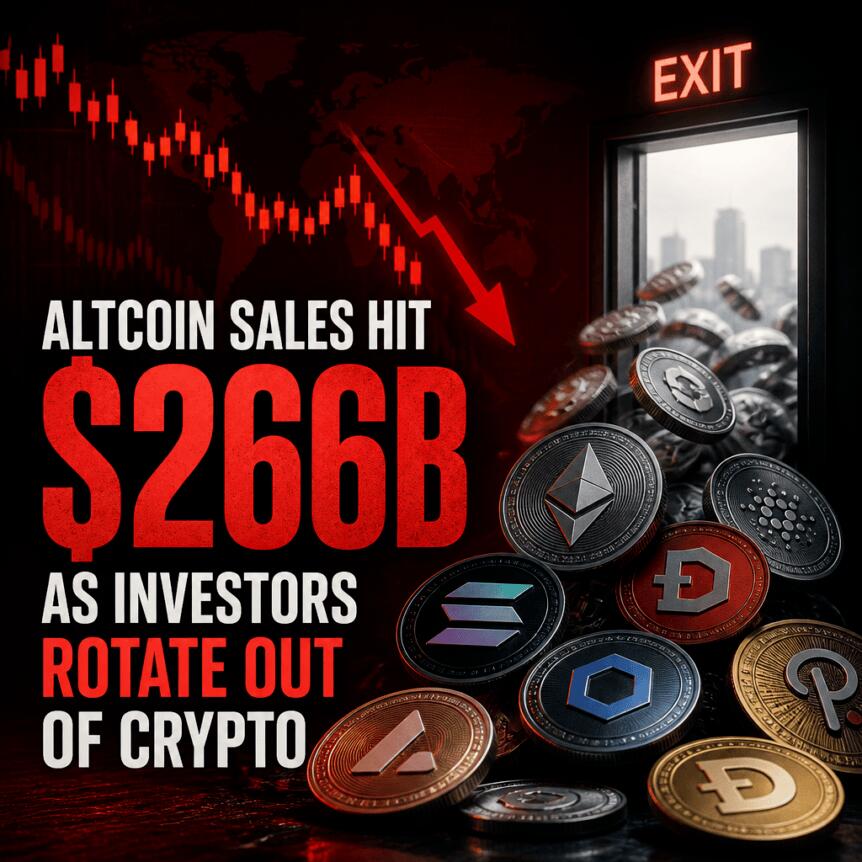
Altcoin spot demand has been under sustained pressure, but derivatives activity suggests traders are still heavily engaged with non-Bitcoin assets. On June 16, altcoins (excluding Ether) recorded $266 billion in net selling volume on centralized exchanges—the deepest reading since CryptoQuant began tracking spot demand in 2020—according to figures cited by analyst IT Tech on CryptoQuant.
At the same time, altcoins are taking a leading share of derivatives attention. CryptoQuant data referenced in the report shows altcoins accounted for 51% of daily futures trading volume on Binance on June 16, versus 28.85% for Bitcoin and 20.20% for Ether—an imbalance that points to capital rotating within crypto markets and into other exchange-linked products rather than consistently flowing into altcoin spot.
Key takeaways
- Altcoins excluding Ether saw one-year cumulative net outflows of $266 billion on centralized exchanges on June 16, the lowest since CryptoQuant’s 2020 tracking began.
- Despite those spot outflows, altcoins represented 51% of Binance futures trading volume on June 16, leading both Bitcoin and Ether.
- The divergence implies active trading and potential recycling of liquidity rather than fresh spot accumulation.
- Exchange stablecoin balances appear broadly steady since December 2024, suggesting liquidity remains available even as allocation becomes more selective.
- CryptoQuant data cited in the report points to rapid growth in exchange-linked “traditional asset” derivatives, including metals and pre-IPO perpetual products.
Spot selling hits a record low while futures stay crowded
The clearest tension in the data is between spot flows and market participation. IT Tech, quoting CryptoQuant analytics, said the one-year cumulative buy-sell difference for altcoins (excluding Bitcoin and Ether) fell to -$266 billion on June 16. The metric’s significance lies in what it represents: aggregate spot demand strength versus selling pressure over an extended period.
Such a persistent negative balance typically indicates that, at least on net, buyers have not been able to absorb the supply leaving exchanges. In this case, the report frames the shift as selling pressure outweighing buying demand “for an extended period,” pushing the cumulative figure to a new low.
But the story changes when looking at trading activity. CryptoQuant data cited alongside the spot metric shows that altcoins are dominating daily futures volume on Binance. On June 16, altcoins made up 51% of trading volume, while Bitcoin and Ether lagged with 28.85% and 20.20% respectively.
CryptoQuant’s referenced coverage also notes that altcoins have led exchange trading volumes for most of 2025, except for a short interval in February when Bitcoin temporarily overtook the sector. For investors, this is an important nuance: negative spot demand and heavy futures participation can coexist, often because derivatives positions do not require the same net spot purchases as long-only spot strategies.
What the divergence may mean for liquidity recycling
The report’s interpretation is that the combination of low or deeply negative spot demand and high futures turnover suggests capital rotation within altcoin markets—potentially involving repeated entering and exiting of positions—rather than a sustained inflow of spot capital.
In practical terms, when net selling pressure rises, traders may still keep deploying into altcoin exposure via futures, perps, or other leveraged instruments. That can sustain high derivatives volume even when exchange spot balances reflect ongoing selling. Meanwhile, fresh buying—if it exists—may be getting directed elsewhere or arriving in smaller, less consistent bursts.
This matters for market participants monitoring “demand” signals. For example, a decline in spot buy-sell balances might not immediately translate into reduced trading activity, especially if leverage and hedging strategies continue to concentrate volume in altcoins. Traders watching for a directional shift may therefore want to track whether futures dominance changes at the same time as spot outflows improve—or if futures remain strong while spot selling persists.
The report also flags a broader pattern: attention and liquidity may be spreading beyond altcoin spot entirely, moving toward other exchange products that can absorb stablecoin and trading capital.
Stablecoin balances look resilient, while deployment gets more selective
Another pillar of the report concerns exchange-held stablecoins. Analyst MorenoDV indicated that exchange stablecoin balances have changed little since December 2024. Using CryptoQuant’s “exchange supply ratio” for ERC-20 stablecoins, the report states that the figure has generally fluctuated between 0.40 and 0.46—meaning roughly 40% to 46% of circulating ERC-20 stablecoins have remained on exchanges for more than a year.
In other words, the liquidity needed to trade has not disappeared. Instead, the allocation of that liquidity appears to be shifting. The report contrasts this stability with price volatility: it says Bitcoin experienced swings exceeding 50% during the same period, trading between $60,000 and $120,000. Meanwhile, Binance’s share of total stablecoin supply has been described as sitting in the 25% to 30% range, accounting for more than half of exchange-held reserves.
For investors, the key takeaway is that “available liquidity” and “where it gets deployed” are becoming two separate questions. Stablecoin balances may remain broadly steady, but traders and capital providers may be deploying that liquidity into a wider set of instruments rather than keeping the money concentrated in spot.
Traditional-asset derivatives and pre-IPO contracts gain traction
The report points to a possible explanation for that shift: exchange users are increasingly spreading liquidity across assets that resemble traditional-market instruments. CryptoQuant data cited in the piece highlighted the expansion of metals futures and other non-crypto exposures.
According to CryptoQuant, metals futures volume peaked at nearly $500 billion in March 2026 as gold and silver reached record highs. The report also notes that the trading activity in “pre-IPO perpetual” products expanded rapidly—from about $2 million in March to $715 million in May and $2 billion in June.
On Binance specifically, the report says the exchange processed $10.3 billion in pre-IPO perpetual volume in June, roughly 20 times higher than the entire month of May, while maintaining around 83% control of that segment. It links this acceleration to growth across multiple asset categories—metals, oil, equities, and pre-IPO contracts—suggesting that exchange venues are pulling liquidity into derivatives that do not rely solely on crypto-native token spot demand.
The inclusion of these product categories helps contextualize why altcoin futures might stay active even as altcoin spot selling worsens. If stablecoin liquidity is being reallocated into broader derivative suites, altcoin spot buyers may face stronger competition for capital—while traders still retain access to altcoin exposure through leveraged instruments.
For market participants, the main uncertainty is whether the current pattern is temporary rotation or a longer structural rebalancing. Readers should watch next for signs of stabilization in altcoin spot buy-sell balances and whether altcoin dominance in futures changes as liquidity continues to migrate toward metals, oil, equities, and pre-IPO perpetual markets—areas where the report indicates Binance retains the largest concentration of deployable stablecoin capital.
This article was originally published as Altcoin Sales Hit $266B as Investors Rotate Out of Crypto on Crypto Breaking News – your trusted source for crypto news, Bitcoin news, and blockchain updates.