During the recent market rally, altcoins accounted for nearly 65% of the volumes observed on the Binance exchange. This is their highest level in two years. Their cumulative valuation also in
During the recent market rally, altcoins accounted for nearly 65% of the volumes observed on the Binance exchange. This is their highest level in two years. Their cumulative valuation also increased by approximately 135 billion dollars. These data indicate that traders have increased their exposure to assets other than bitcoin and Ether. However, this is not enough to confirm an altseason, as the majority of large cryptos have not yet outperformed BTC over three months.
In Brief
- Altcoins captured up to 65% of volumes on Binance.
- Bitcoin and Ether represented 21% and 13.6%, respectively.
- Their cumulative capitalization increased by about 135 billion dollars.
- The Altcoin Season Index remained at 37, far from the 75 confirmation threshold.
Altcoins capture 65% of volumes traded on Binance
The share of altcoins in Binances volumes reached 65% at the peak of the recent market rally. This capitalization represents their highest level since 2024, according to an analysis published by CryptoQuant on August 25.
Simultaneously, bitcoin represented only 21% of the transactions carried out on the exchange platform. Ether’s share stood at 13.6%. Therefore, other cryptos concentrated nearly three times more activity than the two main market assets combined.
This development appeared after a strong rise in bitcoin. At the same time, bitcoin climbed about 30%. The leading crypto rebounded beyond $81,000 on August 25. This initial BTC surge attracted more liquidity and investors before this activity expanded to riskier assets.
CryptoQuant analysts explain:
After a long period of low volatility and moderate volumes, it is the altcoins that have captured the attention and capital of investors, which could signal a broader resurgence of risk appetite across the market.
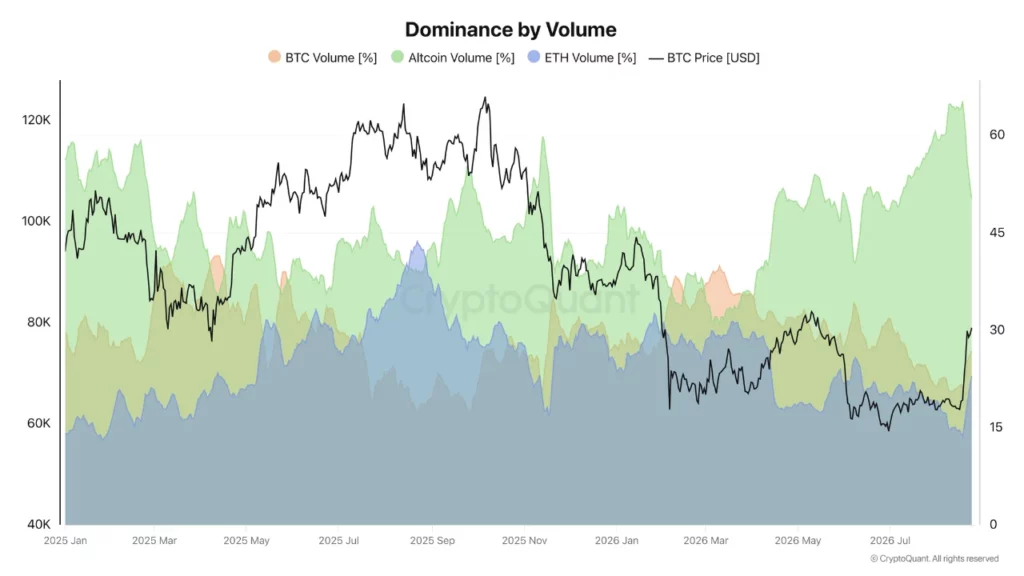
Altcoin volume dominance, Source: CryptoQuant
The 65% peak must, however, be viewed within its scope. It concerns volumes measured on Binance, not across all centralized platforms, decentralized exchanges, and derivatives markets. Binance is an important indicator due to its size, but its clientele and the composition of listed assets can influence the distribution of trades.
Volume dominance also does not correspond to market dominance. It measures the share of the amount traded over a given period. A crypto can generate high volume due to rapid back-and-forth trading, automated operations, or high volatility, without attracting an equivalent amount of durable capital.
Altcoins capitalization gains 135 billion dollars
The cumulative capitalization of altcoins increased by about 135 billion dollars during the same rally phase. This activity, part of a broader recovery, contributed to adding roughly 500 billion dollars to the total crypto market.
During the third week of this August, the ecosystem׳s valuation then reached nearly 2740 billion dollars. This is its highest level since May. Bitcoin thus ended this period with a weekly gain of 22%, while many altcoins recorded increases of over 20%.
Zcash notably gained nearly 70% in one week and briefly exceeded $873. XRP rose by 51%, while Hyperliquid’s HYPE reached a record of $82.43, according to the market report. These performances contributed to the increase in the cumulative value of altcoins.
However, the 135 billion dollars do not represent 135 billion in new investments. A crypto׳s capitalization corresponds to its price multiplied by the number of tokens in circulation. A price increase applied to a limited fraction of tokens traded can therefore raise the theoretical valuation of the total supply.
Volume measures the total value of transactions made. The same capital can be counted multiple times when a trader buys then sells an asset. Neither volume increases nor capitalization increases thus allow precise identification of net money inflows.
The expression “rotation from bitcoin” must also be used with caution. The decline in BTC’s share in volumes shows that altcoins triggered more trades. It does not prove that bitcoin holders directly sold their assets to buy alternative tokens. New stablecoin deposits or leverage usage can also fuel this activity.
Your 1st cryptos with BinanceThis link uses an affiliate program.Two indicators remain far from confirming an altseason
Despite the volume shift, relative performance indicators do not yet signal an altseason. The BlockchainCenter Altcoin Season Index showed a score of 37 on August 26.
This index examines the performances of the top 50 eligible cryptos over 90 days. It only recognizes an altseason when 75% of them outperform bitcoin. Stablecoins and tokens backed by other assets are excluded from the calculation.
The CoinMarketCap indicator also showed a score of 37. Its methodology, however, covers the top 100 cryptos. The agreement between the two results indicates that the recent rally remains too short or too concentrated to constitute widespread outperformance against BTC.
The signal appears all the more fragile as bitcoin’s dominance in total capitalization remained close to 59.7%. Thus, BTC retained a share higher than that of all other categories taken separately, despite the decrease of its presence in Binance volumes.
Nonetheless, the situation marks a notable change from June. At that time, CryptoQuant’s CEO, Ki Young Ju, considered that the traditional rotation from bitcoin to altcoins had almost disappeared. The volumes of BTC-altcoin pairs had then fallen to their lowest level since 2021.
The current peak shows that speculative interest may quickly return to alternative assets. To confirm a lasting trend, this activity will need to persist beyond a few sessions, spread to multiple platforms, and be accompanied by outperformance of a majority of altcoins over 90 days. For now, the data signals a rotation in trades, but not yet a true altseason.