Bitcoin is having one of its roughest months in years. The world's largest cryptocurrency has fallen below $60,000, and investors have been pulling money from the funds that once fueled its r
Bitcoin is having one of its roughest months in years.
The world's largest cryptocurrency has fallen below $60,000, and investors have been pulling money from the funds that once fueled its rally.
One crypto trader sees something more encouraging underneath the damage.
Michaël van de Poppe, a crypto trader and analyst, says the rest of the crypto market is holding up surprisingly well.
In his view, Bitcoin's slide has little to do with crypto itself.
Related: Ripple veteran weighs whether Wall Street can secretly buy billions in XRP
Ether holds its ground against Bitcoin
His argument starts with the ETH/BTC ratio. That's the price of Ether, the native token of the Ethereum blockchain, measured in Bitcoin rather than in dollars.
When the ratio falls, Ether is losing ground to Bitcoin. When it holds steady, the two are moving in step.
Ether "is still not moving vs. [Bitcoin]," van de Poppe wrote on X.
"That's phenomenal."
Ether usually swings harder than Bitcoin during a selloff. A flat ratio suggests investors aren't rushing out of the wider crypto market faster than they're leaving Bitcoin.
Van de Poppe sees that as a sign that "the crypto ecosystem is resilient vs. Bitcoin." He added that the Bitcoin correction is "100% driven through other markets."
The selloff traces back to tech stocks
The past two weeks support at least part of that view. Bitcoin has moved closely with technology stocks throughout November.
It fell below $60,000 on Nov. 20 for the first time since July, the same day a broad tech selloff hit the Nasdaq. It then rebounded on Monday, Nov. 23, when chipmaker Nvidia reinstated Jensen Huang as CEO and tech stocks rallied.
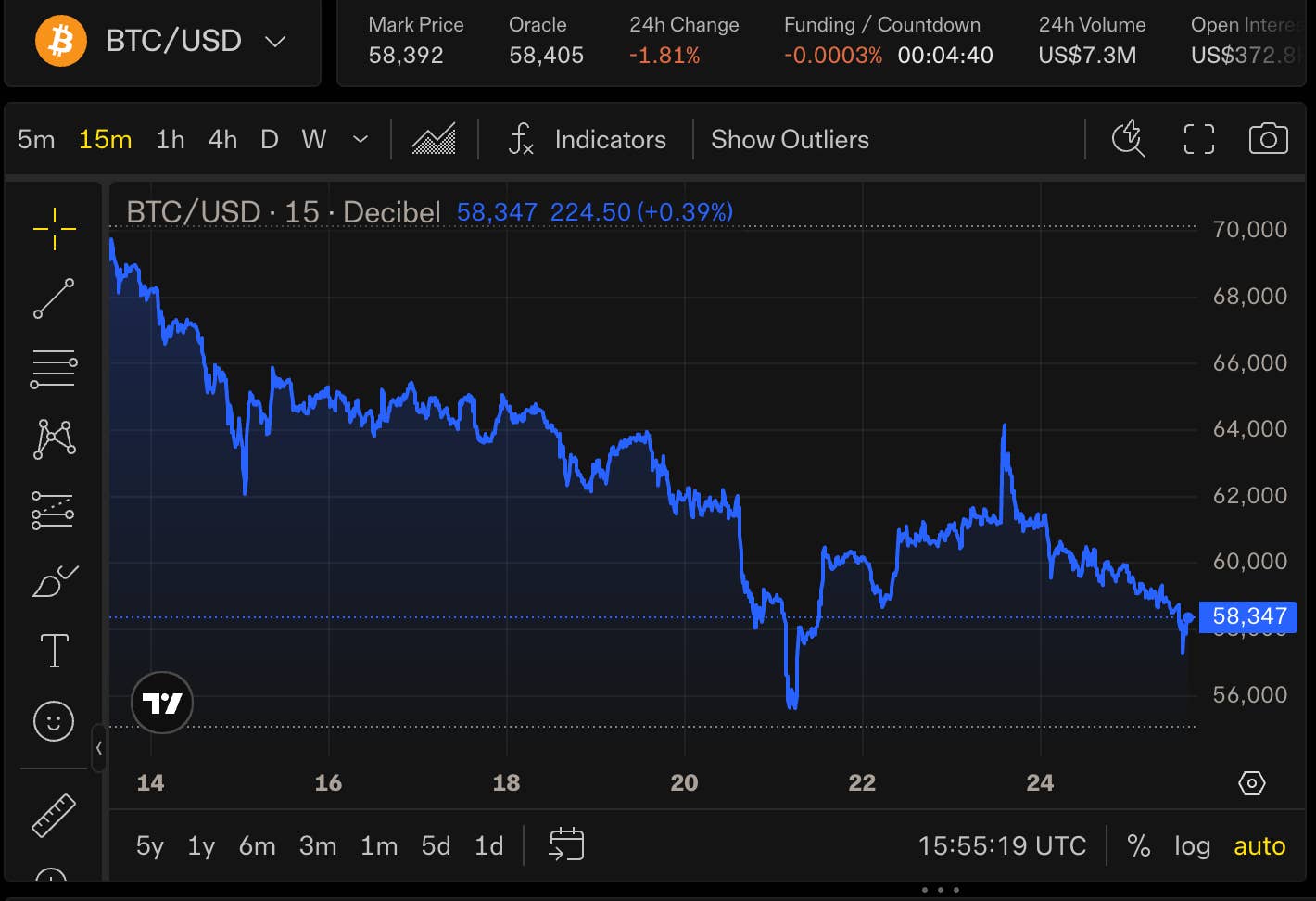
That bounce didn't last. Bitcoin was trading at $58,392 as of 10:55 a.m. ET on Wednesday, down 1.81% over the past 24 hours, according to Decibel.
Bitcoin price at press time. Source:
Decibel
It's down more than 20% in November.
Popular on TheStreet Roundtable:
The pressure is also showing up in Bitcoin exchange-traded funds, which let investors buy Bitcoin exposure through a regular brokerage account.
U.S. spot Bitcoin ETFs saw $231.56 million in net outflows on Tuesday, Nov. 24, their sixth straight day of withdrawals, according to SoSoValue data.
BlackRock's iShares Bitcoin Trust, the largest of the funds, accounted for $175.3 million of that.
Total assets in the funds fell to $72.01 billion from $94.43 billion on Nov. 9, mostly because of falling prices.
Waiting for a real low on the Nasdaq
Van de Poppe isn't calling a bottom yet.
He's watching for one specific signal first: a genuine low in Nasdaq-100 futures, which track the 100 largest non-financial companies on the Nasdaq exchange.
He drew a line between that and Monday's jump, which he called "news-driven." In his view, only a true bottom in tech stocks will bring money back into Bitcoin.
That low hasn't arrived yet. Nasdaq-100 futures fell more than 3% early Wednesday, following reports that the Trump administration is preparing new tariffs on 16 major U.S. trading partners.
Once a real bottom forms, he expects liquidity to "pour back into" Bitcoin through the ETFs, helping the market find a base.
Until then, he's taking a measured approach. He said he's "still slowly scaling into Bitcoin," meaning he's buying gradually instead of all at once. He's also holding off on bigger moves in smaller tokens for now.
His view stands out because it reframes the selloff. It's less about crypto's own health and more about how closely Bitcoin now trades with Wall Street.
Related: Cathie Wood scraps plans for two new crypto ETFs