The crypto market has been watching the CLARITY Act with intense focus, and for good reason. This legislation is one of the most important pieces of crypto regulatory framework in U.S. histor
The crypto market has been watching the CLARITY Act with intense focus, and for good reason. This legislation is one of the most important pieces of crypto regulatory framework in U.S. history.
But with Senate Majority Leader Thune suggesting the bill might not reach the floor before the August recess, traders are asking a pressing question: could another Bitcoin price crash be on the horizon?
The paradox is that while Washington debates, Wall Street’s biggest players are building infrastructure as if the law has already passed. JPMorgan, Bank of America, and Citi announced a shared tokenized deposit network.
These institutions have the best legal and political information available. They are not spending billions on infrastructure for a framework they expect to fail.
Why the CLARITY Act Delay Has Bitcoin Traders on Edge
The CLARITY Act was expected to provide much-needed regulatory structure for digital assets in the United States. The bill would create clear rules for crypto exchanges, define which assets fall under securities laws, and create a pathway for traditional financial institutions to offer crypto services with legal certainty.
When the White House reached an agreement on the ethics provision on July 20th, optimism surged. The final working draft surfaced on Wednesday, and Senator Lummis committed to reaching a deal. But then Senator Thune poured cold water on the timeline, telling reporters the bill likely would not make it before the August recess.
The Senate floor schedule matters because Congress faces a tight window. With only about ten business days remaining before recess, the bill needs to overcome procedural hurdles. Without that, the CLARITY Act slips to September or later.
For Bitcoin traders, the delay introduces new uncertainty. The market had begun pricing in a relatively smooth passage, and any setback could cause a negative reaction.
What Dan Gambardello Says About the Bill
Crypto analyst Dan Gambardello has been closely tracking the CLARITY Act’s progress, and he shared a critical point that many observers have missed. While politicians debate and delays accumulate, the largest financial institutions on earth are building as if the law were already in place.
Gambardello pointed to several examples. Charles Schwab, with $12 trillion in client assets, is openly targeting Coinbase’s market share and considering crypto acquisitions. Vanguard, which blocked Bitcoin ETFs in 2024, recently posted its first Head of Digital Assets role. Samsung announced native stablecoin support for Samsung Wallet. The Fraternal Order of Police, representing 382,000 members, endorsed the bill this morning.
The crypto industry has poured $189 million into the 2026 midterms, making it the single largest corporate political spender this cycle. Fair Shake, the industry super PAC, holds almost $127 million in cash. Ripple alone contributed $48 million.
Gambardello’s argument is clear. Institutions with the best legal teams and lobbyists do not build settlement networks, trust banks, and multi-year roadmaps if they expect regulatory failure. They are voting with their capital, and they have already concluded that crypto is here to stay regardless of the CLARITY Act’s timing.
Bitcoin Price Analysis: Can BTC Hold Key Support Amid Regulatory Uncertainty?
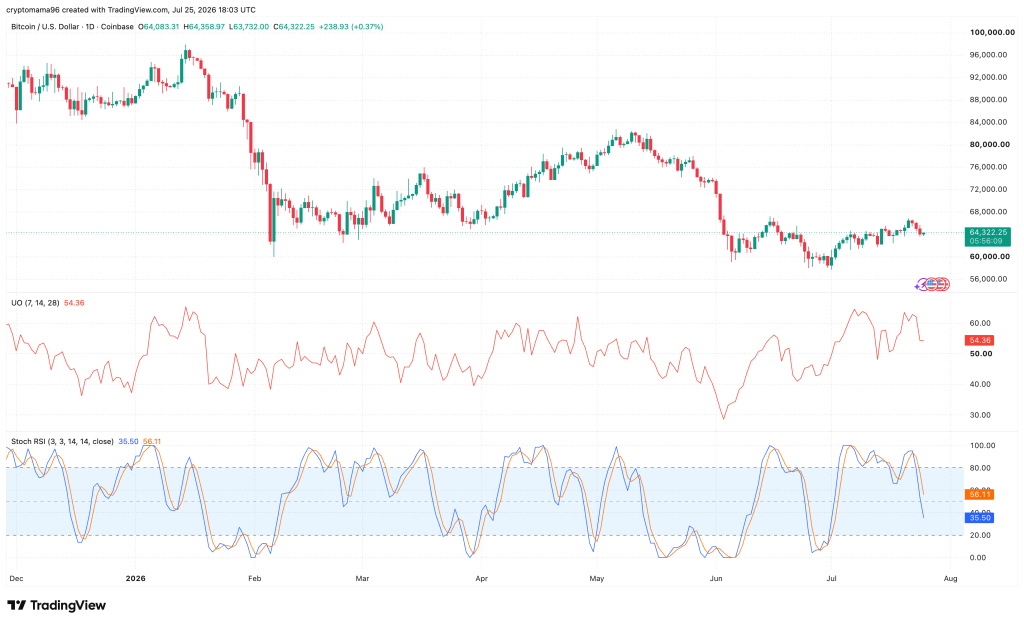
From a technical perspective, Bitcoin currently trades in a consolidation pattern between $60,000 and $66,000. This sideways movement follows a decline from the $82,000-$83,000 region and suggests the market is waiting for a catalyst.
Key levels to watch include immediate resistance at $65,500-$66,000 and major resistance at $67,500-$68,500. On the downside, support sits at $62,500-$63,000 with major support at $59,000-$60,000.
Source: TradingView
The Ultimate Oscillator at 54.36 shows neutral momentum. Neither overbought nor oversold conditions exist, which typically means the market is coiled for a move in either direction. However, the Stochastic RSI has produced a bearish crossover and is moving lower from elevated levels.
The chart structure shows buyers have repeatedly failed to push above the $66,000 area during July. Sellers continue defending resistance aggressively. Unless Bitcoin closes decisively above $66,000-$68,000, the market remains in consolidation rather than a confirmed uptrend.
This technical setup matters because Bitcoin price is trading near support rather than at new highs. That makes it more vulnerable to negative news. A regulatory disappointment could increase selling pressure, especially if short-term traders decide to take profits.
Bitcoin Price Prediction: How Could a CLARITY Act Failure Affect BTC?
If the CLARITY Act fails to pass in 2026, the initial reaction would likely involve increased volatility and profit-taking by short-term traders. Reduced institutional optimism would probably push Bitcoin toward the $60,000 support level.
A break below $59,000-$60,000 on heavy volume could open the door to the mid-$50,000 range as the next major demand zone. Altcoins would likely experience more declines given their higher sensitivity to regulatory uncertainty.
However, several factors suggest the downside may be limited. The CLARITY Act primarily affects regulatory certainty rather than Bitcoin’s underlying fundamentals.
The key drivers remain intact: institutional adoption, spot ETF demand, corporate treasury accumulation, fixed supply, and broader macroeconomic liquidity.
Read also: XRP Price Prediction: Analyst Who Predicted 500% Rally Says $15 Is Next
Would a Delayed CLARITY Act Trigger a Short-Term Sell-Off or Create a Buying Opportunity?
Bitcoin’s 2026 setup looks more like a policy-sensitive consolidation than a clean trend. Price sits in the low-to-mid $60,000s, and ETF flows still swing sentiment day to day.
If the CLARITY Act does not pass this year, we would expect a negative but probably not catastrophic reaction: weaker institutional confidence, more regulatory ambiguity, and a higher chance that traders demand a bigger risk discount on BTC.
The CLARITY Act is being treated by the market as a signal for U.S. crypto market structure. A failure to pass would keep regulatory clarity off the table and prolong uncertainty for exchanges, funds, and treasury-style crypto holders. In the near term, the most plausible effect is a sentiment hit rather than an automatic collapse.
Our base case is that a failure to pass in 2026 would be a moderate negative catalyst, not a structural death blow. BTC still has support from institutional adoption.
Frequently Asked Questions
What if you invested $1,000 in Bitcoin 10 years ago
A $1,000 investment in Bitcoin made about 10 years ago would be worth hundreds of thousands of dollars today, depending on the exact purchase date and sale price.
Who sold 10,000 Bitcoin for pizzaLaszlo Hanyecz is the programmer who famously spent 10,000 BTC on two pizzas in May 2010 and was one of Bitcoin’s first real-world commercial transactions.
How much will 1 Bitcoin be worth in 2030No one can predict Bitcoin’s price in 2030 with certainty. Its value will depend on adoption, institutional demand, regulation, macroeconomic conditions, and overall market sentiment.
Subscribe to our YouTube channel for daily crypto updates, market insights, and expert analysis.
The post Another Bitcoin Price Crash Incoming? Why the CLARITY Act Might Not Pass appeared first on CaptainAltcoin.