There is no direct evidence that Anthropic's IPO is pulling money out of crypto. All that is certain is that two moves coincide: according to the prospectus it filed with the US Securities an
There is no direct evidence that Anthropic's IPO is pulling money out of crypto. All that is certain is that two moves coincide: according to the prospectus it filed with the US Securities and Exchange Commission, Anthropic aims to raise between $57.75 billion and $64.35 billion from investors, while US spot bitcoin ETFs have lost a combined $1.91 billion over seven consecutive trading days. At the same time, bitcoin stood at $64,715 on Sunday morning, 3.5 percent lower than 24 hours earlier. This article separates what is documented from what remains conjecture.
Readers have been asking the question for days, and it is a fair one: at up to $64.35 billion, the IPO is exceptionally large, and it falls in a week in which the crypto crash has pushed bitcoin down to almost half its record. Anyone who holds crypto and is wondering whether to reallocate needs the orders of magnitude and the dates, not slogans.
Anthropic IPO in numbers: 825 million shares at $70 to $78
The basis is the amended registration statement (Form S-1/A) that Anthropic filed with the SEC on November 10, 2026. A prospectus is the mandatory document in which a company discloses its business, risks and offering terms before going public. According to the prospectus filed with the SEC, the offering comprises 825,000,000 Class A shares. Anthropic itself is selling 801,351,354 of them; the remaining 23,648,646 shares come from existing shareholders. The preliminary price range is $70 to $78 per share, and the stock is to be listed on the Nasdaq Global Select Market under the ticker ANT.
Multiplying the number of shares by the range gives an offering size of $57.75 billion at the low end and $64.35 billion at the top. On top of that comes a private placement: strategic partners including Google, Nvidia, Broadcom, Micron, Microsoft and TSMC Partners are buying non-voting Class N shares worth a combined $26.0 billion at the offering price, according to the prospectus. At an assumed price of $74, Google and Nvidia each take about $10 billion of that. Anthropic estimates net proceeds from the IPO and the private placement at about $84.6 billion at the midpoint of the range, or around $93.7 billion if the over-allotment option is exercised in full.
A separate prospectus applies to retail investors in Europe. As cryptoticker.io reported on November 14, Anthropic is reserving at most 80,135,135 shares for Germany and other countries in the European Economic Area, worth about $5.9 billion at the midpoint of the range. The subscription routes offered by German banks and brokers are covered in our article on the Anthropic IPO and its subscription period.
Bitcoin ETF outflows: $1.91 billion in seven trading days
On the crypto side, the story is fund flows. A spot ETF is an exchange-traded fund that actually holds the coins; when an investor withdraws money, the issuer usually has to sell bitcoin or buy less. According to data from Farside Investors, US spot ETFs lost a net $185.4 million on November 13. Of that, about $143.5 million came from BlackRock's IBIT and around $41.9 million from Fidelity's FBTC. It was the seventh straight day of outflows; for the period from November 5 to 13, outflows add up to $1,907.4 million, according to Crypto Briefing, based on Farside.
Totals vary depending on the data provider and the period. For the two weeks to November 14, some trade outlets cite around $2.35 billion, covering a longer window. Anyone comparing figures should therefore always check the time frame. If you prefer to invest through a fund rather than an exchange, the products tradable in Germany are listed under buying crypto ETFs in Germany.
Bitcoin price on November 15: $64,715, ether below $1,800
The market has been falling for days. According to CoinGecko, bitcoin traded at $64,715 at around 9:45 a.m. German time on Sunday, with a 24-hour low of $62,081. That leaves the price 48.7 percent below its record high of $126,080 from October 6, 2025. Based on CoinMarketCap daily closes, bitcoin lost 3.5 percent on November 12, 4.3 percent on November 13 and 6.0 percent on November 14; Saturday's close was $64,128.
Ethereum fell more sharply over the same period and stood at $1,799.78, down 5.2 percent in 24 hours. The Fear and Greed Index from alternative.me measures crypto market sentiment on a scale from 0 to 100 and stands at 10, in the zone of extreme fear. The day before it was 13. A running overview of prices is available on the bitcoin price page.
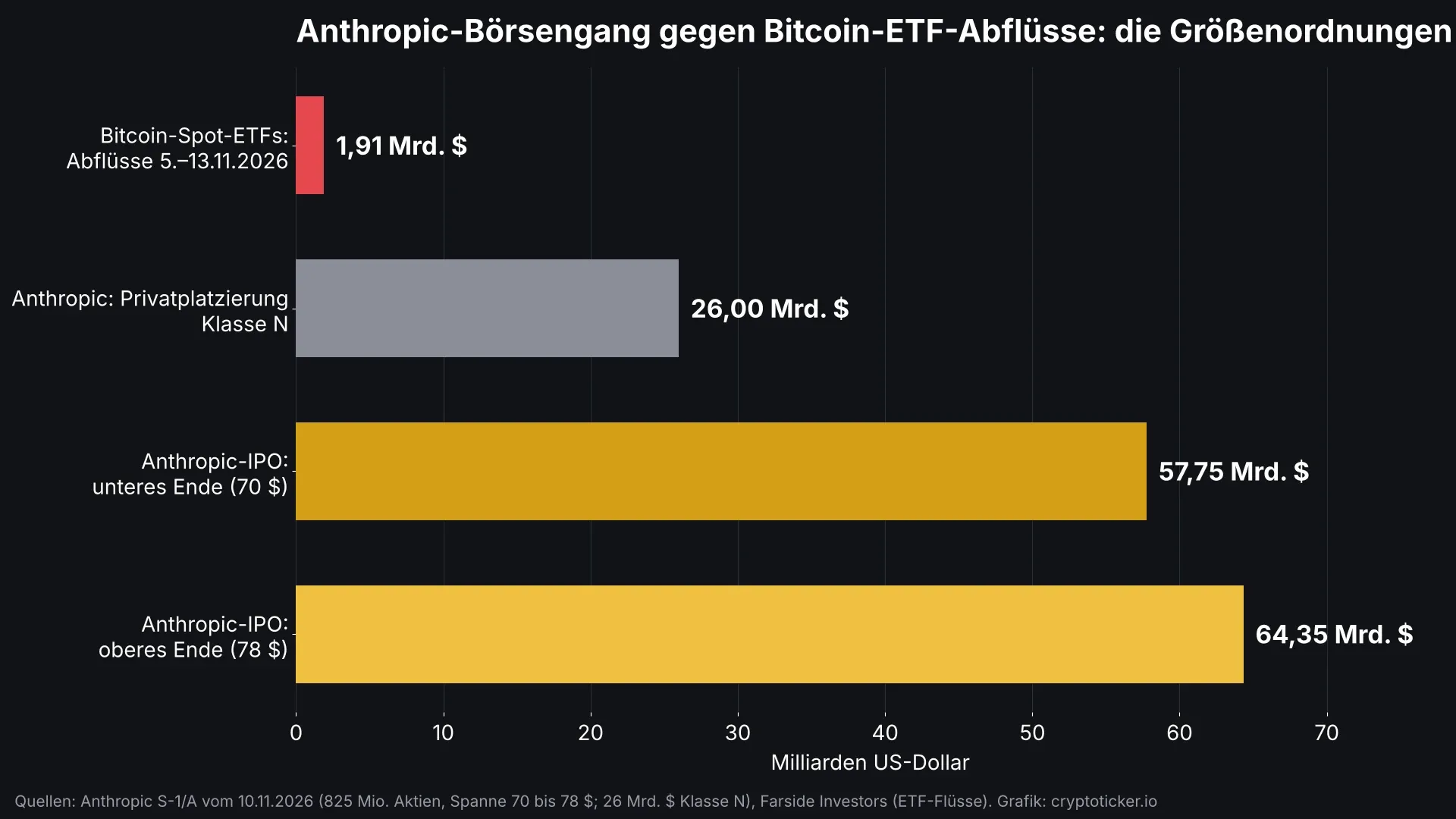
The seven days of bitcoin ETF outflows look small next to the size of Anthropic's offering. Chart: cryptoticker.io
Capital drain from the IPO: the case for the theory
Three observations support the idea that the IPO is tying up liquidity that might otherwise also flow into crypto. First, the sum is large. The offering size at the top of the range is more than thirty times the ETF outflows of the seven trading days. Even a small part of it, if reallocated from risky assets, would show up in fund flows.
Second, the investor groups overlap. People who bought bitcoin as a growth bet in recent years are often interested in technology stocks too. Retail investors in Germany need money in their settlement account to subscribe; according to our report of November 14, the amount stays reserved until settlement on November 20. Anyone who sells coins to fund that creates selling pressure, even if it does not appear as such in any statistic.
Third, demand for Anthropic is already visible in the crypto market itself. Perpetual futures on Anthropic's valuation, futures contracts without expiry that track a price, have been trading on decentralized venues for weeks. cryptoticker.io described what that means for investors in October under Anthropic perps on Hyperliquid. Capital posted there as collateral is not available for spot purchases of bitcoin or ether.
Counterarguments: why the IPO alone does not explain the price slump
The timeline argues against the theory first. The ETF outflow streak began on November 5, five days before Anthropic set the price range in its amended prospectus. A large part of the offering also goes to institutional investors who manage equity budgets and often hold no crypto at all, or only small allocations. The $26 billion private placement comes from corporations with a strategic interest, not from crypto investors.
Other causes are also better documented. Our article of November 14 on why bitcoin is falling cites rate fears ahead of the next US Federal Reserve meeting, the ETF outflows and shrinking stablecoin balances. Forced selling of leveraged positions adds to that: according to a cryptoticker.io analysis of November 15 based on CoinGlass data, about $2 billion in positions were liquidated in 24 hours, mostly longs on bitcoin and ether. The details are in our article on crypto liquidations.
On balance, the IPO is one possible factor among several. No statistic shows how much money has moved from bitcoin into the Anthropic subscription. Anyone reading the opposite should ask for the source.
Dates until the listing: pricing on November 18, trading from November 19
According to US media reports and the European prospectus that cryptoticker.io covered on November 14, the offering price is due to be set on Wednesday, November 18. Retail investors in Germany can subscribe until that day, though some banks close their order books earlier. The shares are to start trading on Nasdaq on Thursday, November 19, with settlement following on November 20. The SEC filing itself does not give these dates, and all of them are subject to change.
For the crypto market, the period after the listing is the most interesting. If allocations are tight, some investors buy more on the exchange on the first trading day and need liquidity again to do so. If the money is instead refunded after allocation, it can flow back into other markets. Which effect dominates will only show in ETF flows the following week. How to get the shares through the subscription, at the listing or later is summarised on the Anthropic stock page.

No statistic directly shows whether investors are selling crypto to subscribe to Anthropic. Illustration, AI-generated
Long and short in IPO week: leverage, liquidation and stop-loss
If you want to trade the move rather than bet on the subscription, you should understand how leveraged positions work. Long means betting on rising prices, short on falling ones. Leverage multiplies the position relative to the collateral posted. At 10x leverage, a 10 percent price change moves the position by 100 percent, in both directions. For a long position, that means: if bitcoin falls 10 percent from $64,715 to around $58,240, the collateral is used up and the exchange forcibly closes the position. Because of fees and maintenance margin, that happens even slightly earlier.
At 100x leverage, a move of about 1 percent is enough. At a price of $64,715, that is about $650, a range bitcoin can cover within minutes in the current market. A worked example: with €500 of collateral and 10x leverage, you control a position of €5,000. If the price rises 5 percent, you make about €250, half your stake; if it falls 5 percent, the same half is gone.
Two tools limit the risk. A stop-loss is an order that automatically closes a position at a predetermined price before liquidation kicks in. Position size determines what percentage of the account a single trade may cost; many traders cap that at a low single-digit percentage. The crypto broker comparison shows which platforms offer leveraged products with stop-loss orders. CFDs are complex instruments and come with a high risk of losing money rapidly due to leverage; a large share of retail investor accounts lose money with them.
Regulated trading venues under MiCA: crypto and stocks in Germany
Since the EU's MiCA crypto regulation took effect, providers that trade or hold crypto assets for clients in the EU need a licence as a crypto-asset service provider. MiCA stands for Markets in Crypto-Assets and covers, among other things, capital requirements, custody and disclosure obligations. For investors switching between crypto and stocks in a volatile week, that has a practical side: several licensed providers offer crypto assets and securities under one roof, so you can switch without transferring money between two platforms.
The comparison of regulated crypto exchanges lists which providers hold a MiCA licence and what they cost. If you only want to trade crypto, the terms are in the crypto exchange comparison. In a phase of extreme fear, what matters most is execution under heavy load, the fees for market orders and whether stop orders still trigger during fast price jumps.
Will bitcoin fall below $60,000? The levels below and above
According to CoinGecko, the 24-hour low was $62,081. Below that, the round $60,000 mark is the next level where many traders place orders. To the upside, the November 13 close at $68,249 is the first zone where the price recently failed to hold, followed by the November 12 close at $71,343. These are not forecasts but levels that show whether the sell-off is continuing or could be running out of steam.
For the Anthropic question, two numbers are worth watching next week: daily bitcoin ETF flows after November 19 and the price of ANT shares in the first days of trading. If outflows stay high even though subscription money has been refunded, that argues against the IPO as the main cause. If flows turn positive after the listing, that would suggest at least part of the capital was only parked.
Anthropic IPO: from November 19 it will show where the money goes
Until the listing, the link between the IPO and the crypto crash remains a conjecture with plausible arguments on both sides. Three steps help you assess the situation yourself:
- Check your venue: make sure your provider holds a MiCA licence before you reallocate positions in a hectic week. The comparison of regulated crypto exchanges with a MiCA licence gives an overview.
- Limit leverage: if you want to trade the move around November 19, set a stop-loss and work out your liquidation level beforehand. Platforms with stop orders are listed in the broker comparison.
- Compare fees: if you want to buy after the slump, compare the cost per order. The terms of the major platforms are in the exchange comparison.
(As of November 15, 2026. This article is not investment advice. Prices and fee structures change; check the terms with the provider before you buy.)