Key Takeaways Spot Bitcoin ETFs in the United States experienced net outflows of $462.7M during the previous week, breaking a three-week positive streak Ethereum ETFs attracted $196.9M in net
Key Takeaways
- Spot Bitcoin ETFs in the United States experienced net outflows of $462.7M during the previous week, breaking a three-week positive streak
- Ethereum ETFs attracted $196.9M in net inflows during the same timeframe, with BlackRock driving $148.8M on Friday alone
- The ETH/BTC ratio has climbed more than 25% in Q3, marking its strongest quarterly performance since Q3 2025
- Ethereum’s third-quarter return on investment is nearing 60%, approaching its historical Q3 peak of over 66%
- Technical indicators for both cryptocurrencies show mixed signals, with critical moving averages serving as pivotal zones
Last week saw a notable divergence in cryptocurrency ETF flows, with spot Bitcoin ETFs hemorrhaging $462.7 million in net capital while Ether ETFs simultaneously attracted $196.9 million. This contrasting pattern has sparked discussion about potential institutional reallocation between the two leading digital assets.
The exodus from Bitcoin funds occurred consistently over four consecutive trading days, spanning Tuesday through Friday. The most severe session came on Thursday, when $282.7 million departed from Bitcoin investment vehicles—representing the largest single-day withdrawal since July’s volatility.
The ARK 21Shares Bitcoin ETF experienced the heaviest redemptions, recording $234.2 million in outflows. Grayscale’s Bitcoin Trust ETF wasn’t far behind with $129.1 million in withdrawals. Even industry giant BlackRock’s iShares Bitcoin Trust ETF saw $52.5 million exit, while Fidelity’s Wise Origin Bitcoin Fund registered $50.7 million in outflows.
However, context matters: despite the recent reversal, Bitcoin ETFs maintain a positive trajectory for September, with approximately $307.3 million in cumulative net inflows for the month.
Ether Funds Attract Consistent Capital
Ethereum-focused products displayed a different pattern, with early-week volatility giving way to significant Friday gains. BlackRock’s iShares Ethereum Trust ETF dominated that session, capturing $148.8 million in fresh capital, while the 21Shares Core Ethereum ETF secured an additional $29.1 million.
These Ethereum ETF movements align with a broader third-quarter narrative. The ETH/BTC trading pair has surged over 25% this quarter, representing its most impressive quarterly advancement since Q3 2025. Meanwhile, Ethereum’s quarter-to-date return on investment is closing in on 60%, narrowly trailing its all-time Q3 benchmark of over 66% established the previous year.
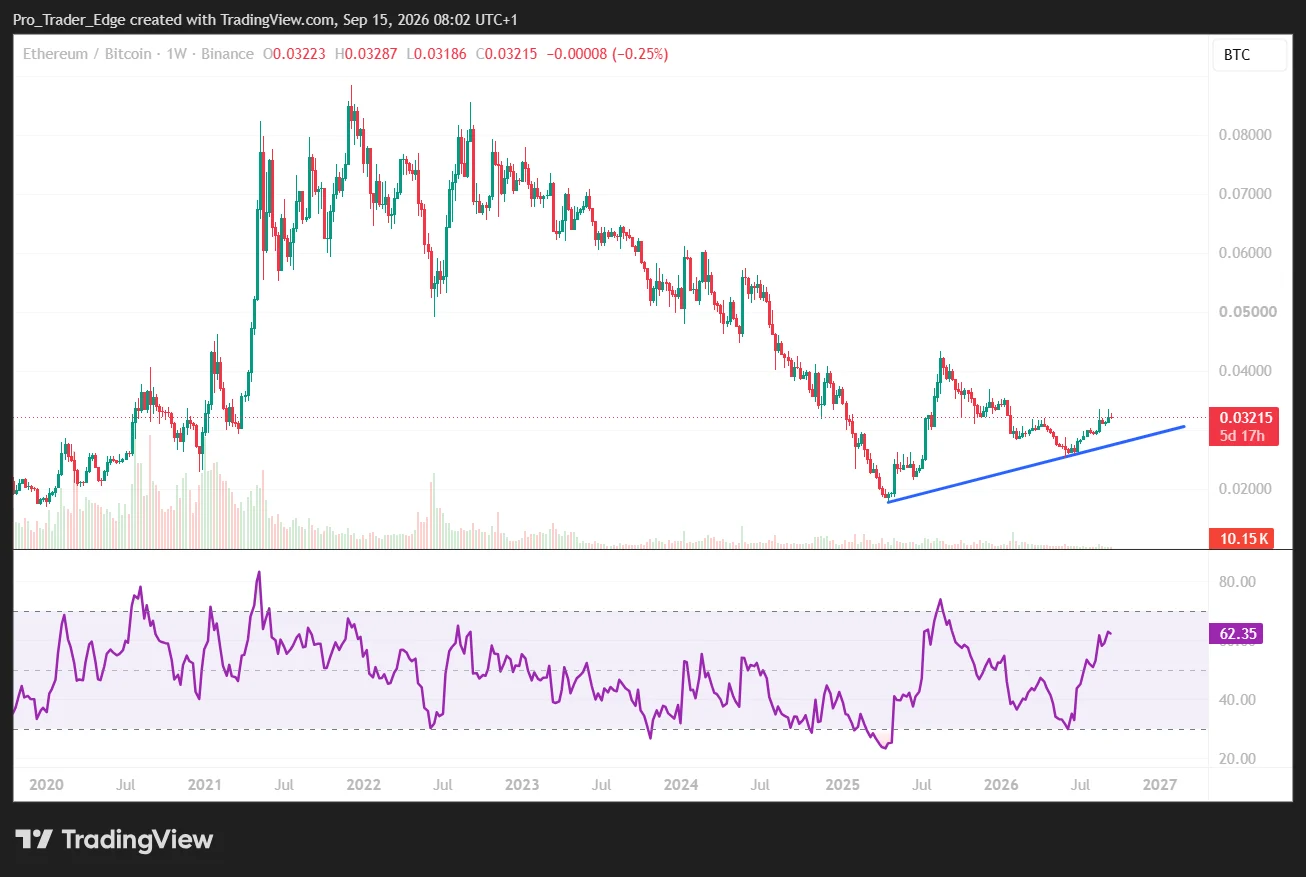
Source; TradingView
Ethereum’s share of total cryptocurrency market capitalization has also expanded by over 25% on a quarter-over-quarter comparison, while Bitcoin’s dominance increased by a modest 1.5% during the identical timeframe.
Technical Charts Show Mixed Signals
While ETF flow data suggests divergence, price movements for both digital assets haven’t definitively validated a sustained rotation.
Bitcoin declined to $76,370 during the week but discovered support above its 100-hour moving average positioned at $77,290. The leading cryptocurrency has since advanced toward its 200-hour moving average around $78,151, with current pricing hovering near $78,200 as of Monday morning trading.
Ethereum experienced a steeper decline to $2,402 before staging an impressive rally to $2,666—representing approximately 7.75% appreciation within hours. That momentum has subsequently evaporated, with prices retreating to approximately $2,510, barely above its converged 100- and 200-hour moving averages at $2,494 and $2,497 respectively.
Technical analysts suggest Ethereum must decisively breach and maintain levels above the $2,531 to $2,567 resistance band to demonstrate genuine upward momentum.
Market observers caution that a single week of divergent ETF activity might simply represent routine portfolio rebalancing or strategic profit-taking rather than a fundamental shift in institutional allocation. Multiple consecutive trading sessions showing Ethereum inflows paired with Bitcoin outflows would be necessary to validate an authentic capital rotation.
Both cryptocurrencies are currently attempting to find equilibrium, though neither has convincingly penetrated critical resistance thresholds.
The post Are Institutions Rotating Capital From Bitcoin (BTC) to Ethereum (ETH)? appeared first on Blockonomi.