What Does Arthur Hayes Expect Next for DeFi and Risk Assets? Is DeFi in for another rough patch? The Arthur Hayes DeFi prediction says the worst may not be behind it yet. The BitMEX co-founde
What Does Arthur Hayes Expect Next for DeFi and Risk Assets?
Is DeFi in for another rough patch? The Arthur Hayes DeFi prediction says the worst may not be behind it yet.
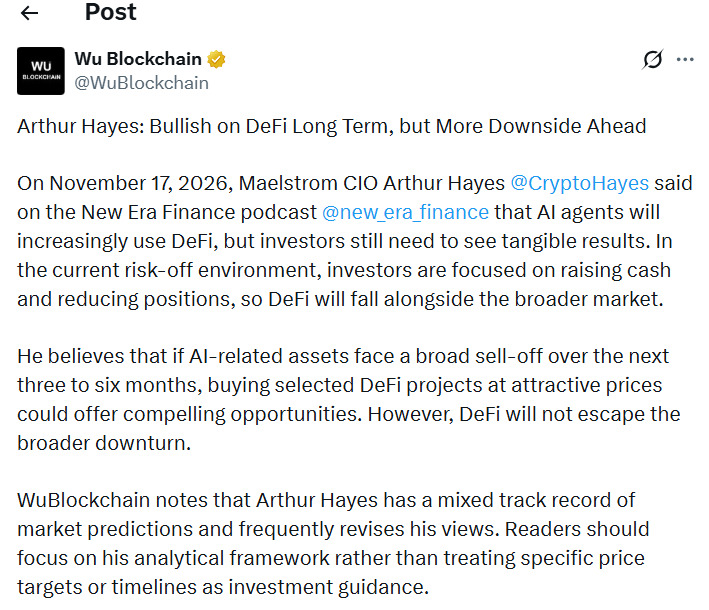
The BitMEX co-founder and Maelstrom chief investment officer expects decentralized finance to fall along with the wider market while investors stay away from risk.
Hayes is warmer on the long view. He has talked about AI agents using crypto-based financial tools, and he sees an AI asset sell-off as a possible chance to buy a few strong protocols. His reasoning is kept apart from guesswork here.
Source note:The comments came from a podcast released in mid-November 2026, which covered the Anthropic IPO, risk-off markets, and AI agents.
His views were also shared on X, and coverage on November 26 added more detail. This Arthur Hayes DeFi prediction reflects what he said at that time.
What Arthur Hayes Says About DeFi and AI Agents
Hayes expects DeFi to stay weak while markets keep avoiding risk.
He has discussed AI agents using crypto tools, but nothing yet proves they will lift DeFi demand.
In his view, an AI-asset sell-off could open the door for a few selected protocols.
He names two projects: Hyperliquid (HYPE) and Ethena (ENA).
Everything here is opinion, not a confirmed market outcome.
What Is the Arthur Hayes DeFi Prediction and Why Does It Matter?
DeFi covers lending, trading, and earning through smart contracts instead of banks. It is a young, volatile corner of crypto, and its tokens react fast to market mood.
The Arthur Hayes DeFi prediction comes in two parts. Near term, he expects weakness. Further out, he sees possible opportunity.
A risk-off market simply means investors are moving from volatile assets toward cash and safer holdings. DeFi tokens sit far out on the risk curve, so they tend to get sold early.
It is one trader's view. It carries no fixed date or price.
Why Does Hayes Expect More Downside for DeFi in Risk-Off Markets?
The main worry is forced selling. When leveraged traders get liquidated or funds face redemptions, they sell whatever trades easily. Smaller-cap tokens usually take the first hit. The same liquidity swings shape any Bitcoin price forecast too.
On the podcast, Hayes described the Anthropic IPO as a key test for the wider AI trade and discussed what could happen if the offering struggled. It priced at $83 a share and began trading on November 19, 2026, raising about $81.3 billion.
After underwriters used their extra-share option, total IPO proceeds rose to about $93.5 billion, according to the company filing. His comments came before the listing, so the result was unknown when he spoke.
Separate coverage of his DeFi remarks adds that AI listings could pull money away from smaller tokens.
Stress also travels. The UST stablecoin collapse is a well-studied case of trouble spreading across connected DeFi markets.
How Could AI Agents Change the Long-Term Outlook for DeFi Usage?
Hayes discussed how AI agents may use crypto-based financial infrastructure. His work at Flop Labs also explores a currency network for AI agents. Whether that creates meaningful DeFi demand remains uncertain.
The picture is easy to imagine. Software rebalances a portfolio at 3 a.m. while nobody is awake.
AI agents can interact with crypto wallets through software, but secure autonomous activity still depends on permissions, safeguards, and real usage. They would also need keys, and the basics of self-custody of crypto show who holds control when no bank is involved.
On the same podcast, Hayes doubted that stablecoins suit agents, since issuers can freeze them. Results are still missing. A possible future use is not current demand.
Could an AI Sell-Off Create the Next DeFi Buying Opportunity?
Here the argument turns. Hayes has said an AI asset bubble could eventually burst.
If investors stop paying extreme prices for AI stocks, that money needs a new home, and some could flow toward DeFi projects that already earn real income.
Later coverage discussed late 2027 or 2028 as a possible window for that rotation. That timeline comes from the coverage, not from a confirmed Hayes forecast.
Each step could fail. The sell-off may never arrive, and the money may go elsewhere if it does.
Which DeFi Projects Has Hayes Highlighted, and What Is the Catch?
The Arthur Hayes DeFi prediction names two projects: Hyperliquid and Ethena. He has said he likes protocols that earn real fees and send part of that income back to token holders through buybacks.
A buyback means a protocol spends revenue to buy its own token from the market. As a simple illustration, a protocol earning $10 million in fees might spend a slice of it this way.
Buybacks may create demand, but the effect depends on the amount, frequency, funding source, and token design. They do not guarantee a higher price.
His fund keeps Bitcoin as its core holding, a coin explained in how Bitcoin works, so DeFi picks sit on the riskier side.
Past trades add context. On October 24, 2026, Hayes said Maelstrom had taken profits on its directional positions in ETH, ENA, and other altcoins.
On-chain trackers tied about $22.28 million in token movements to linked wallets, including 14 million ENA. On June 4, 2026, he also said on X that he had sold all his HYPE and NEAR.
These trades do not show his current holdings. Project mentions are not endorsements, and his views may change.
What Data Should Be Watched Before Calling a Real DeFi Recovery?
One green day proves little. A sharp bounce can be a short squeeze, and those fade fast. These five signals say more than price:
Total value locked (TVL):The pile of assets parked in DeFi apps. Many lean on it, yet verifying TVL figures is harder than it looks.
Revenue and fees: What a protocol actually earns says more than its token price.
Stablecoin supply:More coins in circulation can mean more liquidity, but that cash may never have reached DeFi.
DEX trading volume: Busy trading looks good, yet some of it is wash trading, where one trader swaps with themselves to fake demand. Check volume against fees and real users.
Token unlocks and liquidations:Large unlocks and forced selling can stall a rally even when other numbers look fine.
Expert Take: What Stands Out Most in the Hayes DeFi Outlook?
Hayes puts profit first, and that is the strongest part of his case. A protocol with paying users rests on firmer ground than one that lives on hype.
Timing is the weak spot. Late 2027 or 2028 is a long way off. Thin liquidity or a geopolitical shock could change the picture long before then. Rules matter as well, because shifting US crypto rules could change how platforms treat DeFi tokens.
The real test comes down to AI agents. Do they bring in measurable fees and repeat users? Wallet support alone would not show that DeFi demand has shifted. Investors can check the numbers on official protocol dashboards.
Conclusion: Is DeFi Close to Its Next Bull Run or Still Early?
The Arthur Hayes DeFi prediction comes down to two things: risk in the short run and a possible opening later.
Neither is certain. AI agents would need real, measurable use before they change anything for DeFi. The idea that money could shift out of AI assets into DeFi depends on how markets behave first.
A single forecast, even from a well-known trader, is not proof of a recovery. The better signs are rising revenue and fees, steady stablecoin activity, and a growing base of users.
Disclaimer:This article only shares general information and is not financial advice. Crypto prices can drop quickly, and money put into them can be lost. Readers should do their own research before making any decision.