The Bank of England raised Bank Rate by a quarter point to 4% on 5 November, with eight of the nine Monetary Policy Committee members voting for the move and one dissenting in favour of a hal

The Bank of England raised Bank Rate by a quarter point to 4% on 5 November, with eight of the nine Monetary Policy Committee members voting for the move and one dissenting in favour of a half point. Bitcoin traded near $80,390 in the hour before the 12:00 UTC announcement, lost about 1% by the end of that hour, then broke through the New York session to $75,568, its lowest print since 16 September. By 17:20 UTC it was $75,923, down 5.5% over 24 hours, and CoinGlass counted $1.06 billion of liquidations in the same window.
The vote itself is a British story. The reason it lands on a bitcoin chart is energy. The MPC’s November summary puts Brent crude at an average of $108 a barrel over the 15 UK working days to 27 October, 38% above the assumption in its July report, and UK gas at 216 pence a therm, 81% higher. Headline CPI inflation was 3.5% in September, and the Bank now projects it near 4.5% in the first quarter of 2027 and around 5% in the second.
That is a second supply shock arriving after a disinflation that had already stalled, and it explains why a currency committee in London was tightening on the same afternoon that an asset with no cash flows lost 5.5%. The two facts are connected, but not in the way the headlines suggest. The evidence available does not establish the Bank’s decision as the cause of bitcoin’s afternoon break: the steepest hourly fall came in the 15:00 UTC hour, three hours after the release and just after the US cash open, and the instruments that liquidated hardest outside crypto were semiconductor trackers.
What the committee actually agreed
Eight members, including Governor Andrew Bailey, voted for 25 basis points. Catherine Mann voted for 50, taking Bank Rate to 4.25%, on the argument that projected CPI of 4.9% by mid-2027 needs a faster response. The split matters less than the disagreement about what comes next. Huw Pill wrote that “a single 25-basis point hike is unlikely to be sufficient” and that reaching the stance needed “is likely to require more policy tightening, including in the near term.” Megan Greene said “additional hikes will likely be required going forward.” Clare Lombardelli saw “likely to be a case for a further increase in rates in the near term.”
Alan Taylor framed the opposite reading in one line: “as of now, this is not the start of a hiking cycle” describing the move as “a risk-management ‘one-for-now’ insurance hike” after which “the next move could be up, down, or sideways.” Bailey kept it conditional: “Without news which softens the risks to inflationary pressures, I can see the argument for a further increase in rates.” The Bank’s own summary repeats that “monetary policy is not on a pre-set path.”
Two balance-sheet details fill in the background. The stock of gilts held for monetary policy purposes stood at £362 billion on 4 November. Benchmark two-year mortgage rates had risen by nearly 50 basis points since the start of September, and the Bank’s Market Participants Survey put the median expected Bank Rate path at 4% in November and 4.25% in February. The next decision is 17 December 2026.
The second energy shock, in the Bank’s own numbers
The MPC’s diagnosis is unusually blunt about cause. “The conflict in the Middle East is now in its ninth month.” the summary opens, before noting that global energy prices “have continued to rise from an already elevated level.” Its conclusion follows the same logic: “the degree of inflationary pressure in the pipeline is now sufficient to warrant an increase in Bank Rate.”
The arithmetic behind that sentence is worth setting out because it defines what would have to change for the Bank to stop. Of the 3.5% September CPI print, direct energy effects contributed about 1 percentage point, most of it fuels. Staff projections put inflation at roughly 4.5% in 2027 Q1 and around 5% in 2027 Q2, with the Budget measures announced on 28 October subtracting about a quarter point by the second quarter of 2027. The central projection assumes larger second-round effects on wages and prices than the July report did, and the Bank’s adverse scenario assumes energy stays higher for longer.
Members disagreed on how much of the domestic disinflation had genuinely stalled before the shock. Bailey argued that indirect and second-round effects “have not emerged yet”, while warning that firms absorbing costs through margins and fixed-price contracts “can only be temporary.” Ramsden said he had become “somewhat less confident about the domestic disinflation process.” The practical difference between those views is the difference between one hike and a short cycle.
Why a UK rate rise is not, by itself, a bitcoin mechanism
Bitcoin has no coupon, no earnings and no maturity, so there is no discounted cash flow for Bank Rate to move. The transmission runs through three looser channels. The first is global risk appetite: a second energy shock raises the odds that other central banks stay tight for longer, and crypto trades as the highest-beta expression of that risk. The second is leverage cost, since funding in perpetual futures is priced off dollar and, at the margin, sterling money markets. The third is the UK’s own crypto market infrastructure, which a rate decision does not touch.
The relative sizes matter. Bitcoin fell 5.5% and ether fell 7.3% on the day, while the Bank’s 25 basis points moved the two-year mortgage rate by roughly half a point over two months. A domestic rate change of that scale cannot reprice a global asset by 5% on its own. What it can do is confirm the direction of the macro regime, and reinforce a market that had already lost its 20-day and 50-day averages. The Fed’s October decision played the same role for dollar liquidity: a policy signal that traders read as one more reason to cut risk into year-end.
What bitcoin did, hour by hour
The intraday sequence is easier to read from the candles than from the commentary. At 11:00 UTC, bitcoin closed at $80,390. The 12:00 hour, when the announcement landed, closed at $79,662 after touching $79,520: a 0.9% move that looks like positioning, not repricing. The 13:00 hour was flat at $79,662. The break came at 14:00, which closed at $78,288, and the 15:00 hour printed the low of $75,568 before closing at $76,030. Bitcoin spent the next two hours between $75,641 and $77,006.
The rest of the market moved with it, and further. Ether was $2,248.83 at 17:20 UTC, down 7.29% in 24 hours, against a 5.49% fall for bitcoin. Solana was $89.66, down 6.59%, XRP $1.2365, down 5.54%, and BNB $691.50, down 3.43%. Divide ether’s decline by bitcoin’s and the beta is 1.33: for every point bitcoin lost, ether lost a third of a point more, which is the signature of a deleveraging move rather than a bitcoin-specific event.
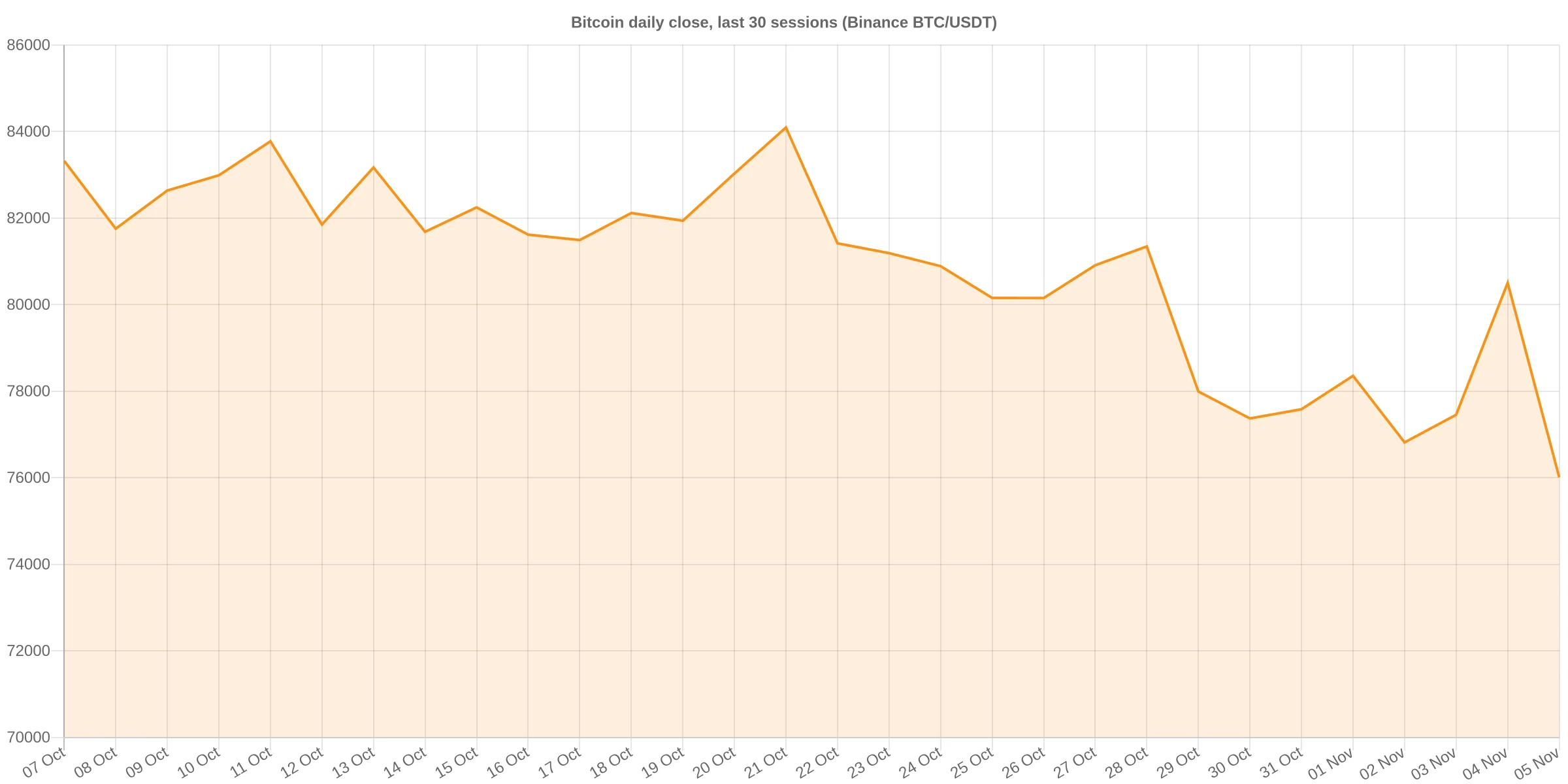
Bitcoin daily close, 30 sessions to 5 November 2026. Source: Binance BTC/USDT.
The liquidation map: $1.06 billion, 88% of it longs
CoinGlass put total liquidations across exchanges at $1.06 billion over 24 hours, with longs accounting for $932.09 million, or 87.9% of the total, and 205,250 traders liquidated. The largest single order was $10.94 million on Binance’s ETHUSDT contract at $2,243.86. The concentration is the interesting part: the four-hour bucket held $879.82 million of that total, which works out to 83% of the day’s liquidations occurring in roughly four hours, or about $3.7 million a minute on average across the window.
Two caveats belong on those numbers. Exchange reporting is throttled: Binance and OKX publish at most one liquidation update per second, so the CoinGlass total is a floor rather than a complete count. And the same page shows how far the flush reached beyond crypto. Memory and semiconductor products traded as perpetuals appeared among the largest liquidation lines on the CoinGlass heatmap, with SNDK at $49.56 million, SOXL at $48.93 million and MU at $17.11 million. When leveraged exposure to memory chips is being forcibly closed in the same hours as crypto longs, the common factor is a portfolio-level risk cut, not a view on British monetary policy.
The levels, the basis, and what would invalidate them
Computed from 210 daily Binance BTC/USDT candles, the 20-day simple moving average sits at $80,040, the 50-day at $82,060 and the 200-day at $73,242. At $75,923, bitcoin is 7.5% below its 50-day average and 3.7% above its 200-day. The 14-day relative strength index is 34.2, close to but not inside the sub-30 band usually described as oversold.
Those numbers define the two conditions worth watching, each with a stated basis and no chain of targets beyond it. A daily close below $73,242 would put bitcoin under its 200-day average for the first time since the autumn, and would invalidate the reading that this is a pullback inside an uptrend. A reclaim of $80,040, the 20-day average and roughly the level bitcoin held before the 12:00 release, would neutralise the break. Anything between the two is noise on this timeframe, and neither condition predicts direction on its own.
What would actually change the picture
The Bank’s own condition is energy. Bailey wrote that the central projection requires “real progress towards settling the conflict in the Middle East”, and that absent it, “risks to energy prices, and so to inflation, are to the upside.” Brent at $108 is the variable to watch, not the vote count. A sustained fall in crude would remove the reason for the hike faster than any domestic data series.
The real-rate arithmetic also deserves more attention than the headline. With Bank Rate at 4% and CPI at 3.5%, the real policy rate is +0.5 percentage points, which is restrictive on the September print. On the Bank’s own projections of 4.5% and 5%, the same 4% is -0.5 and -1.0 points in real terms. Policy is tight against what inflation has been and loose against what the Bank expects it to be, which is why three members wrote that more tightening is likely and one wrote that the next move could be in any direction.
None of that touches the structural story underneath. In September, UK banks completed their first interbank tokenised deposit transactions, a settlement change that a 25-basis-point move does not alter. Bitcoin’s 5.5% slide is a leverage event inside a macro week. The Bank of England supplied the macro, and the energy market supplied the reason.
Frequently Asked Questions
Did the Bank of England raise interest rates today?
Yes. The Monetary Policy Committee announced on 5 November 2026 that it had voted 8–1 to raise Bank Rate by 0.25 percentage points to 4%, from 3.75% at the September meeting. Catherine Mann voted for a 0.5-point increase to 4.25%.
Why did the Bank of England raise rates?
The Bank cited a second energy shock from the Middle East conflict. Brent averaged $108 a barrel over the 15 UK working days to 27 October, 38% above its July assumption, and UK CPI inflation was 3.5% in September. Staff projections put inflation near 4.5% in 2027 Q1 and around 5% in 2027 Q2.
Is the Bank of England done hiking?
The committee says policy is not on a pre-set path. Huw Pill, Megan Greene and Clare Lombardelli each wrote that further tightening is likely in the near term, while Alan Taylor described this as a one-off insurance hike after which the next move could be up, down or sideways. The next decision is 17 December 2026.
Did the Bank of England decision cause bitcoin’s drop?
The timing argues against it as the main cause. Bitcoin fell about 1% in the announcement hour, stayed flat the next hour, and made its sharpest move between 14:00 and 15:00 UTC, after the US cash session opened, when semiconductor-linked liquidations ran alongside $879.82 million of crypto liquidations in four hours. The available evidence supports correlation with a broader risk-off move, not a direct causal link.
What is Bank Rate now and when is the next MPC meeting?
Bank Rate is 4% after the 5 November 2026 decision. The next Monetary Policy Committee decision is due on 17 December 2026, with the minutes of the meeting ending 16 December published the same day.
Data: Bank of England Monetary Policy Summary and Minutes, November 2026, Binance BTC/USDT, CoinGlass liquidation data, Alternative.me Fear and Greed Index. Market figures are a snapshot taken at 17:20 UTC on 5 November 2026.